
Join Our JEE Preparation Group
Prep with like-minded aspirants; Get access to free daily tests and study material.
Sign in
Please select an account to continue using cracku.in
↓ →
Join Our JEE Preparation Group
Prep with like-minded aspirants; Get access to free daily tests and study material.
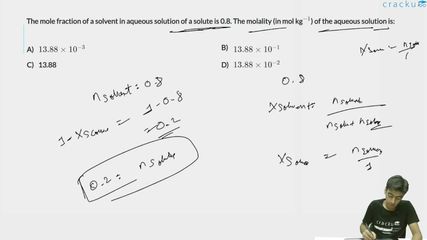
The mole fraction of a solvent in aqueous solution of a solute is 0.8. The molality (in mol kg$$^{-1}$$) of the aqueous solution is:
For a binary solution containing only one solute and one solvent, the mole fraction of the solvent is given by the general definition
$$X_{\text{solvent}} \;=\; \frac{n_{\text{solvent}}}{n_{\text{solute}} \;+\; n_{\text{solvent}}}.$$
We are told that $$X_{\text{solvent}} = 0.8.$$ To make the arithmetic straightforward, we may choose any convenient total number of moles. The easiest choice is to take the total number of moles of the solution as $$1$$. Let us therefore write
$$n_{\text{solute}} + n_{\text{solvent}} = 1.$$
Substituting this into the definition of mole fraction, we have
$$0.8 \;=\; \frac{n_{\text{solvent}}}{1} \;=\; n_{\text{solvent}}.$$
Hence
$$n_{\text{solvent}} = 0.8,$$
and since the total is $$1,$$ the moles of solute must be
$$n_{\text{solute}} = 1 - 0.8 = 0.2.$$
Now, the solvent is water (the phrase “aqueous solution” tells us this). The molar mass of water is $$18 \text{ g mol}^{-1}.$$ Therefore, the mass of $$0.8$$ mol of water is
$$m_{\text{water}} = 0.8 \times 18 \text{ g} = 14.4 \text{ g}.$$
To use the definition of molality we need this mass in kilograms, so
$$m_{\text{water}} = 14.4 \text{ g} = 0.0144 \text{ kg}.$$
The formula for molality ($$m$$) is
$$m \;=\; \frac{\text{moles of solute}}{\text{mass of solvent in kg}}.$$
Substituting the values just found, we obtain
$$m \;=\; \frac{0.2}{0.0144} \text{ mol kg}^{-1}.$$
Carrying out the division,
$$m \;=\; 13.888\ldots \text{ mol kg}^{-1}.$$
Rounded appropriately,
$$m \;=\; 13.88 \text{ mol kg}^{-1}.$$
Hence, the correct answer is Option C.
Was this solution helpful?
Click on the Email ☝️ to Watch the Video Solution
Create a FREE account and get:
_1.webp)

Educational materials for JEE preparation

Ask our AI anything

AI can make mistakes. Please verify important information.
AI can make mistakes. Please verify important information.
