
Join Our JEE Preparation Group
Prep with like-minded aspirants; Get access to free daily tests and study material.
Sign in
Please select an account to continue using cracku.in
↓ →
Join Our JEE Preparation Group
Prep with like-minded aspirants; Get access to free daily tests and study material.
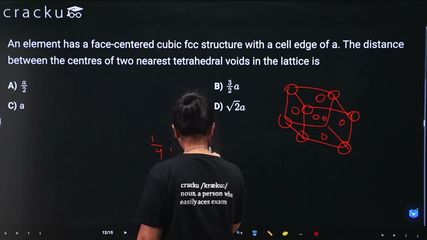
An element has a face-centered cubic fcc structure with a cell edge of a. The distance between the centres of two nearest tetrahedral voids in the lattice is
We have a face-centred cubic (fcc) crystal whose unit-cell edge length is denoted by $$a$$.
In an fcc lattice the tetrahedral voids are situated at those points whose fractional coordinates, measured from one corner of the unit cell, are of the form
$$\left(\frac14,\;\frac14,\;\frac14\right),\; \left(\frac34,\;\frac14,\;\frac14\right),\; \left(\frac14,\;\frac34,\;\frac14\right),\; \left(\frac34,\;\frac34,\;\frac14\right),$$
and the four analogous points obtained by replacing the $$z$$-coordinate $$\frac14$$ by $$\frac34$$. Thus there are eight tetrahedral voids per unit cell, symmetrically distributed.
To obtain the smallest or “nearest” separation between two tetrahedral void centres we look for a pair whose coordinates differ by the least possible amount. The simplest choice is the pair
$$T_1\;:\;\left(\frac14,\;\frac14,\;\frac14\right)$$ $$T_2\;:\;\left(\frac14,\;\frac34,\;\frac14\right)$$
These two points lie on the same $$x$$ and $$z$$ coordinates, differing only along the $$y$$-direction.
Now, the difference in their fractional coordinates is
$$\Delta x = \frac14 - \frac14 = 0,$$ $$\Delta y = \frac34 - \frac14 = \frac12,$$ $$\Delta z = \frac14 - \frac14 = 0.$$
In Cartesian form the actual linear distance is obtained by multiplying each fractional difference by the cell edge $$a$$, then applying the three-dimensional distance formula. Stating that formula first:
$$d = \sqrt{(\Delta x \,a)^2 + (\Delta y \,a)^2 + (\Delta z \,a)^2}.$$
Substituting the individual components we get
$$d = \sqrt{\bigl(0 \cdot a\bigr)^2 + \left(\frac12\,a\right)^2 + \bigl(0 \cdot a\bigr)^2}$$ $$\;\; = \sqrt{0 + \frac14\,a^2 + 0}$$ $$\;\; = \sqrt{\frac14\,a^2}$$ $$\;\; = \frac12\,a.$$
So the minimum (nearest-neighbour) distance between the centres of two tetrahedral voids in the fcc lattice is $$\displaystyle \frac{a}{2}.$$
Hence, the correct answer is Option A.
Was this solution helpful?
Click on the Email ☝️ to Watch the Video Solution
Create a FREE account and get:
_1.webp)

Educational materials for JEE preparation

Ask our AI anything

AI can make mistakes. Please verify important information.
AI can make mistakes. Please verify important information.
