
Join Our JEE Preparation Group
Prep with like-minded aspirants; Get access to free daily tests and study material.
Sign in
Please select an account to continue using cracku.in
↓ →
Join Our JEE Preparation Group
Prep with like-minded aspirants; Get access to free daily tests and study material.
In the following reaction; xA $$\to$$ yB
$$\log_{10}\left(-\frac{dA}{dt}\right) = \log_{10}\left(-\frac{dB}{dt}\right) + 0.3010$$
'A' and 'B' respectively can be:
We start with the general stoichiometric equation for the reaction
$$xA \;\longrightarrow\; yB$$
The instantaneous rate of disappearance of the reactant A is written as $$-\dfrac{d[A]}{dt}$$ and the rate of formation of the product B as $$\dfrac{d[B]}{dt}$$. For any elementary reaction, these rates are related to the common rate $$r$$ by the stoichiometric coefficients, according to the formula
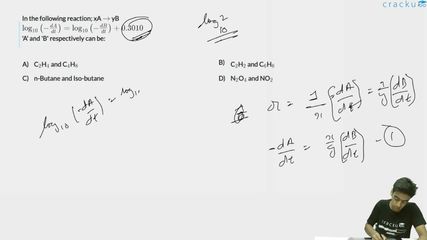
$$r \;=\; -\dfrac{1}{x}\,\dfrac{d[A]}{dt} \;=\; \dfrac{1}{y}\,\dfrac{d[B]}{dt}.$$
Rearranging the first and last members, we obtain a direct relation between the two measurable rates:
$$-\dfrac{d[A]}{dt} \;=\; \dfrac{x}{y}\,\dfrac{d[B]}{dt}.$$
Now we take the common logarithm (base 10) of both sides. Using the rule $$\log_{10}(mn)=\log_{10}m+\log_{10}n$$, we get
$$\log_{10}\!\left(-\dfrac{d[A]}{dt}\right) \;=\; \log_{10}\!\left(\dfrac{x}{y}\,\dfrac{d[B]}{dt}\right) \;=\; \log_{10}\!\left(\dfrac{d[B]}{dt}\right) +\log_{10}\!\left(\dfrac{x}{y}\right).$$
The question itself gives us the following empirical relation:
$$\log_{10}\!\left(-\dfrac{dA}{dt}\right) \;=\; \log_{10}\!\left(\dfrac{dB}{dt}\right) +0.3010.$$
By simple comparison of the two expressions, we identify
$$\log_{10}\!\left(\dfrac{x}{y}\right)=0.3010.$$
We recall the fundamental logarithmic value $$\log_{10}2=0.3010.$$ Therefore
$$\dfrac{x}{y}=2.$$
This means the stoichiometric coefficient of A is exactly twice that of B. The simplest integral choice satisfying this ratio is
$$x=2,\qquad y=1,$$
so the reaction must be
$$2A \;\longrightarrow\; B.$$
Now we inspect each option to see which chemical conversion fits the form $$2A \to B$$:
A. $$\mathrm{C_2H_4}\;(A) \;\longrightarrow\; \mathrm{C_4H_8}\;(B)$$ can be written as $$2\,\mathrm{C_2H_4} \to \mathrm{C_4H_8}.$$ Here two ethene molecules dimerise to give one molecule of butene, exactly matching the required stoichiometry.
B. $$3\,\mathrm{C_2H_2} \to \mathrm{C_6H_6}$$ involves a 3 : 1 ratio, not 2 : 1.
C. The isomerisation $$\mathrm{n\!-\!C_4H_{10}} \to \mathrm{iso\!-\!C_4H_{10}}$$ is a 1 : 1 process.
D. The dissociation $$\mathrm{N_2O_4} \to 2\,\mathrm{NO_2}$$ has the inverse 1 : 2 ratio.
Only option A satisfies the deduced stoichiometric requirement $$2A \to B$$.
Hence, the correct answer is Option A.
Click on the Email ☝️ to Watch the Video Solution
Create a FREE account and get:
_1.webp)

Educational materials for JEE preparation

Ask our AI anything

AI can make mistakes. Please verify important information.
AI can make mistakes. Please verify important information.


