
Join Our JEE Preparation Group
Prep with like-minded aspirants; Get access to free daily tests and study material.
Sign in
Please select an account to continue using cracku.in
↓ →
Join Our JEE Preparation Group
Prep with like-minded aspirants; Get access to free daily tests and study material.
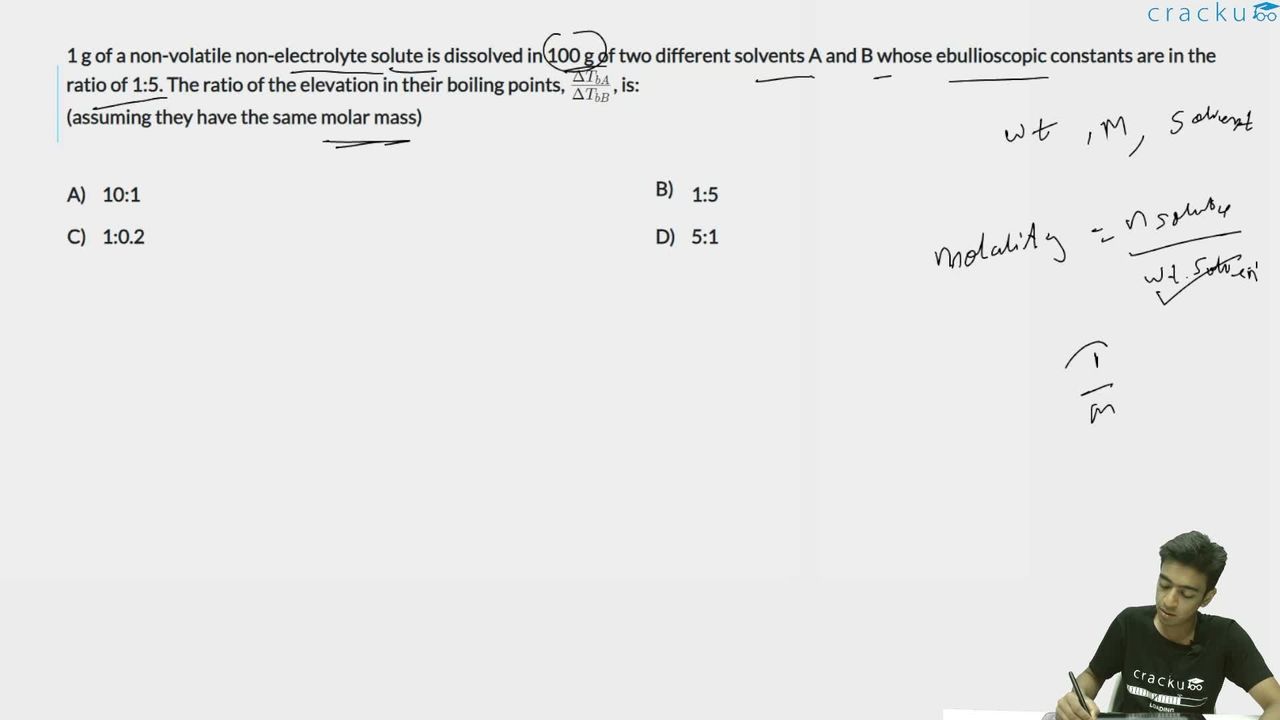
1 g of a non-volatile non-electrolyte solute is dissolved in 100 g of two different solvents A and B whose ebullioscopic constants are in the ratio of 1:5. The ratio of the elevation in their boiling points, $$\frac{\Delta T_{bA}}{\Delta T_{bB}}$$, is:
(assuming they have the same molar mass)
We recall the colligative-property relation for boiling-point elevation:
$$\Delta T_b = K_b \, m$$
where $$\Delta T_b$$ is the rise in boiling point, $$K_b$$ is the ebullioscopic (boiling-point elevation) constant of the solvent, and $$m$$ is the molality of the solution.
For each solvent we dissolve the same mass of solute, namely $$1\ \text{g}$$. The mass of each solvent taken is $$100\ \text{g} = 0.1\ \text{kg}$$. If the molar mass of the solute is $$M\ (\text{g mol}^{-1})$$, its number of moles is
$$n = \frac{\text{mass of solute}}{\text{molar mass}} = \frac{1}{M}\ \text{mol}.$$
Hence the molality of either solution is
$$m = \frac{n}{\text{kilograms of solvent}}=\frac{\dfrac{1}{M}}{0.1}= \frac{10}{M}\ \text{mol kg}^{-1}.$$
Because the same amounts are used, the molality $$m$$ is identical for solvents A and B.
Let $$K_{bA}$$ and $$K_{bB}$$ be the ebullioscopic constants of solvents A and B, respectively. We are told that their ratio is
$$\frac{K_{bA}}{K_{bB}} = \frac{1}{5}.$$
Now the boiling-point elevations are
$$\Delta T_{bA}=K_{bA}\,m \quad\text{and}\quad \Delta T_{bB}=K_{bB}\,m.$$
Taking their ratio gives
$$\frac{\Delta T_{bA}}{\Delta T_{bB}} = \frac{K_{bA}\,m}{K_{bB}\,m}= \frac{K_{bA}}{K_{bB}} = \frac{1}{5}.$$
Thus the elevation in boiling point for solvent A is one-fifth that for solvent B, so the required ratio is
$$\frac{\Delta T_{bA}}{\Delta T_{bB}} = 1:5.$$
Hence, the correct answer is Option B.
Was this solution helpful?
Click on the Email ☝️ to Watch the Video Solution
Create a FREE account and get:
_1.webp)

Educational materials for JEE preparation

Ask our AI anything

AI can make mistakes. Please verify important information.
AI can make mistakes. Please verify important information.
