91- 6303239042
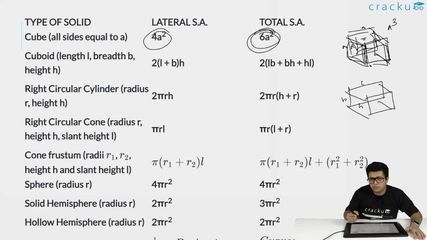
| TYPE OF SOLID | LATERAL S.A. | TOTAL S.A. |
| Cube (all sides equal to a) | $$4a^2$$ | $$6a^2$$ |
| Cuboid (length l, breadth b, height h) | 2(l + b)h | 2(lb + bh + hl) |
| Right Circular Cylinder (radius r, height h) | 2πrh | 2πr(h + r) |
| Right Circular Cone (radius r, height h, slant height l) | πrl | πr(l + r) |
| Cone frustum (radii $$r_1$$, $$r_2$$, height h and slant height l) | $$\pi(r_1+r_2)l$$ | $$\pi[(r_1+r_2)l+(r_1^2+r_2^2)]$$ |
| Sphere (radius r) | $$4πr^2$$ | $$4πr^2$$ |
| Solid Hemisphere (radius r) | $$2πr^2$$ | $$3πr^2$$ |
| Pyramid | $$\frac{1}{2}\times\ Perimeter\times\ Slant\ Height$$ | $$Curved\ Surface\ area+Base\ area$$ |
| Prism | $$Perimeter\times\ Height$$ | $$Curved\ Surface\ area+2\times\ Base\ area$$ |
Slant height of cone: l = $$\sqrt{(r² + h²)}$$
Slant height of frustum: l = $$\sqrt{(h² + (r₁−r₂)²)}$$
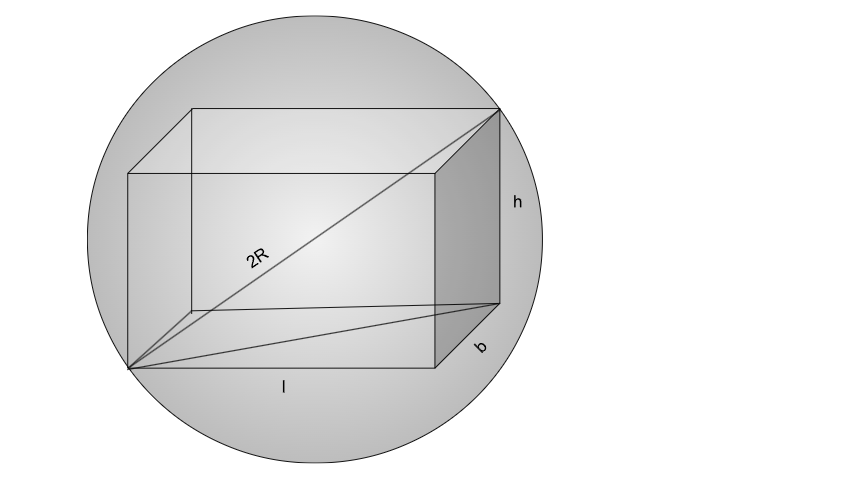
Diagonal of cuboid: $$\sqrt{(l² + b² + h²)}$$
Diagonal of cube: a$$\sqrt3$$
Euler's formula for 3D figures (specifically closed) states that the number of faces (F) plus the number of vertices (V) minus the number of edges (E) always equals 2: $$F+V-E\ =\ 2$$.