91- 6303239042
Characteristics of the four quadrants:
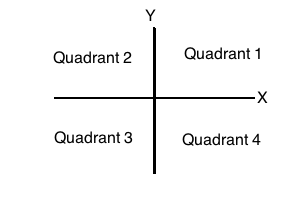
- Quadrant I: X is Positive, Y is Positive
Quadrant II: X is Negative, Y is Positive
Quadrant III: X is Negative, Y is Negative
Quadrant IV :X is Positive, Y is Negative
Sign in
Please select an account to continue using cracku.in
↓ →
Characteristics of the four quadrants:
Find the number of points with integral coordinates which lie in the region enclosed by |x|+|y| = 4 or on the boundary.
Find the number of integral points (x,y) that satisfy $$\frac{x^2}{16}+\frac{y^2}{25} \leq 1$$
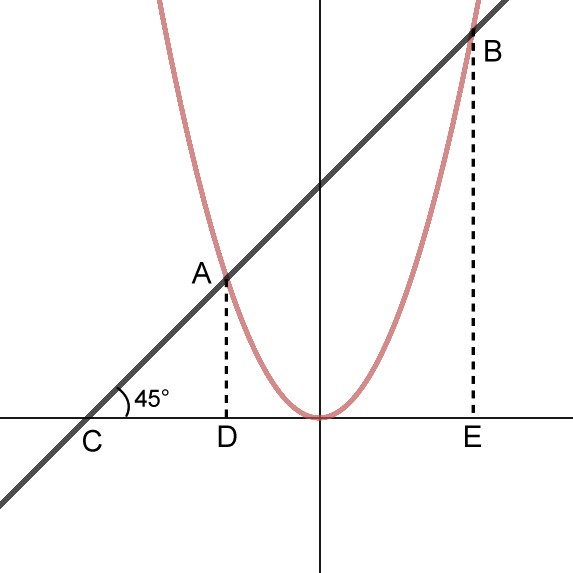
A parabola is represented by the equation $$y = x^2$$. A line y = x+b cuts the parabola at two different points A and B, such that A is in the second quadrant and B is in the first quadrant and AB = AC where C is the point where the line y = x+b intersects x- axis. Find the ratio of the y co-ordinates of B and A.
Log in to view all questions
LoginStart your IIM journey with the right preparation and crack CAT 2026.

Educational materials for CAT preparation