91- 6303239042
Parallelogram:
- 1. Opposite sides are equal and parallel.
2. Opposite angles are equal.
3. Adjacent angles are supplementary.
4. Diagonals bisect each other.
5. Each diagonal divides it into two congruent triangles.
6. Sum of squares of diagonals = sum of squares of the four sides: $$d_1^2 + d_2^2 = 2(a^2 + b^2)$$
Rhombus:
- 1. A parallelogram with all sides equal.
2. Opposite angles are equal.
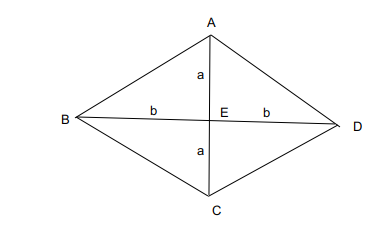
3. Diagonals are perpendicular and bisect each other.
4. Diagonals are not necessarily equal.
5. Diagonals bisect the vertex angles.
6. Adjacent angles are supplementary (add to $$180^o$$).
Rectangle:
- 1. A parallelogram with all angles equal to 90°.
2. Opposite sides are equal and parallel.
3. Diagonals are equal in length and bisect each other.
4. Diagonals are not necessarily perpendicular.
Square:
- 1. A quadrilateral with all sides equal and all angles equal to 90°.
2. Diagonals are equal, perpendicular, and bisect each other.
Trapezium
-
1. A quadrilateral with exactly one pair of parallel sides (called bases); the non-parallel sides are called legs.
2. The angles on the same leg are supplementary (co-interior angles).
3. The line joining the midpoints of the legs (median or mid-segment) is parallel to the bases and equal to half their sum: $$m = \dfrac{a + b}{2}$$.
4. The diagonals divide each other in the ratio of the parallel sides: if diagonals meet at O, then $$\dfrac{AO}{OC} = \dfrac{BO}{OD} = \dfrac{a}{b}$$.
5. Area $$= \dfrac{1}{2}(a + b)\,h$$.
Isosceles Trapezium
-
1. A trapezium whose non-parallel sides (legs) are equal.
2. Base angles are equal (both angles on each base).
3. Diagonals are equal in length.
4. Opposite angles are supplementary, so it is a cyclic quadrilateral.
5. It has one line of symmetry — the perpendicular bisector of the bases.
Kite:
- 1. A trapezium whose non-parallel sides (legs) are equal.
2. Base angles are equal (both angles on each base).
3. Diagonals are equal in length.
4. Opposite angles are supplementary, so it is a cyclic quadrilateral.
5. It has one line of symmetry — the perpendicular bisector of the bases.