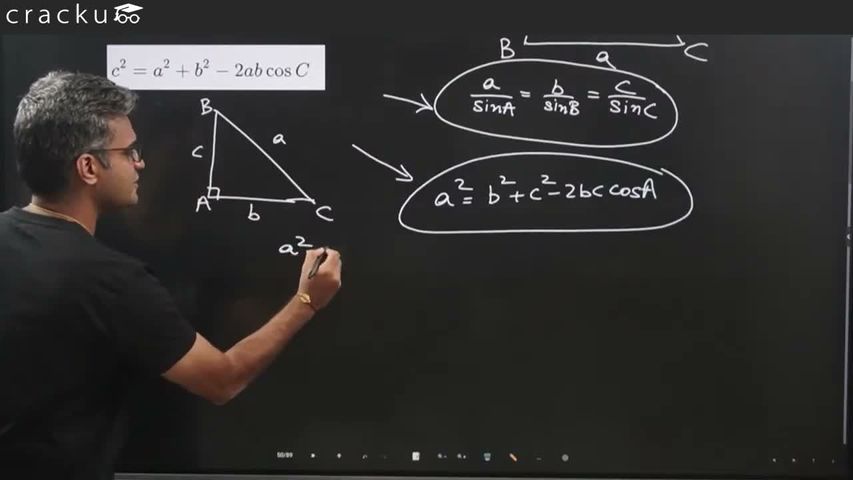
In a triangle ABC, according to cosine rule, we know that
$$a^2 = b^2 + c^2 - 2bc CosA$$
This can be written as Cos A = $$\frac{b^2 + c^2 - a^2}{2bc}$$
Obtuse angle => one angle is greater than 90 degrees. Let that angle be A.
If angle A is greater than 90 degrees, then the cosine of A is negative.
=> $$\frac{b^2 + c^2 - a^2}{2bc}$$ is negative
=> $$b^2 + c^2 - a^2$$ is negative because bc cannot be negative as they are lengths of sides.
=> $$a^2 > b^2 + c^2$$ is the condition for an obtuse angle to exist.
Here there are 2 cases. One case is that the longest side is 16 and the other case is that the side with length 16 is not the longest side.
If the longest side is 16, then the minimum length of the third side is 5 because sum of two sides must be greater than the third side.
$$16^2 - 12^2$$ = 256 - 144 = 112. So the square of the length of the third side can be up to 112. Hence the third side can be of any integral length between 5 and 10, both inclusive => 6 possibilities.
If the longest side is not 16, then the square of the length of the third side must be greater than $$12^2 + 16^2$$ = 400, that is the length of the side must be greater than 20. But, the maximum length can be (16 + 12 - 1), which is equal to 27. So, the length can be from 21 to 27 => 7 possibilities.
In total, 13 obtuse triangles can be formed with 2 of the sides equal to 12 and 16.