91- 6303239042
Centroid:
- Formed by the three medians, each joining a vertex to the midpoint of the opposite side.
- The medians are always concurrent; their point of intersection is the centroid.
- In a triangle, the centroid divides the median in the ratio 2:1.
Incircle:
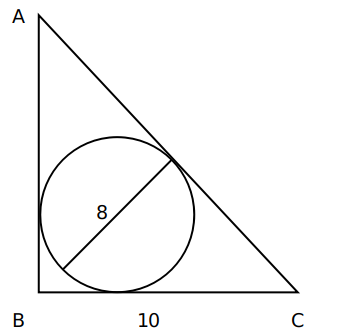
The incenter of a triangle is formed by the intersection of the three internal angle bisectors of the triangle.
Consider the triangle ABC with incentre I, and the incircle touching the triangle at P, Q, R as shown in the diagram. As tangents drawn from a point are equal, AP=AQ, CP=CR and BQ=BR.
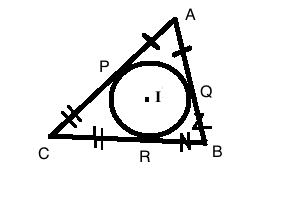
r = $$\dfrac{\text{Area}}{\text{s}} $$, where $$s$$ is the semi-perimeter and $$r$$ is the in-radius.
- If a is the side of an equilateral triangle, inradius = $$ = a/2\sqrt{3}$$.
- If a, b, and c are the sides of a right-angled triangle and c is the hypotenuse, then
Inradius = $$\dfrac{(a + b - c)}{2}$$
Circumcircle:
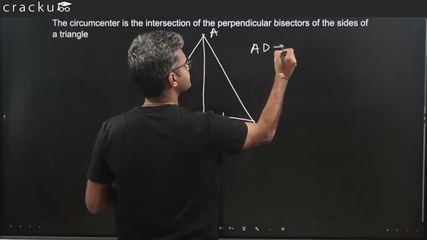
- Circumcenter is formed by the intersection of perpendicular bisectors of the three sides.
- If a is the side of a triangle opposite to angle A, circumradius = $$\dfrac{a}{2\sin A}$$
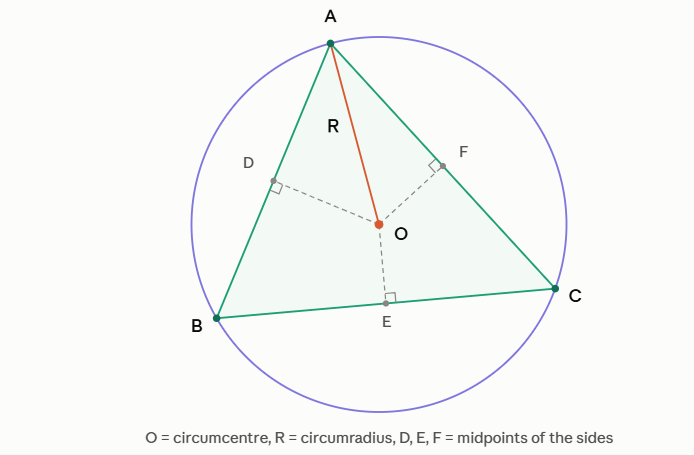
- Another generic formula for circumradius is $$R = \dfrac{\text{abc}}{\text{4A}}$$
- If a is the side of an equilateral triangle, circumradius = $$ a/\sqrt{3}$$
- If a, b, and c are the sides of a right-angled triangle and c is the hypotenuse, then
Circumradius = $$\dfrac{c}{2}$$
Orthocentre:
- Formed by the three altitudes, each drawn from a vertex perpendicular to the opposite side.
- The altitudes are concurrent; their intersection is the orthocentre.
- Position: inside for acute, at the right-angle vertex for right-angled, outside for obtuse.