91- 6303239042

If a quadrilateral has all its vertices on the circle and its opposite angles are supplementary (here x+y = 180°), then that quadrilateral is called a cyclic quadrilateral.
- In a cyclic quadrilateral, the opposite angles are supplementary
- Area of a cyclic quadrilateral is $$A$$ = $$\sqrt{(s-a)(s-b)(s-c)(s-d)} $$ where s=(a+b+c+d)/2
- The exterior angle is equal to the opposite angle of its remote interior angle. (here ∠CBX = ∠ADC)
- Area = 1/2 * One diagonal * Sum of perpendiculars drawn to the diagonal
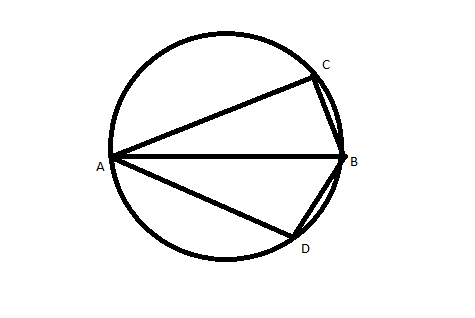
- Ptolemy's theorem states that the product of the diagonals equals the sum of the products of the opposite sides. AC*BD = AB*CD + AD*BC.