91- 6303239042
According to the 2011 census, the Indian State that has the dubious distinction of having the worst male female ratio is............
Sign in
Please select an account to continue using cracku.in
↓ →
According to the 2011 census, the Indian State that has the dubious distinction of having the worst male female ratio is............
The `IFSC Code' is analphanumeric comprising of 11 characters that facilitates electronic fund transfer in the country. The alphabet 'I' in the abbreviation `IFSC' stands for................
Loading solution...
Which of the following has recently (August 2016) been appointed as head of a legal panel by the BCCI to help implementation of the Justice Lodha Committee reforms ?
Loading solution...
The first Indian captain to score a double century in a Test match outside India is.............
Loading solution...
`Kudsi Erguner', musician player of the `ney' (reed flute) has recently been named as the UNESCO artist for peace 2016. He is a well-known musicologist and composer from.............
Loading solution...
The 'International meeting on Counter Terrorism' was recently (August 2016) held in ..........
Loading solution...
India's First 'International Financial Services Centre' (IFSC) banking unit, set up by YES Bank has started operations at GIFT city in the Indian state of :
Loading solution...
The Human Rights activist from India who is amongst the winners of 2016 Raman Magsaysay Award is ...................
Loading solution...
Under the Pradhan Mantri Suraksha Bima Yojana (PMSBY), the risk coverage is Z 2 lakh for accidental death and full disability and Z 1 lakh for partial disability. The cover is however............. not available to
Loading solution...
In India 'Commodities Derivatives Market' is regulated by............
Loading solution...
Who amongst the following has recently (July 2016) been appointed as the Chairperson of L ok Sabha privileges committee ?
Loading solution...
The 2016 "VVEF India Economic Summit" is going to be held in :
Loading solution...
Researchers have recently spotted 101 species of spiders belonging to 65 genera from the `Chinnar Wildlife Sanctuary' situated in.........
Loading solution...
The 'Bhimbetka Rock Shelters', a world heritage site, is situated in the Indian state of.........
Loading solution...
Chairman of the 'Bank Board Bureau' (BBB), Shri Vinod Rai has recently stepped down from the board of,...........
Loading solution...
The First technology meet under the Hydrocarbon Vision 2030 for Northeast India was recently(August 2016) held in ...............
Loading solution...
A coup was recently(July 2016) attempted (but failed), against the state institution including the government by a fraction within a country's armed forces in which of the following countries ?
Loading solution...
'Vembanad Lake' is the longest lake in India and the largest lakein the Indian state of............
Loading solution...
Recently introduced by National Payments Corporation of India (NPCI), the `NACH' is acentralised ............
Loading solution...
The '2019 Cricket World Cup' will be hosted by ...........
Loading solution...
Anurag Thakur is the First serving BJP 'Member of Parliament' to join the territorial army as an officer. The constituency represented by Shri hakur in the parliament is :
Loading solution...
With a view to provide comprehensive support for start-ups and other self-employment activities, the Government had set upMM'Self-Employment and Talent Utilization' (SETU) under the :
Loading solution...
Jeddah-based Islamic Development Bank has recently announced that it will open its first Indian branch in ..................
Loading solution...
The Union Cabinet has recently (July 2016) approved setting up of a major port at Enayam near Colachel in the Indian State of :
Loading solution...
According to the 2015 revision of the UN World PopulationProjections, the World Population in 2100 is projected to be around
Loading solution...
The Khangchendzonga National Park (KNP) is the first 'mixed' heritage site from India to make it to the UNESCO World Heritage List. The KNP is situated in the Indian State of ..............
Loading solution...
The Reserve Bank of India has authorized non-banks to operate 'White Label ATMs' under the provisions of .................
Loading solution...
A new museum 'The Stables' constructed by the Central Public Works Department in a building which was earlier used as part of the stables was naugurated in ...........
Loading solution...
The `Ringgif is the present day currency of
Loading solution...
The State Bank of India (SBI) has recently (August 2016) unveiled a new home loan scheme "SBI Shaurya Home Loan' which istargeted at
Loading solution...
The headquarters of the 'United Nations World Tourism Organisation' is situated in :
Loading solution...
The first unit of the Kundankulam Power Plant was recently (August 2016) dedicated to the nation jointly by PM Narendra Modi and Russian President Vladimir Putin. The plant is situated in the Indian state of.............
Loading solution...
The `PMKVY' scheme pertains to :
Loading solution...
The city of 'Ottawa' is the capital of...........
Loading solution...
The 750 MW Rewa Ultra-mega solar power project is proposed to be set up in the Indian state of..........
Loading solution...
'September 28', the death anniversary of Louis Pasteur is observed every year as 0the..............
Loading solution...
Kalikho Pul who was recently (August 2016) found dead under mysterious circumstances was the former Chief Minister of the Indian State of..........
Loading solution...
The 'National Thermal Power Corporation Limited' (NTPC) had recently (August 2016) listed the first Indian quasi-sovereign `green Masala bond' on London Stock ExChange (LSE) and had raised an amount of............
Loading solution...
The Reserve Bank of India prepares a 'Financial Stability Report' (FSR) on basis for the apex-level Financial Stability and Development Council (FSDC).
Loading solution...
The first SAARC Young Parliamentarians Conference (YPC) was recently (August 2016) held in...........
Loading solution...
SMERA Ratings Limited is a joint initiative of Dun and Bradstreet Information Services India Private Limited (D&13), leading public/private sector banks in India and......
Loading solution...
The Reserve Bank of India (RBI) -has introduced from April 1, 2016. It is a new methodology of setting lending rate by commercial banks, and will replace the existing method.
Loading solution...
With a view to train 1.24 lac youth from Jammu & Kashmir in vocational courses under the skill development initiative `Himayat Programme', the Government of India has recently (July 2016) allocated anamount of for the programme.
Loading solution...
The `Rabobank' is a Dutch multinational financial banking compan headquartered in :
Loading solution...
'M-Pesa', a mobile based money transfer and payment service, was launched by Vodafone in the year 2007. In India, Vodafone India Launched it in 2013 in association with
Loading solution...
State Bank of India (SBI) has initiated the process of merging its five associate banks with itself. The merged entity would create a financial sector powerhouse, with total assets estimated to be worth around :
Loading solution...
According to RBI guidelines, a non-banking entity seeking authorisation as Bharat Bill Payment Operating Unit (BBPOU) under the proposed Bharat Bill Payment System (BBPS) should have a minimum net worth of at least
Loading solution...
Eminent litterateur `Mahim Bora' who died recently (August 2016) at the age of 92 was a well-known literary figure and educationalist from the Indian State of.........
Loading solution...
The operation `Raahat' was an operation of the Indian Armed Forces to evacuate Indian citizens and other foreign nationals from.................. in 2015.
Loading solution...
The `Srisailam Dam' is Constructed across the Krishna river in the Indian State of :
Loading solution...
In the presence of Bangladesh Railway minister, the Union Railway Minister Suresh Prabhu recently flagged off the 'Tripura Sundari Express' which will run between Agartala and............
Loading solution...
`ONICRA is a leading.........
Loading solution...
The `Hopman Cup' is associated with the game of :
Loading solution...
IOM's stated mission is to promote humane and orderly migration by providing services and advice to governments and migrants. What does IOM stand for ?
Loading solution...
Which of the following is an autobiography on Lawn Tennis star Sania Mirza ?
Loading solution...
. The 'Sultan Azlan Shah Cup' is related to the game of
Loading solution...
kannur Lokesh Rahul commonly known as KL Rahul is related to which of the following sports ?
Loading solution...
The sportsperson who had won overall 23 gold medals in four Olympics is...........
Loading solution...
The headquarters of Canara Bank is situated in..........
Loading solution...
Who is the author of the book `Exploring Marxist Bengal' ?
Loading solution...
Who has won the 2016 World Snooker Championship ?
Loading solution...
What is the theme of 2016 International Museum Day ?
Loading solution...
The 42nd G7 summit in 2016 was held in which country ?
Loading solution...
What is the range of advanced version of BrahMos Missile, which was recently successfully tested by Indian Air Force ?
Loading solution...
Which of the following cities has become India's first city to have its own "City Animal" ?
Loading solution...
Which campaign has been launched to make gram panchayats along the banks of Ganga Open Defecation Free ?
Loading solution...
`RajVayu' mobile app has been launched by which state government for sharing data of air quality index ?
Loading solution...
Which country has been elected for the first time to chair the UN's legal affairs committee ?
Loading solution...
Banks do not provide which of the following services ?
Loading solution...
Which web portal has been launched to reduce paper work in the Lok Sabha, the lower house of Parliament of India ?
Loading solution...
Which of the following is not the part of the structure of the financial system in India ?
Loading solution...
Prior to the establishment of Reserve Bank of India, the Government banking business was conducted by which of the following organizations ?
Loading solution...
Which expert committee has been constituted to explore alternatives to pellet guns as non-lethal weapons ?
Loading solution...
Which of the following is not a general credit control measure ?
Loading solution...
Which State Government has recently signed pact with to develop food value chain in the state ?
Loading solution...
The process of the total valuation of the financial capital assets of a country is known as............
Loading solution...
The 2016 India International Footwear Fair (IIFF) has started in which of the following cities ?
Loading solution...
The term 'hyper-inflation' means :
Loading solution...
Which state tourism has recently (August, 2016) organised a `Freedom Ride' ?
Loading solution...
The world's tallest girder rail bridge will come up in which of the following state of India ?
Loading solution...
Each sentence given below has two blanks. Each blank indicates that something has been omitted. Choose the word that best fits in the meaning of the sentence as a whole.
Most auto-rickshaw drivers in the city to ply for short distances, since doing so does not............ them much.
Loading solution...
Though surprising, it is ............. that Rupesh has not got the job by of his parents' political connections.
Loading solution...
In order to avoid due to car parking, appropriate signage and painted boundary strips at parking locations have been in the building premises.
Loading solution...
During power cuts, one can never get to the customer service executive to a complaint regarding the same.
Loading solution...
In the olden days, shopkeepers used to dupe the customers by attacking removable magnetic weights their weighing instruments.
Loading solution...
Read the following passage carefully and answer the questions.
The term "shadow bank" was coined in 2007 to describe risky off-balance-sheet vehicles hatched by banks to sell loans repackaged as bonds. Today, the term is used more loosely to cover all financial intermediaries that perform bank-like activity but are not regulated as one. These include mobile payment systems, pawnshops, peer-topeer lending websites, hedge funds and bond-trading platforms set up by technology firms. Among the biggest are asset management companies. In 2013 investment funds make such loans raised a whooping $97 billion worldwide. The Financial Stability Board, an international watchdog estimates that globally, the informal lending sector serviced assets worth $80 trillion in 2014 up from $26 trillion more than a decade earlier. Shadow banks have flourished in part because the traditional ones, battered by losses incurred during the financial slump, are under pressure. Tighter capital requirements and fear of heavy penalties have kept them grounded. In China, where banks are discouraged from lending to certain industries and are mandated to offer frustratingly low interest rates on deposits, non-banks fill the gap. About two-thirds of all lending in the country by shadow banks are in fact 'bank loans in disguise'. Critics worry that unlike banks, which lend against deposits from customers, non-banks loan money using investor's cash and rotating lines of credit. This is especially risky when skittish investors who bet on short term gains withdraw their money at once. But non-bank financing need not always be a bad thing. It offers an additional source of credit to individuals and businesses in countries where formal banking is either expensive or absent. It also take some burden off banks which have big 'maturity mismatches' (the difference between the amount of time a depositor's money is parked in the bank minus the time that it is loaned out). And belatedly, regulators, too, are waking up to the new financial order of shadow banking.Banks must now declare structured investment vehicles on their balance sheets. Authorities are imposing leverage limits on various forms of shadow banks in America and Europe. It is a small start to rein in an industry that accounts for a quarter of the global financial system.
Which of the following can be said about banking regulators ?
Loading solution...
Which of the following is the central theme of the passage ?
Loading solution...
Which of the following has/have impacted the growth of shadow banks ?
A. Faulty audits of these institutions by the Financial Stability Board.
B. The state of traditional banks post the financial crisis.
C. Need for credit which traditional banks are unable to meet.
Loading solution...
Which of the following can be used to replace the phrase Among the biggest are asset management companies' ?
Loading solution...
Which of the following aptly describes the tone of the passage ?
Loading solution...
In these questions, some parts of the sentences have errors and some are correct. Find out which part of a sentence has an error and mark corresponding to the appropriate correct option. If a sentence is free from error, mark corresponding to "No error' option in the Answer sheet.
One way of dealing with such a situation is by issuing a legal notice to the accused, when the other is to settle the matter amicably.
Loading solution...
The shrewd manager left Samarth with no choice however to resign from the post by transferring him to an entirely remote and hostile location.
Loading solution...
It is ironic that the management of the organisation refuses to adhere to the same standards of corporate governance that it requires of companies deals with it.
Loading solution...
With so lowly call rates, the new/ telecom service company is definitely going/ to give the current market leaders a/ run for their money and market share.
Loading solution...
As retailers may well be on their/ way to experiment with the change in policy/ for the next few months, consumers may also take/ time to get used to late night shopping.
Loading solution...
Read the following passage carefully and answer the questions.
These are difficult times for America's free-traders. There is anger at `globalism'. Even Americans who were in favour of the Trans-Pacific Partnership (TPP)-an ambitious new agreement between 12 Pacific-rim-countries- have turned against it. This may be linked to a globalisation of supply chains. Production of traded goods has become `unbundled'. Firms once tended to design new gadgets and order the supplies needed to build them in a single factory or city. In the past' few decades, more efficient global shipping and improvements in communications allow firms to spread production across far- flung locations to design a phone in America, source parts from several Asian economies, and assemble it in China. The share of parts and components in trade rose from 22% to 28% between 1980 and 2000. In 2005, trade in 'intermediate inputs' accounted for an estimate 56% of trade in goods and 73% in services across rich countries. This contributed to a dramatic acceleration in global trade growth. It also changed the waymany workers view trade. As production has spread around the world, countries have specialised in different segments of the supply-chain. While those, such as China, with lots of low-cost labour, focused on manufacturing and assembly, more advanced economies followed a different path. Cities like New York and San Francisco enjoyed an initial advantage in the most lucrative bits of the Modern supply chain: research and development, engineering and finance. As a result, growth in supply-chain trade has been a boon for the powerful and profitable firms with headquarters in those cities, and for the highly skilled, well compensated workers they employ. America's lot in this new world is, on the whole, a happy one. Many countries envy its fortunate position as a hub for innovative cities. Most studies of the potential effects of TPP conclude that the deal would raise American output by a small but meaningful amount: just under a percentage point of GDP, perhaps over the next 15 years. But the obstacles confronting new trade deals are formidable. More generous redistribution, perhaps through an expanded programme of trade-adjustment assistance, could help neutralise some opposition. But discomfort with TPP is mostly rooted in a mistrust of the elite. Voters who are sceptical of the value of TPP will be unlikely to change their stripes without some demonstration that pacts of its kind benefit the many rather than just the few.
Which of the following is true in context of the passage ?
Loading solution...
Which of the following best describes the America's view of TPP ?
Loading solution...
What do the statistics in the passage convey ?
Loading solution...
Which of the following is the author's view of free trade ?
Loading solution...
According to the passage, which of the following is/are (an) effects of 'unbundling' ?
A. Unfair and exploitative working conditions in developing countries.
B. Drop in quality standards of manufactured goods.
C. Unemployment for some sections of the workforce in develciped countries.
Loading solution...
In these questions, there are two statements which can be combined into a single statement in a number of different ways without changing their meaning. Below them are given three probable starters (1), (2) and (3) of such a combined sentence. One, two, three or none of them may be correct. Decide upon which is/are correct, if any and mark the option which denotes your answer. If none of the three starters is suitable mark, 'None' as your answer.
Shanghai is supposed to be the "diamond" on China' Silk Road Economic Belt —a new metropolis carved out of the mountains in the country's and northwest. It is shaping up to be fool's gold, a ghost city in the making.
A. Shanghai is supposed to be the
B. Instead of being the 'diamond' on China's Silk Road Economic Belt
C. Because Shanghai is shaping up to be fool's gold.
Loading solution...
A quieter, cleaner future is not that far away, with more automobile buyers gradually taking to electric vehicles. Even with limited driving range, electric vehicles can successfully replace the bulk of personal cars on roads.
A. It's a myth that electric vehicles can successfully
B. In addition to limited driving range
C. Despite limited driving range, electric vehicles can
Loading solution...
A survey revealed that consumers think smartphone makers are releasing too many new models each year. Handset devices are one of the most frequently replaced electronic products.
A. Handset devices are one of the most frequently replaced electronic products and
B. Even though handset devices are replaced every year
C. While consumers think smartphone makers are releasing too many models each year
Loading solution...
In the given passage, there are blanks, each of which has been numbered. Against each, five words are suggested, one of which fits the blank appropriately. We all have a …(1)... in the infrastructure surrounding us-the roads, buildings, power lines and telephone networks that we …(2)... on daily. How well they are built and operated is …(3)... to economic growth and is a key arbiter of an economy's competitiveness- and yet, virtually every economy faces an array of infrastructure challenges. Just a few examples illustrate some of the pressing issues. South Africa's power distribution network has an estimated maintenance backlog of $4 billion- equivalent to half of the country's total investment in electronic power generation and distribution in 2011. The U.S. Department of Transportation estimates that 15% of the country's roads are in an unacceptable condition and Just to keep …(4)... with anticipated global GDP growth, the world needs to spend $57 trillion, or on average $3.2 trillion a year, on infrastructure over the next 18 years. That is more than the entire worldwide stock of infrastructure on the ground today-and nearly 60% more than the world has invested over the past 18 years. Tackling maintenance backlogs, future-proofing infrastructure to cope with climate change and ..(5)... development goals such as access to clean water and all-weather roads to transport goods to markets would cost a great deal. The bill for all of that looks prohibitive at a time when many governments are highly indebted and capital is tight. A focus on both, the huge need for additional investment and potential difficulties in financing it, …(6)... the debate Pessimism rules, but it needn't be that way. There are ways of cutting the bill down to size and dealing with the challenge. The answer …(7)... in improving the way we plan, build and operate infrastructure- in other words, we need to boost its productivity.
(1)
Loading solution...
(2)
Loading solution...
(3)
Loading solution...
(4)
Loading solution...
(5)
Loading solution...
(6)
Loading solution...
(7)
Loading solution...
In the following number series only one number is wrong. Find out the wrong number.
18.3, 20.6, 16, 22.9, 13.7, 2.2, 11.4
Loading solution...
2, 4, 11, 37, 151, 771, 4633
Loading solution...
188, 154, 140, 132, 128, 126, 125
Loading solution...
6, 4, 5, 11, 39, 179, 1127
Loading solution...
9, 5, 6, 10.5, 23, 61, 183
Loading solution...
A, B and C started a business with investments of 1,600/-, 2,100/- and 1,500/- respectively. After 8 months from the start of the business, B and C invested additional amounts in the ratio of 3 : 5 respectively. If the respective ratio between total annual profit and C’s share in the annual profit was 3 : 1, what was the additional amount invested by B after 8 months ?
Loading solution...
A shopkeeper purchased 15 kg of variety A rice at X per kg and 10 kg of variety B rice at ‘X+ 5’ per kg. The shopkeeper sold the whole quantity of variety A rice at 10% profit and that of variety B rice at 20% profit. The total selling price of variety A rice was 30/- more than that of variety B rice. Had the two varieties been mixed and sold at an overall profit of 20%, what would have been the selling price of the mixture per kg?
Loading solution...
In the given questions, two quantities are given, one as Quantity I and another as Quantity II. You have to determine relationship between two quantities and choose the appropriate option.
a: If quantity I ≥ quantity II
b: If quantity I > quantity II
c: If quantity I < quantity II
d: If quantity I = quantity II or the relationship cannot be established from the information that is given
e: If quantity quantity II
1 >a>0 > b
Quantity:
1. value of $$\frac{(a+b)^{2}-a^{2}-b^{2}}{(a+b)^{2}-(a^{2}-b^{2})}$$ = $$\frac{1}{2(ab^{3}+ab)}$$
Loading solution...
There are three positive numbers- a, b and c. The average of a and b is less than the average of b and c by 1.
Quantity :
I. Value of c.
II. Value of a
Loading solution...
Three equal circles are drawn on a triangle ABC, with points A, B and C as the centres. Radius of each of the
circle is equal to half of the side of the triangle ABC. (Figure not to the scale)
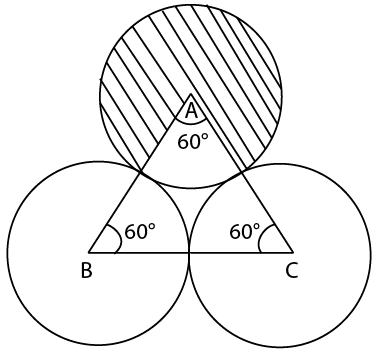
Area of shaded region 1 = $$128\frac{1}{3}cm^{2}$$
Quantity :
I. The area of the shaded region 2 ( in cm^{2} )
II. 30 cm^{2}
Loading solution...
Ram invested P in scheme A and 2P in scheme B, for two years each. Scheme A offers simple interest p.a. Scheme B offers compound interest (compounded annually) at the rate of 10% p.a. Respective ratio between the interest earned from scheme A and that earned from scheme B was 8 : 21.
Quantity :
I. Rate of interest offered by scheme A.
II. Rate of interest offered by scheme C (simple interest p.a.), when 1,600/- is invested for 3 years earns an interest of 384/-.
Loading solution...
Rutuja bought two articles-article A at X and article B at X + 50. She sold article A at 20% profit and article B at 10% loss, and earned 35/- as profit on the whole deal.
Quantity :
I. Profit earned by Rutuja on selling article A (in ).
II. Loss incurred (in ) when an article which costs 480/- is sold at 20% loss.
Loading solution...
Arun and Bhadra are brothers. In how many years from now will Bhadra’s age be 50 years ? •
I. The ratio of the current ages of Arun and Bhadra is 5 : 7 respectively.
II. Bhadra was born 10 years before Arun.
III. 5 years hence, Arun’s age would be three-fourth of Bhadra’s age at that time.
Loading solution...
A right-angled triangle is inscribed in a given circle. What is the area of the given circle (in cm2) ?
I. The base and height of the triangle (in cm) are both the roots of the equation $$x^{2}-23x+120=0$$
II. The sum of the base and height of the triangle is 23 cm.
III. The height of the right-angled triangle is greater than the base of the same.
Loading solution...
What is the ratio between the marled price of two identical items, P and Q, which had been purchased at the same price ?
I. Item P was sold at a profit of 20%, while item Q was sold at a loss of 10%.
II. Item P was sold at a discount of 4%. The percentage by which Item Q’s cost price had been marked up is 2.5 times the profit % earned on selling item P.
III. The overall profit earned on selling items P and Q was 5%.
Loading solution...
Three workers A, B and C complete a given piece of work within different time spans, while working individually. What is the ratio of efficiencies of C and B respectively ?
I. A takes 100% more time than C to complete the given piece of work.
II. B completes the given piece of work within 8 days.
III. B takes 2 days less than A to complete the given piece of work.
Loading solution...
What is the three-digit number having each digit different from the other ?
I. Each of the digits of the given number is a multiple of 3.
II. The digit in the unit’s place is 50% less than that in the hundred’s place.
Loading solution...
The respective ratio between the time taken by a boat to travel the same distance downstream in stream A and that in stream B is 8 : 7. The speed of the boat is 12 km/h and the speed of stream A is half the speed of stream B. What is the speed of stream B ? (in km/h)
Loading solution...
To complete a project, 18 women take 4 more days than the number of days taken by 12 men. If eight men complete the project in 9 days, how much work will be left when 15 women and 12 men together work for 3 days ?
Loading solution...
Refer to the pie charts and answer the given questions. Data regarding number of foreign students (male + female) from different countries- A, B, C, D and E, studying in higher education level in the country XYZ in the year 2014 Total number of foreign students (male + female) = 9000

Foreign female students = 3500

What is the respective ratio between the total number of male students from countries B and C together and total number of students (male + female) from the same countries together ?
Loading solution...
What is the average number of male students from countries C, D and E ?
Loading solution...
The total number of female students from countries A and B .together is what percent of male students from country A ?
Loading solution...
Female students from country E is what percent more than those from country C ?
Loading solution...
Male students from country E in the year 2015 were 20% more than those from the same country in the previous year. If the male students from country E constituted 60% of the total students (male + female), in the year 2015, how many foreign students from country E in the same year were females ?
Loading solution...
Abhay rolled a pair of die together. What is the probability that one die showed a multiple of 2 and the second die showed neither a multiple of 3 nor 2 ?
Loading solution...
Study the table and answer the given questions

Note: Some of the data is deliberately missing (indicated by —). You need to calculate the values based on the given data to answer the given questions
Only 40% and 20% of females were graduates in villages A and C respectively. If female population of villages A and C were equal, what was the respective ratio of number of non-graduate females (including illiterate females) in villages A and C?
Loading solution...
If in village E, 40% of male literates and 40% of female literates were graduates, what percent of total population were graduates ?
Loading solution...
In village B, the number of females was what percent less than the number of males ?
Loading solution...
The total number of literates (male and female) in Village D was 4320. If the number of illiterate females was 320 more than the number of illiterate
Loading solution...
In village C, the number of females increased by 20% from 2011 to 2015. If the number of literate females was equal in 2011 and 2015, what percent of female population of village C Was literate ?
Loading solution...
In the past, consumers would rarely walk into an ice cream store and order low-fat ice cream. But that isn't the case today. An increasing health consciousness combined with a much bigger selection of tasty low-fat foods in all categories has made low-fat ice cream a very profitable item for ice cream store owners. Which of the following best support the statement ?
Loading solution...
All the major rivers in the state have been flowing way over the danger level for the past few weeks. Which of the following is/are possible effect(s) of the above cause ?
A. Many villages situated near the river banks are submerged forcing residents to flee.
B. Government has decided to provide alternate shelter to all the affected villagers residing near the river banks.
C. The entire state has been put on high flood alert
Loading solution...
In these questions, relationship between different elements is shown in the statements. These statements are followed by two conclusions. Read them carefully and mark the appropriate answer.
Give answer :
a: If either conclusion I or II follows
b: If neither conclusion I nor II follows
c: If only conclusion II follows
d: If both conclusions I and II follow
e: If only conclusion I follows
Statements:
C ≥ V ≤ R = N ≥ T > Q : Y ≥ N < A
Conclusions :
I. Q > V
II. Q < Y
Loading solution...
Statements:
C ≥ V ≤ R = N ≥ T > Q : Y ≥ N < A
Conclusions :
I. Q ≥ Y
II. A > Q
Loading solution...
Statements :
P ≥ R < U ≤ M < V ; T ≤ U ; L < M
Conclusions :
I. T < L
II. V >L
Loading solution...
Statements :
P ≥ R < U ≤ M < V ; T ≤ U ; L < M
Conclusions :
I. V > T
II. T ≤ P
Loading solution...
Study the given information carefully and answer the given question. Following are the observations of an experiment on 'sleep and memory' conducted on 18 healthy young adults (ages 18 to 25) and 18 healthy older adults (ages 61 to 81).
A. The recall after 8 hours of sleep in younger adults was 65% more than that in the older adults.
B. Night-sleep had higher negative impact on all of the participants as compared to that of day sleep of equal duration.
C. If a given set' of words is memorised immediately before going to sleep, its recall after waking up was found to be better in younger adults than in the older adults.
Which of the following can be concluded from the given findings of the research ?
I. As per the experiment, there is some correlation between sleep and memory.
II. The part of brain involved in memory is more active during the day as compared to that during the night.
III. A sleep of more than 8 hours can improve the memory in older adults.
IV. Memorising something immediately after waking up from an 8-hour long sleep will yield better results than memorising before sleep.
Loading solution...
In this question are given two statements I and II. These statements may be either independent causes or may be effects of independent causes or a common cause. One of those statements may be the effect of the other statement. Read both the statements and. decide which of the given answer choice correctly depicts the relationship between these two statements.
Statements :
I. Company ABC, a leading automobile company in country G has decided to merge all its subsidiary companies into the parent company last week.
II. Company XYZ, a subsidiary of automobile company ABC, has opened five new branches in country F in the previous financial year.
Loading solution...
If all the letters in the word `REGULATION' are arranged in English alphabetical order from left to right and then all the vowels are changed to the next alphabet in the English alphabetical series and all the consonants are changed to the previous alphabet in English alphabetical series, how will the word be written ?
Loading solution...
In Country A, it is mandatory for all government organizations to provide transportation facilities (home pick-up and drop) to employees if 75% or more number of total employees working in the organization reside more than 15 km away from office. The same, however, does not apply to XY enterprises as only 1500 of their employees travel more than 15 km to work. Which of the following can be inferred from the given statement ?
A. The total number of employees in XY enterprises is definitely more than 2000.
B. Only 25% employees of XY enterprises travel less than 15km to ofice.
C. If 25 new recruits who travel more than 15 km join XY enterprises, the XY enterprises will definitely have to provide transportation facilities.
D. XY enterprises is definitely not a government enterprise
Loading solution...
Study the given information carefully to .answer the given questions.
Seven people — J, K, L, M, N, O and P have an interview on seven different days of the same week, starting from Monday and ending on Sunday, but not necessarily in the same order. Each one of them also likes different subjects namely - Statistics, Zoology, Sociology, English, Mathematics, Psychology and Economics, but not necessarily in the same order. Only four people have their interview between N and the one Who likes Zoology. Neither N nor the one who likes Zoology has an interview on Sunday. P has an interview immediately after the one who likes Zoology. Only two people have their interviews between P and J. The one who likes Psychology has an interview on one of the days before J but not on Wednesday. Neither N nor P likes Psychology. Only two people have their interviews between the one who likes Psychology and the one who likes Statistics. The one who likes Economics has an interview immediately before the one who likes Statistics. The number of people having interview between P and the one who likes Economics is same as that of the number of people between J and the one who likes English. N does not like English. Only one person has an interview between the one who likes English and K. The one who likes Sociology has an interview immediately after O. L has an interview on one of the days after M
.
Four of the following five are alike in a certain way based on the given arrangement and hence form a group. Which of the following does not belong to the group ?
Loading solution...
How many people have their interviews between L and M ?
Loading solution...
Which of the following statements is TRUE as per the given arrangement ?
Loading solution...
Who has an interview immediately after K ?
Loading solution...
How many people have their interview before the one who likes Mathematics ?
Loading solution...
Study the following information and answer the given questions.
Seven people, namely, J, K, L, M, N, O and P like seven different movies namely, Twilight,
Gladiator, Wanted, Dread, Hero, Jumanji and Signs but not necessarily in the same order. Each person also works in the same office but in a different department (on the basis of experience) namely Administration, Production, Marketing, HR, Finance, R&D; and Client relations (CR), not necessarily in the same order. (Please Note: Each person has been allocated to a department as per increasing order of experience with the one in Administration being the least experienced whilst the one in Client Relations (CR) being the most experienced). Only two persons have less experience than K. P works in R&D.; The one who likes Wanted has more experience than K but less than one who likes Jumanji. P neither likes Wanted nor Jumanji. The one who likes Wanted does not work in Finance. J, who is more experienced than K, likes twilight. The person who works in Production is less experienced than the person who likes Hero. K does not like Hero. The person who works in HR is more experienced than both L and N. N is not the least experienced person. The one who likes Signs has more experience than N. M is more experienced than J. L does not like Dread.
Four of the following five are alike in a certain way based on the given arrangement and so form a group. which is the one that does not belong to that group ?
Loading solution...
Which combination represents the department in which 0 works and the movie he likes ?
Loading solution...
Which of the following movies does M like ?
Loading solution...
As per the given arrangement, HR is related to Signs and CR is related to Hero in a certain way. To which of the following is Production related to in the same way ?
Loading solution...
Which of the following pairs represent the respective people who have more experience than J and less experience than K ?
Loading solution...
Read the given information and answer the question. `Despite spending huge amount of money, we have not yet been able to find life on other planets. I am personally of the opinion that such research should stop with immediate effect as it is a waste of time and money as no good will ever come out of it Instead it would be better to use this money to research other elements in space' Statement by a Scientist from Space Institute of Country X. Which of the following does not weaken the statement of the scientist of space institute of country X?
Loading solution...
This question consists of information and two statements numbered I and II given below it. You have to decide which of the given statements weaken(s) or strengthen(s) the information and decide the appropriate answer. In order to discourage crowd built-up at railway station X, the platform ticket (charged to all such priced at Rs. 10 should be increased to Rs. 20.
I. The price of ticket from X to nearest railway station is Rs. 12.
II. On an average, every railway station generates Rs. 24 lacs revenue by charging Rs. 10 for platform ticket while X generates Rs.28 lacs.
Loading solution...
Which of the following expressions will be definitely false if the given expression 'G > H = I ≥ V ≤ Y ≤ Z ≤ T is definitely true ?
Loading solution...
A word and number arrangement machine when given an input line of words and numbers rearranges them following a particular rule in each step. The following is an illustration of input and rearrangement. (All the numbers are two-digit numbers.)
Input : 42 prey burn 78 21 melt gulp 96 83 head
Step I : ban 23 42 prey 78 melt gulp 96 83 head
Step II : gap 44 ban 23 prey 78 melt 96 83 head
Step III : had 80 gap 44 ban 23 prey melt 96 83
Step IV : mat 85 had 80 gap 44 ban 23 prey 96
Step V : pay 98 mat 85 had 80 gap 44 ban 23
Step V is the last step of the above arrangement as the intended output of arrangement is obtained.
As per the rules followed in the given steps, find the appropriate steps for the given input.
Input : 61 rust 33 colt 86 four torn 28 49 leap
Which of the following is the fourth to the left of the eighth element from the left end of step II ?
Loading solution...
Which of the following represents the element that is fifth to the right of 'cat' in step III ?
Loading solution...
In step III, how many elements are there between '86' and the third element from the left end ?
Loading solution...
What is the difference between the third element from the right end in step V and the fifth element from the left end in step II ?
Loading solution...
'torn' is related to 'rust' in step I in the same way as `lap' is related to 'tan' in step V. Following the same pattern to which element is '86' related to in step IV ?
Loading solution...
This question consists of a statement followed by two courses of action numbered I and II given below it. A course of action is an administrative decision to be Everything in the statement to be true and then decide which of the suggested courses of action logically follow(s) from the given statement.
Most of the people looking for buying/renting properties these days complain of being taken to the same property by more than 6-7 brokers. So even after contracting multiple agents, they end up having usually the same options.
Courses of action :
I. All the owners should strictly give the responsibility of their properties to only one.
II. The brokers should be instructed to mandatorily disclose the list of all the properties they will
be showing the customers on a particular day before taking them to the actual site.
Loading solution...
Study the following information to answer the given questions. In a certain code language, `economy and work related' is written as `oj my bx st' `work and employment today' is written as `pk bx oj dy' `employment for growth only' is written as 'el pk fd zn' `growth is related today' is written as 'el dy gm my' (All codes are two letter codes only)
If the code for 'related people only' is 'xd my fd' then what may be the code for 'people for decision' in the given code language ?
Loading solution...
What does the code `pk' stand for in the given code language ?
Loading solution...
What may be the code for `economy is boosting' in the given code language ?
Loading solution...
Which of the following additional statements is required to definitely find the code of `and' in the given code language ?
Loading solution...
What is the code for 'growth today' in the given code language ?
Loading solution...
Study the following information carefully to answer the given question
Ten persons from different companies viz Samsung, Bata, Microsoft, Google, Apple, HCL, ITC, Reliance, Airtel and Vodafone are sitting in two parallel rows containing five people each, in such a way that there is an equal distance between adjacent persons. In row 1- B, C, D, E and F are seated and all of them are facing south. In row-2 R, S, T, U and V are seated and all of them are facing north. Therefore, in the given seating arrangement, each member seated in a row faces another member of the other row. (All the information given above does not the order of seating as in give thefinal arrangement.)
• There people sit between R and the person from Apple. The person from Reliance is an
immediate neighbour of the one who faces the person from Apple. V sits to the immediate left of the one who faces the person from Reliance.
• Only one person sits between V and T. The person from Bata sits second to the right of the one who faces T. F sits second to the left of the person from Google. The person from Google does not sit at an extreme end of the line.
• Only two people sit between F and D. The person from Samsung faces an immediate neighbour of D. U is an immediate neighbour of the person from Microsoft. V is not from Microsoft. B sits second to the left of C.
• The person from ITC is an immediate neighbour of the person from Vodafone. Neither V nor F is from ITC. The person from ITC faces the person from HCL.
F is related to ITC in the same way as T is related to HCL, based on the given arrangement. To who amongst the following is D related to following the same pattern ?
Loading solution...
Which of the following is true regarding E ?
Loading solution...
Who amongst the following sit at extreme end of the rows ?
Loading solution...
Four of the following five are alike in a certain way based on the given arrangement and so form a group. Which is the one that does not belong to that group
Loading solution...
Who amongst the following faces the person from Airtel ?
Loading solution...
Which of the following symbols should replace the question mark(?) in the given expression in order to make the expressions `H < R' as well as 'D ≥ M' definitely true ?
D ≥ I ≥ H = S ? M < P ≤ R
Loading solution...
T is the father of M and P. P is the only daughter of V. M is married to N. A and B are children of M. How is V related to B ?
Loading solution...
A severe cyclonic storm hit the Eastern coastlii;te last month resulting in huge loss of life and property on the entire east coast and the Government had to disburse a considerable amount for relief activities through the district administration machineries. Which of the following may possibly be a follow up measure to be taken by the Government?
Loading solution...
These questions consist of a question and two statements numbered I and H given below it. You have to decide whether the data provided in the statements are sufficient to answer the question. Read both the statements and mark the appropriate answer.
Give answer :
Topic:banking-reasoning-data-sufficiency
a: The data even in both statements I and II together are not sufficient to answer the question.
b: The data in statement I alone are sufficient to answer the question while the data in statement II alone are not sufficient to answer the question.
c: The data either in statement I alone or in statement II alone are sufficient to answer the question.
d: The data in both statements I and II together are necessary to answer the question.
e: The data in statement II alone are sufficient to answer the question while the data in statement I are not sufficient to answer the question.
In a building, the ground floor is numbered one, first floor is numbered two and so on till the topmost floor is numbered five. Amongst five people- M, N, O, P and Q, each living on a different floor, but not necessarily in the same order, on which floor does Q live ?
I. O lives on an odd numbered floor. M lives immediately below O. Only two people live between M and P. N lives neither immediately below M nor immediately below P.
II. N lives on an even numbered floor. Only two people live between N and O. Only one person lives between O and Q.
Loading solution...
Among people A, B, C, D, E and F, each having a different height, who is the second shortest ?
I. Only two people are taller than A. E is taller than both B and C. F is shorter than E. F is taller than C.
II. Only two people are shorter than D. A is taller than D but shorter than E. F is neither the tallest nor the shortest. B is taller than C.
Loading solution...
How many people are standing between A and D (Note: All are standing in a straight line facing north) ?
I. K stands second from the left end of the line. Only four people stand between K and T. Y is an immediate neighbour of T. A stands second to the right of Y. As many people stand between K and D as between A and D.
II. A stands second from the right end of the line. Z stands third from the left end of the line. D stands exactly in the centre of the line. As many people stand between A and T as between D and Z.
Loading solution...
How far and in which direction is Point M from Point S ?
I. Point E is 2m to the east of Point S. Point B is 4m to the south of Point E. Point L is 10m to the east of Point B. Point L forms a midpoint of the vertical straight line of 8m formed by joining points Q and D. Point M is 5m to the west of Point Q.
II. Point M is 8m to the north of Point A. Point M forms the midpoint of the horizontal straight line formed by joining points O and F. Point F is 8m to the west of Point O. Point S is 4m to the west of Point F.
Loading solution...
Amongst six people-P, Q R, S, T and U standing around a circle, some facing the centre while some facing outside (i.e. oppositeto the centre) but not necessarily in the same order, what is the position of T with respect to U ?
I. P stands second to the right of R. R faces the centre. Q stands second to the left of P. Q is an immediate neighbour of both U and T. U and P face opposite directions (i.e. if U faces the centre then P faces outside and vice-versa.) Only two people stand between P and T.
II. Only two people stand between R and U. P stands to the immediate left of U. P faces outside. R is an immediate neighbour of T.
Loading solution...
In these questions, two/three statements followed by two conclusions numbered I and II are given. You have to take the given statements to be true even if they seem to be at variance from commonly known facts and then decide which of the given conclusions logically follows from the given statements disregarding commonly known facts.
Give answer :
a: If either conclusion I or II follows
b: If neither conclusion I nor II follows
c: If only conclusion II follows
d: If both conclusions I and II follow
e: If only conclusion I follows
Statements :
Some coffee is tea.
All tea is water.
All water is milk.
Conclusions :
I. All coffee being water is a possibility.
II. All milk is tea.
Loading solution...
Statements :
No sea is a sky.
Some skies are kites.
All kites are balloons.
Conclusions :
I. Some balloons are seas.
II. All balloons being skies is a possibility.
Loading solution...
Statements :
Some stars are planets.
Some planets are galaxies.
Some galaxies are suns.
Conclusions :
I. All suns being galaxies is a possibility.
II. Some galaxies are stars.
Loading solution...
Statements :
All registers are pens.
All pens are pencils.
No pencil is rubber.
Conclusions :
I. No register is rubber.
II. All pencils are pens.
Loading solution...
Statements :
Some radios are televisions.
Some televisions are phones.
All phones are computers.
Conclusions :
I. All computers being televisions is a possibility.
II. Some radios being phones is a possibility.
Loading solution...
Statements :
All cats are dogs.
All wolves are dogs.
All dogs are jackals.
Conclusions :
I. All wolves are jackals.
II. Atleast some jackals are cats.
Loading solution...
Study the given information carefully to answer the given questions:
Seven boxes- A, B, C, D, E, F and G are kept one above the other, but not necessarily in the same order. Each box has a different number viz. 2, 4, 5, 7, 8, 9 and 12, but not necessarily in the same order. Only three boxes are kept between G and box number 9. Only two boxes are kept between G and B. B is kept at one of the positions below box number 9. Only one box is kept between B and box number 4. E is kept immediately below box number 12. E is kept at one of the places above box number 9. There is only one box between E and the box having number less than E. E's box number is neither 7 nor 8. Only two boxes are kept between box number 5 and F. The difference between F and the box immediately below it is less than four. C is not the topmost box. C's box number is not 4. Only two boxes are kept between C and A.
What is the number of box C ?
Loading solution...
How many boxes are kept between E and box number 4 ?
Loading solution...
What is the position of D in the given stack of boxes ?
Loading solution...
Which of the following boxes is kept immediately above A ?
Loading solution...
Four of the following five are alike in a certain way and hence form a group. Which of the following does not belong to the group ?
Loading solution...
Which of the following boxes is numbered 8 ?
Loading solution...
A major portion of cash frow that country M yields is through agricultural activities. However, in past half a decade the revenue earned from agriculture has noticeably reduced." — A report. Which of the given statements may be a reason for the given situation ?
A. Country M is employing new techniques to yield good crop and boom the productivity.
B. Country M has faced two major droughts in the last five years.
C. The revenue from other industries has increased in the past five years.
Loading solution...
Start your IIM journey with the right preparation and crack CAT 2026.

Educational materials for CAT preparation