91- 6303239042
If $$\log_4m + \log_4n = \log_2(m + n)$$ where m and n are positive real numbers, then which of the following must be true?
Sign in
Please select an account to continue using cracku.in
↓ →
If $$\log_4m + \log_4n = \log_2(m + n)$$ where m and n are positive real numbers, then which of the following must be true?
$$\log_4mn=\log_2(m+n)$$
$$\sqrt{\ mn}=(m+n)$$
Squarring on both sides
$$m^2+n^2+mn\ =\ 0$$
Since m, n are positive real numbers, no value of m and n satisfy the above equations.
Mr. Jose buys some eggs. After bringing the eggs home, he finds two to be rotten and throws them away. Of the remaining eggs, he puts five-ninth in his fridge, and brings the rest to his mother’s house. She cooks two eggs and puts the rest in her fridge. If her fridge cannot hold more than five eggs, what is the maximum possible number of eggs bought by Mr. Jose?
Loading solution...
Mohan has some money (₹M) that he divides in the ratio of 1:2. He then deposits the smaller amount in a savings scheme that offers a certain rate of interest, and the larger amount in another savings scheme that offers half of that rate of interest. Both interests compound yearly. At the end of two years, the total interest earned from the two savings schemes is ₹830. It is known that one of the interest rates is 10% and that Mohan deposited more than ₹1000 in each saving scheme at the start. What is the value of M?
Loading solution...

A small store has five units of a new phone model in stock: two white, two black, and one red. Three customers arrive at the shop to buy a unit each. Each one has a pre- determined choice of the colour and will not buy a unit of any other colour. All the three customers are equally likely to have chosen any of the three colours. What is the probability that the store will be able to satisfy all the three customers?
Loading solution...
At any point of time, let x be the smaller of the two angles made by the hour hand with the minute hand on an analogue clock (in degrees). During the time interval from 2:30 p.m. to 3:00 p.m., what is the minimum possible value of x?
Loading solution...
One third of the buses from City A to City B stop at City C, while the rest go non-stop to City B. One third of the passengers, in the buses stopping at City C, continue to City B, while the rest alight at City C. All the buses have equal capacity and always start full from City A. What proportion of the passengers going to City B from City A travel by a bus stopping at City C?
Loading solution...
.webp)
Rajesh, a courier delivery agent, starts at point A and makes a delivery each at points B, C and D, in that order. He travels in a straight line between any two consecutive points. The following are known: (i) AB and CD intersect at a right angle at E, and (ii) BC, CE and ED are respectively 1.3 km, 0.5 km and 2.5 km long. If AD is parallel to BC, then what is the total distance (in km) that Rajesh covers in travelling from A to D?
Loading solution...
Let $$f(x) = \frac{x^2 + 1}{x^2 - 1}$$ if $$x \neq 1, -1,$$ and 1 if x = 1, -1. Let $$g(x) = \frac{x + 1}{x - 1}$$ if $$x \neq 1,$$ and 3 if x = 1.
What is the minimum possible values of $$\frac{f(x)}{g(x)}$$ ?
Loading solution...
Swati can row a boat on still water at a speed of 5 km/hr. However, on a given river, it takes her 1 hour more to row the boat 12 km upstream than downstream. One day, Swati rows the boat on this river from X to Y, which is N km upstream from X. Then she rows back to X immediately. If she takes at least 2 hours to complete this round trip, what is the minimum possible value of N?
Loading solution...

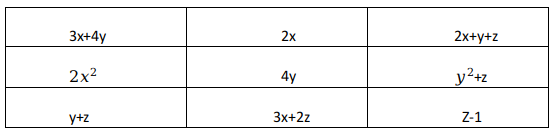
Rahul has just made a $$3 \times 3$$ magic square, in which, the sum of the cells along any row, column or diagonal, is the same number N. The entries in the cells are given as expressions in x, y, and Z. Find N?
Loading solution...
On the bank of the pristine Tunga river, a deer and a tiger are joyfully playing with each other. The deer notices that it is 40 steps away from the tiger and starts running towards it. At the same time, the tiger starts running away from the deer. Both run on the same straight line. For every five steps the deer takes, the tiger takes six. However, the deer takes only two steps to cover the distance that the tiger covers in three. In how many steps can the deer catch the tiger?
Loading solution...
Read the following scenario and answer the three questions that follow.
A company awards incentives to its employees for successful project performances. It rates successful project performance in categories A*, A, B, and C. Employees, in solo projects rated A*, A, B, and C, are awarded incentives ₹6 lakh, ₹5 lakh, ₹3 lakh, and ₹1 lakh respectively. When a project has multiple team members, the following scheme is used to award the incentives:
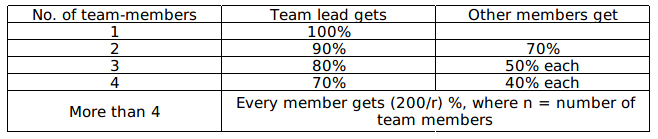
For example, for a project rated A, with three members, the team lead gets ₹4 lakh, and the other team members get ₹2.5 lakh each. A project always has a single team lead.
Six employees: Altaf, Bose, Chakrabarthi, Dipa, Ernie, and Fatima receive a total of ₹45 lakh in incentives by participating in a total of eight different projects that does not involve any other person. Not all six employees are involved in all eight projects.
The following are additionally known about these eight projects:
1. One project involves all six employees. Four projects involve three each, and the rest, two each.
2. Exactly three projects are rated C, for which a total of ₹4.8 lakh is paid.
3. Only one project is rated A*.
What BEST is known about the team compositions for the projects rated C?
Loading solution...

What BEST is known about the team composition for the project rated A*?
Loading solution...
Total amount of money paid for projects rated A (in lakhs of Rupees) is:
Loading solution...
Read the following scenario and answer the three questions that follow.
A quick survey at the end of a purchase at buyagain.com asks the following three questions to each shopper:
1. Are you shopping at the website for the first time? (YES or NO)
2. Specify your gender: (MALE or FEMALE)
3. How satisfied are you? (HAPPY, NEUTRAL or UNHAPPY)
240 shoppers answer the survey, among whom 65 are first time shoppers. Furthermore:
i. The ratio of the numbers of male to female shoppers is 1 : 2 while the ratio of the numbers of unhappy, happy and neutral shoppers is 3 : 4 : 5
ii. The ratio of the numbers of happy first-time male shoppers, happy returning male shoppers, unhappy female shoppers, neutral male shoppers, neutral female shoppers and happy female shoppers is 1 : 1 : 4 : 4 : 6 : 6
iii. Among the first-time shoppers, the ratio of the numbers of happy male, neutral male, unhappy female and the remaining female shoppers is 1 : 1 : 1 : 2, while the number of happy first-time female shoppers is equal to the number of unhappy first-time male shoppers
What is the number of happy male shoppers?
Loading solution...

Which among the following is the lowest?
Loading solution...
Which among the following cannot be determined uniquely?
Loading solution...
The six faces of a wooden cube of side 6 cm are labelled A, B, C, D, E and F respectively. Three of these faces A, B, and C are each adjacent to the other two, and are painted red. The other three faces are not painted. Then, the wooden cube is neatly cut into 216 little cubes of equal size. How many of the little cubes have no sides painted?
Loading solution...

ABC is a triangle with integer-valued sides AB = 1, BC >1, and CA >1. If D is the mid-point of AB, then, which of the following options is the closest to the maximum possible value of the angle ACD (in degrees)?
Loading solution...
Find z, if it is known that:
a: $$-y^2 + x^2 = 20$$
b: $$y^3 - 2x^2 - 4z \geq -12$$ and
c: x, y and z are all positive integers
Loading solution...
An encryption system operates as follows:
Step 1. Fix a number k $$(k \leq 26)$$.
Step 2. For each word, swap the first k letters from the front with the last k letters from the end in reverse order. If a word contains less than 2k letters, write the entire word in reverse order.
Step 3. Replace each letter by a letter k spaces ahead in the alphabet. If you cross Z in the process to move k steps ahead, start again from A.
Example: k = 2: zebra --> arbez --> ctdgb.
If the word “flight” becomes “znmorl” after encryption, then the value of k:
Loading solution...

Read the following scenario and answer the three questions that follow.
The following plot describes the height (in cm), weight (in kg), age (in years) and gender (F for female, M for male) of 20 patients visiting a hospital.

A person’s body mass index (BMI) is calculated as weight (in kg) divided by squared height (measured in square metres). For example, a person weighing 100 kg and of height 100 cm (1m) will have a BMI of 100. A person with BMI less than or equal to 18.5 is considered as underweight, above 18.5 but less than or equal to 25 as normal weight, above 25 but less than or equal to 30 as overweight, and above 30 as obese.
The average age of the female patients who weigh 50 kg or above is approximately
Loading solution...
The highest BMI among all patients is approximately
Loading solution...
The BMI of the oldest person considered as normal weight is approximately
Loading solution...

The topmost point of a perfectly vertical pole is marked A. The pole stands on a flat ground at point D. The points B and C are somewhere between A and D on the pole. From a point E, located on the ground at a certain distance from D, the points A, B and C are at angles of 60, 45 and 30 degrees respectively. What is AB : BC : CD?
Loading solution...
Two circles P and Q, each of radius 2 cm, pass through each other’s centres. They intersect at points A and B. A circle R is drawn with diameter AB. What is the area of overlap (in square cm) between the circles R and P?
Loading solution...
Four friends, Ashish, Brian, Chaitra, and Dorothy, decide to jog for 30 minutes inside a stadium with a circular running track that is 200 metres long. The friends run at different speeds. Ashish completes a lap exactly every 60 seconds. Likewise, Brian, Chaitra and Dorothy complete a lap exactly every 1 minute 30 seconds, 40 seconds and 1 minute 20 seconds respectively. The friends begin together at the start line exactly at 4 p.m. What is the total of the numbers of laps the friends would have completed when they next cross the start line together ?
Loading solution...

Zahir and Raman are at the entrance of a dark cave. To enter this cave, they need to open a number lock. Raman sees a note on a rock: “ ... chest of pure diamonds kept for the smart one ... number has six digits ... second last digit is 2, third last is 4 ... divisible by all prime numbers less than 15 ...”. Excited, Zahir and Raman seek your help: which of these can be the first digit of the six-digit number that will help them open the lock?
Loading solution...
Read the following statements and answer the question that follows.
1. Some countries are, at least, trying to curb emissions.
2. Morocco is building a colossal solar-power plant in the desert.
3. States in the Middle East and North Africa can do little on their own to mitigate climate change.
4. Saudi Arabia is not going to stop exporting oil, but it plans to build a solar plant that will be about 200 times the size of the biggest such facility operating today.
5. Politics often gets in the way of problem solving.
Arrange the above five statements in a logical sequence.
Loading solution...
Read the following statements and answer the question that follows.
Arrange the above five statements in a logical sequence.
Loading solution...
Which of the following sentences uses a WRONG tag-question?
Loading solution...
Read the following statement:
While start-ups have__________ reach, _____ they introduce ________ products, they open-up ________ markets.
Fill in the blanks meaningfully, in the above statement, from the following options.
Loading solution...
Read the following passage and answer the question that follows.
The painting, which is in poor condition, suggests that a highly advanced artistic culture existed some 44,000 years ago, punctuated by folklore, religious myths and spiritual belief. The scene may be regarded not only as the earliest dated figurative art in the world but also as the oldest evidence for the communication of a narrative in Palaeolithic art.
"This is noteworthy, given that the ability to invent fictional stories may have been the last and most crucial stage in the evolutionary history of human language and the development of modern-like patterns of cognition” researchers said.
Which of the following can be BEST concluded from the passage?
Loading solution...
Read the following passage and answer the two questions that follow.
We stand before this great world. The truth of our life depends upon our attitude of mind towards it - an attitude which is formed by our habit of dealing with it according to the special circumstance of our surroundings and our temperaments. It guides our attempts to establish relations with the universe either by conquest or by union, either through the cultivation of power or through that of sympathy. And thus, in our realization of the truth of existence, we put our emphasis either upon the principle of dualism or upon the principle of unity.
Which of the following statements can be BEST inferred from the passage?
Loading solution...
According to the passage, our emphasis on dualism or on unity is BEST guided by:
Loading solution...
Read the following passage and answer the three questions that follow.
Multitasking has been found to increase the production of the stress hormone cortisol as well as the fight-or-flight hormone adrenaline, which can overstimulate your brain and cause mental fog or scrambled thinking. Multitasking creates a dopamine addiction feedback loop, effectively rewarding the brain for losing focus and for constantly searching for external stimulation. To make matters worse, the prefrontal cortex has a novelty bias, meaning that its attention can be easily hijacked by something new—the proverbial shiny objects we use to entice infants, puppies, and kittens. The irony here for those of us who are trying to focus amid competing activities is clear: The very brain region we need to rely on for staying on task is easily distracted. We answer the phone, look up something on the Internet, check our email, send an SMS, and each of these things tweaks the novelty-seeking, reward-seeking centers of the brain, causing a burst of endogenous opioids (no wonder it feels so good!), all to the detriment of our staying on task. It is the ultimate empty-caloried brain candy. Instead of reaping the big rewards that come from sustained, focused effort, we instead reap empty rewards from completing a thousand little sugarcoated tasks.
In the old days, if the phone rang and we were busy, we either didn’t answer or we turned the ringer off. When all phones were wired to a wall, there was no expectation of being able to reach us at all times—one might have gone out for a walk or be between places, and so if someone couldn’t reach you (or you didn’t feel like being reached), that was considered normal. Now more people have cell phones than have toilets. This has created an implicit expectation that you should be able to reach someone when it is convenient for you, regardless of whether it is convenient for them. This expectation is so ingrained that people in meetings routinely answer their cell phones to say, “I’m sorry, I can’t talk now, I’m in a meeting.” Just a decade or two ago, those same people would have let a landline on their desk go unanswered during a meeting, so different were the expectations for reachability.
According to the passage, why do people in meetings routinely answer their cell phones to say, “I’m sorry, I can’t talk now, I’m in a meeting.”?
Loading solution...
What does the author BEST intend to convey when he says, “Now more people have cell phones than have toilets?”
Loading solution...
Which of the following can be BEST inferred from the passage?
Loading solution...
Read the following passage and answer the three questions that follow.
Considering the multitude of situations in which we humans use numerical information, life without numbers is inconceivable. But what was the benefit of numerical competence for our ancestors, before they became Homo sapiens? Why would animals crunch numbers in the first place? It turns out that processing numbers offers a significant benefit for survival, which is why this behavioural trait is present in many animal populations.
Several studies examining animals in their ecological environments suggest that representing number enhances an animal’s ability to exploit food sources, hunt prey, avoid predation, navigate in its habitat, and persist in social interactions. Before numerically competent animals evolved on the planet, single-celled microscopic bacteria — the oldest living organisms on earth — already exploited quantitative information. The way bacteria make a living is through their consumption of nutrients from their environment. Mostly, they grow and divide themselves to multiply. However, in recent years, microbiologists have discovered they also have a social life and are able to sense the presence or absence of other bacteria; in other words, they can sense the number of bacteria. Take, for example, the marine bacterium Vibrio fischeri. It has a special property that allows it to produce light through a process called bioluminescence, similar to how fireflies give off light. If these bacteria are in dilute water solutions (where they are alone), they make no light. But when they grow to a certain cell number of bacteria, all of them produce light simultaneously. Therefore, Vibrio fischeri can distinguish when they are alone and when they are together.
Somehow they have to communicate cell number, and it turns out they do this using a chemical language. They secrete communication molecules, and the concentration of these molecules in the water increases in proportion to the cell number. And when this molecule hits a certain amount, called a quorum, it tells the other bacteria how many neighbours there are, and all bacteria glow. This behaviour is called “quorum sensing”: The bacteria vote with signalling molecules, the vote gets counted, and if a certain threshold (the quorum) is reached, every bacterium responds. This behavior is not just an anomaly of Vibrio fischeri; all bacteria use this sort of quorum sensing to communicate their cell number in an indirect way via signalling molecules.
Which of the following statements CANNOT be inferred from the passage?
Loading solution...
Based on the passage, which of the following statements BEST defines “quorum sensing” in bacteria?
Loading solution...
Which of the following statements is NOT based on the premises of the passage?
Loading solution...
Read the following passage and answer the question that follows.
We can think of the history of life on earth as a vast, long-term experiment in pure competition. Every living organism is competing with all other living organisms for resources (nutrients, sunlight, water, territory, etc.). Nature, or the natural world, is a laboratory of unfettered competition. It’s a dog-eat-dog, no-holds-barred, day-in and day-out struggle.
There are no governmental regulators to protect the weak or favour the strong. All organisms are given a chance, but not necessarily an equal chance. As the climate and the environment change (and change they do), some organisms are favoured over others at times, but these advantages are fleeting. What nature gives, nature can take away.
Which of the following can be BEST concluded from the passage?
Loading solution...
Read the following excerpt and answer the two questions that follow.
Para 1: We plan to right-size our manufacturing operations to align to the new strategy and take advantage of integration opportunities. We expect to focus phone production mainly in Hanoi, with some production to continue in Beijing and Dongguan. We plan to shift other Microsoft manufacturing and repair operations to Manaus and Reynosa respectively, and start a phased exit from Komaron, Hungary.
Para 2: In short, we will focus on driving Lumia volume in the areas where we are already successful today in order to make the market for Windows Phone. With more speed, we will build on our success in the affordable smart phone space with new products offering more differentiation. We’ll focus on acquiring new customers in the markets where Microsoft’s services and products are most concentrated. And, we will continue building momentum around applications.
Para 3: We plan that this would result in an estimated reduction of 12500 factory direct and professional employees over the next year. These decisions are difficult for the team, and we plan to support departing team members with severance benefits.
Which of the following can be BEST described as the core message of the excerpt?
Loading solution...
In conveying the core message, the Para 2:
Loading solution...
Read the following poem and answer the two questions that follow.
Sit, drink your coffee here; your work can wait awhile.
You're twenty-six, and still have some of life ahead.
No need for wit; just talk vacuities, and I'll
Reciprocate in kind, or laugh at you instead.
The world is too opaque, distressing and profound.
This twenty minutes' rendezvous will make my day:
To sit here in the sun, with grackles all around,
Staring with beady eyes, and you two feet away.
Which of the following BEST captures the essence of the poem?
Loading solution...
What does the poet BEST convey by mentioning grackles in these lines, “...with grackles all around, /Staring with beady eyes, and you two feet away.”?
Loading solution...
Read the following passage and answer the three questions that follow.
Most of recorded human history is one big data gap. Starting with the theory of Man the Hunter, the chroniclers of the past have left little space for women’s role in the evolution of humanity, whether cultural or biological. Instead, the lives of men have been taken to represent those of humans overall. When it comes to the lives of the other half of humanity, there is often nothing but silence.
And these silences are everywhere. Our entire culture is riddled with them. Films, news, literature, science, city planning, economics. The stories we tell ourselves about our past, present and future. They are all marked—disfigured—by a female-shaped ‘absent presence’. This is the gender data gap.
The gender data gap isn’t just about silence. These silences, these gaps, have consequences. They impact on women’s lives every day. The impact can be relatively minor. Shivering in offices set to a male temperature norm, for example, or struggling to reach a top shelf set at a male height norm. Irritating, certainly. Unjust, undoubtedly.
But not life-threatening. Not like crashing in a car whose safety measures don’t account for women’s measurements. Not like having your heart attack go undiagnosed because your symptoms are deemed ‘atypical’. For these women, the consequences of living in a world built around male data can be deadly.
One of the most important things to say about the gender data gap is that it is not generally malicious, or even deliberate. Quite the opposite. It is simply the product of a way of thinking that has been around for millennia and is therefore a kind of not thinking. A double not thinking, even: men go without saying, and women don’t get said at all. Because when we say human, on the whole, we mean man.
This is not a new observation. Simone de Beauvoir made it most famously when in 1949 she wrote, ‘humanity is male and man defines woman not in herself, but as relative to him; she is not regarded as an autonomous being. [...] He is the Subject, he is the Absolute—she is the Other.’ What is new is the context in which women continue to be ‘the Other’. And that context is a world increasingly reliant on and in thrall to data. Big Data. Which in turn is panned for Big Truths by Big Algorithms, using Big Computers. But when your big data is corrupted by big silences, the truths you get are half-truths, at best. And often, for women, they aren’t true at all. As computer scientists themselves say: ‘Garbage in, garbage out.’
Based on the passage, which of the following statements BEST explains “absent presence”?
Loading solution...
Based on the passage, which of the following options BEST describes “double not thinking”?
Loading solution...
Which of the following statements can be BEST concluded from the passage?
Loading solution...
Read the following passage and answer the two questions that follow.
And that has to do with the question of uncertainty and doubt. A scientist is never certain. We all know that. We know that all our statements are approximate statements with different degrees of certainty; that when a statement is made, the question is not whether it is true or false but rather how likely it is to be true or false. We must discuss each question within the uncertainties that are allowed. And as evidence grows it increases the probability perhaps that some idea is right or decreases it. But it never makes absolutely certain one way or the other. Now, we have found that this is of paramount importance in order to progress. We absolutely must leave room for doubt or there is no progress and there is no learning. There is no learning without having to pose a question. And a question requires doubt. People search for certainty. But there is no certainty. People are terrified- how can you live and not know? It is not odd at all. You only think you know as a matter of fact. And most of your actions are based on incomplete knowledge and you really don’t know what it is all about or what the purpose of the world is or know a great deal of other things. It is possible to live and not know.
What does the author BEST mean when he says, “We must discuss each question within the uncertainties that are allowed?”
Loading solution...
Which of the following BEST describes the essence of the passage?
Loading solution...
Read the following sentences and answer the question that follows.
1. We are going to a restaurant but we haven’t decided which one.
2. We went to the toilet behind the tree.
3. It was the November after we went to Indonesia.
4. My friend is travelling to UK.
5. She drinks medicine by a litre.
6. Would you rather go out or watch a TV.
Which of the above sentences have INCORRECT usages of articles?
Loading solution...
Read the following sentences and answer the question that follows.
1. In my opinion, Tom Jones is a picaresque novel.
2. According to me, Tom Jones is a bildungsroman.
3. The books were distributed between Jessica, Neha and Swati.
4. The books were distributed among Jessica and Neha.
5. Life teaches us important lessons.
6. The life moves forward, teaches backward.
Which of the above sentences are grammatically CORRECT?
Loading solution...
Read the following passage and answer the question that follows.
Twitter is not on the masthead of a newspaper. But Twitter has become its ultimate editor. As the ethics and mores of that platform have become those of the paper, the paper itself has increasingly become a kind of performance space. Stories are chosen and told in a way to satisfy the narrowest of audiences, rather than to allow a curious public to read about the world and then draw their own conclusions.
Based on the passage, the writer’s disappointment can be BEST summarised as:
Loading solution...
The table below lists countries and capital cities

Which of the following options has the correct match of the countries with their respective capital cities?
Loading solution...
From which organisation was Timnit Gebru terminated recently?
Loading solution...
Which Wildlife Sanctuary/National Park is identified and prepared to translocate Asiatic Lions from Gir National Park, Gujarat?
Loading solution...
Which of the following is a Danish dependency?
Loading solution...
15-year old Gitanjali Rao was recently in the news. Which of the following best describes her?
Loading solution...
Match the following wild animal species with the national parks/wildlife sanctuaries where they naturally occur in India:

Loading solution...
Which Indian business group built the British Royal Navy ship, HMS Minden, on which the lyrics of the national anthem of the United States of America was supposedly written?
Loading solution...
Which of the following will be a debut event in the Summer Olympics of 2024?
Loading solution...
In India, where did Mahatma Gandhi stage his first major Satyagraha in 1917?
Loading solution...
Who is the chief minister of Jharkhand as of 31st December 2020?
Loading solution...
Which of the following mountain ranges houses the famous pilgrimage Amarkantak?
Loading solution...
Who authored the famous book Economy of Permanence?
Loading solution...
Dries Mertens, recently became the highest goal-scorer for the football club Napoli by surpassing the tally of 115 goals across all competitions. Whose goal scoring record did he surpass?
Loading solution...
Who was the first Indian to win the Global Teacher Prize?
Loading solution...
The first woman to lead a listed Indian Information Technology (IT) company is:
Loading solution...
Which of the following is not an OECD (Organization for Economic Cooperation and Development) member?
Loading solution...
Vijay Prashad’s discussion event at the online Tata Literature Live!,2020, was cancelled. Who was to feature in the discussion with Vijay Prashad?
Loading solution...
What is Hayabusa2?
Loading solution...
Which is the first GI tagged product in India?
Loading solution...
Who was recently appointed as the CEO of Cafe Coffee Day?
Loading solution...
Who was the first woman chief minister in Independent India?
Loading solution...
Tedros Adhanom has been in the news for the last one year for being:
Loading solution...
What is the Nagorno-Karabakh conflict?
Loading solution...
Which of the following is not an online learning application?
Loading solution...
Arecibo telescope, known for its stellar contributions in the field of astronomy, collapsed recently. Where was it located?
Loading solution...
Read the following scenario and answer the three questions that follow.
Ashraf has been working at a cybersecurity company called NuTech Pvt. Ltd. for seven years. Having missed a promotion in the previous appraisal cycle, Ashraf is anxious about it in the upcoming cycle. Ashraf is aware that the HR head is meeting the top management to discuss promotions sometime soon. (At NuTech, the HR head recommends names for promotions to the top management based on inputs from the functional teams.)
On a Friday afternoon, Ashraf receives an email from Sridevi, the HR head. It reads, “Hi, I need an urgent favour from you; please respond if you are free.” It was the first time that Sridevi ever contacted him. Surprised, Ashraf immediately replies back saying, “Sure! How can I help you, Sridevi? Regards, Ashraf.” In a couple of minutes, he receives a reply: “Ashraf, I am in the middle of an important meeting, but have to urgently send gift vouchers worth ₹50,000 to one of our important clients. If you could, please purchase and send the gift vouchers to the email address given below, at the earliest.” Ashraf , without any delay, sends gift vouchers worth ₹50,000 to the given email address.
Ashraf feels happy after this brief email interaction with Sridevi.
Which of the following statements, if true, will BEST make Ashraf strongly hopeful about his imminent promotion?
Loading solution...
Ashraf does not hear anything from Sridevi in the next few days. Anxious, he meets up with Sridevi and enquires if the gift vouchers were appreciated by the client. This surprises Sridevi who closely scrutinises Ashraf’s emails and discovers that they originated from sridevi@nutich.com, instead of sridevi@nutech.com, her official email ID.
Taken aback, Ashraf requests Sridevi’s help in getting compensated by the company for his ₹50,000 loss. Sridevi asks Ashraf to justify his compensation demand. Ashraf gives the following reasons:
1. I erred; however, my financial rectitude is on record.
2. I acted in the greater interest of the company.
3. The spam mail reached my inbox due to the failure of the company’s email filter.
4. A NuTech employee, who was robbed of ₹20,000 of company’s cash, was not punished.
5. In the past, some of my acquaintances had been similarly duped.
Which of the abovementioned reasons, in a combination, will BEST help Sridevi take up the issue with the top management?
Loading solution...
Sridevi begins to doubt Ashraf’s competencies, given the way he handled the phishing emails. Thus, she convenes a meeting with the senior leadership to discuss Ashraf’s role in the company.
In the meeting, she shares the following observations:
1. Ashraf is poor at verbal communication, which is critical at subsequent levels.
2. Ashraf should have been perceptive, even though the company’s email filter failed him.
3. Ashraf joined the email filter team one month prior to his receiving the phishing emails.
4. Ashraf rushed to act on Sridevi’s request despite his busy schedule.
5. Ashraf appears to be highly anxious to get promoted.
Which of the above observations, in a combination, if true, shall BEST go against Ashraf’s chances of getting promoted?
Loading solution...
Read the following scenario and answer the three questions that follow.
The occasion was a hyper publicised switch-on ceremony of solar power facilities on an island, with many villages, in the Bay of Bengal. PK was the brand ambassador of a Multinational Company (MNC) that was banking heavily on this CSR initiative to strengthen its presence in India. For the millions of fans, enamoured by the aging super star’s Robinhood like onscreen exploits, the pre-event speech of PK was their first glimpse into his off-screen persona. After an emotional speech that extolled the virtues of electricity as a driver of wellbeing & need for inclusive growth, PK with a flourish of his hand hit the button to remotely switch on the solar power facilities. Tens of media cameras stationed in all the island villages, started beaming live feed across the world. Quickly, the event turned from one of joy to something of shock and horror, as all the thatched households on the island caught fire. A few villagers were seriously injured in the fire. Watching the coverage, PK slapped the MNC representative standing next to him, on live camera, and collapsed on a couch with his head in his hands.
Soon after, the MNC filed a case against PK for criminal assault and tarnishing its brand image.
Which of the following is the MOST appropriate reason for the MNC to file a case against PK?
Loading solution...
Post the slapping incident, there was a strong social media backlash against PK. His PR team suggested the following social media releases that he could use not only to defend himself but also to garner positive reactions.
Which of the following social media releases will BEST help PK achieve the purpose?
Loading solution...
A few months passed and the slapping incident still garnered a good number of views on social media. PK’s publicist was aware that PK harboured a desire to join politics. She wanted PK to make the most of the publicity around the incident before it fadeed away from public memory in the next few months.
Which of the following options will BEST help PK take just advantage of the situation?
Loading solution...
Read the following scenario and answer the three questions that follow.
Churna is a peaceful village, surrounded by thickly forested high hills that isolate it from the rest of the world. Agriculture is the main occupation of the Churna villagers. Moreover, the forests provide seasonal fruits, tubers, medicinal herbs, and other forest produce in abundance. For all material needs not produced locally, the Churna villagers depend on Tendua, a faraway town.
Once a month, the Churna women would arduously trek with the surplus produce to Tendua. In the Tendua market, they convey the virtues of their produce through a beautiful song and dance routine. Reputed for their hard-bargaining skills, they always manage to extract a premium barter from the traders, more than fulfilling all their other material needs.
Damdu, an ambitious trader of Tendua, wants to have exclusive access to all the surplus produce from Churna.
Which of the following offers to the Churna village will BEST help Damdu achieve her objective?
Loading solution...
The head woman of Churna grants exclusive access to the surplus produce to Damdu. However, Damdu’s euphoria dies down when she finds fewer takers for Churna’s produce in Tendua. This trend continues for the next few months.
Which of the following could be the MOST possible reason for Damdu finding fewer takers for Churna’s produce at Tendua?
Loading solution...
A few months after granting exclusive access to Damdu, the village council of Churna meets to discuss the progress. After much debate and heated discussions, the village council decides to terminate the contract with Damdu. The village council feels that if the contract continues, then:
1. Over time, Churna’s produce will lose its association with Churna.
2. Churna's people will be ignorant of new developments in the market.
3. Churna’s dance and song will lose their identity.
4. Churna’s people will lose social interaction with the outer world.
5. Churna’s people will lose their hard bargaining skills.
Which of the above concerns, when arranged in descending order of significance, will BEST support the decision to terminate the contract with Damdu?
Loading solution...
Read the following scenario and answer the three questions that follow.
Rohini is one of the most popular faculty members in the finance department, known for her in-class engagement with students. Every year, she offers an elective Financial Risk and Derivatives Management in the fourth term which gets subscribed by about hundred students. This year, owing to Covid-19, she is forced to teach the course online, that too, in the fifth term. The fifth term is notorious for its non-negotiable teaching slots. To enable her teaching, Rohini uses her favourite laptop, Maplebook Lite, sold by Maple.
Rohini converts her family bedroom into a “working room” because of the strong wifi signals. The room is mostly used by Rohini for taking her classes; however, Rinku, her husband, also uses it for running his meetings. Rohini has two children, aged 5 and 8, who use the living room as their playground. During meetings and classes, the working room is shut to save it from unwanted disturbance and noises from the living room.
It is 3:10 p.m. and Rohini’s penultimate session of the course is going to end in twenty minutes. As usual, Rinku enters the room with a cup of Darjeeling tea. Just before entering, he asks his kids to stop playing for some time. He quietly places the teacup on Rohini’s study table and exits the room, leaving the door ajar. As soon as he leaves, a tennis ball comes thundering inside, crashing into her Maplebook monitor. The monitor breaks and Rohini’s class ends abruptly, much before the scheduled time.
What should be BEST held responsible for the accident?
Loading solution...
Rohini has her concluding session scheduled the very next day.
Which of the following is the BEST course of action for Rohini regarding the final session?
Loading solution...
With the sixth term round the corner, Rohini goes to the Maple service centre only to find that the replacement for her crashed monitor may take several weeks. However, Dhanraj, the service centre head, offers to replace the damaged monitor with a monitor from a used laptop. He assures Rohini that the used monitor is as good as a new one.
Which of the following options, if true, will give Rohini the BEST reason to accept the offer?
Loading solution...
Read the following scenario and answer the three questions that follow.
Saradeep was the proprietor of Saradeep & Sons Pvt. Ltd., an auto parts manufacturing company. He had three children--Taapsi, Kesar and Sandeep. His wife passed away when Sandeep, the youngest kid of the family, was only eight years old. Taapsi, being the eldest sibling, was more of a mother to Kesar and Sandeep.
Taapsi and Kesar joined Saradeep’s business right after college because Saradeep trusted them immensely. He once told Kesar, “I want key positions to be held by the people I trust."
Saradeep wanted Sandeep also to join his business like Kesar and Taapsi. Saradeep felt that Sandeep had a strong business sense, probably the best among his three children. Hence, Saradeep wanted Sandeep to take his higher education in business studies. However, Sandeep had other aspirations; he wanted to become a lawyer. Of late, he was offered admission to the prestigious National Law School, Bengaluru. As soon as he received the admission offer, he rushed to share this news with his family members.
Sandeep shared the news of the admission offer first with Kesar, who exhibited mixed feelings. He was happy for Sandeep’s admission to the National Law School; nevertheless, he was concerned about their father’s reaction. Moreover, Saradeep had an anxiety attack a few months back and was working from their family mansion in Shimla. Kesar advised Sandeep to delay sharing his selection news with their father.
Which of the following, if true, will BEST enable Sandeep share the news with Saradeep without delay?
Loading solution...
Saradeep requested Kesar to decide on the head of a new manufacturing plant. The plant and its culture had to be moulded in the same way as their other plants. Kesar wanted to identify a candidate, acceptable to Saradeep.
Which of the following candidates is the BEST choice for the position?
Loading solution...
Kesar was also concerned about Taapsi’s reaction to Sandeep joining the National Law School. She wanted to be a fashion designer; however, Saradeep dissuaded her from doing anything other than production engineering. She was very upset with her father’s decision back then; nevertheless, over time, she became a staunch supporter of her father’s values and beliefs. Currently, she headed one of the plants, which also happened to be the best run company plant. Kesar felt that she would not take Sandeep’s decision well; she might try to prevent Sandeep from pursuing higher studies in Law.
Which of the following, if true, will BEST assuage Kesar’s fear regarding Taapsi?
Loading solution...
Read the following scenario and answer the three questions that follow.
Himaja was among the top ten students of her Business Management batch. She got placed in a reputed strategy consulting firm during campus placements. She was delighted to work under Nirmal, her superior, who was known for grooming many stars in the organisation. Nevertheless, he was also regarded as a hard taskmaster. Though she was a fresh recruit, she longed to be in a client-facing role.
During an informal office gathering, Himaja mustered up courage to ask Nirmal for a client-facing role.
Which of the following reasons, if true, will BEST justify Nirmal saying “no” to Himaja?
Loading solution...
Due to her constant pleading, Nirmal assigned Himaja a client-facing role in his project. Nirmal instructed her that he would do all the talking during meetings, and she would diligently listen and take notes. However, in the first meeting, Himaja made a comment which contradicted Nirmal. In the next, she interrupted the client while he was making a point. This offended the client, resulting in Nirmal apologising to the client to save the project.
Which of the following is the MOST appropriate action that Nirmal should take against Himaja’s behaviour?
Loading solution...
Another month passed, and Himaja was working under Shreya in a different team. Shreya was impressed by Himaja’s enthusiasm and sincerity. She asked Himaja to accompany her to a meeting with a new client. During the meeting, Himaja made a statement that offended the client. Shreya tried to diffuse the situation by asking Himaja to apologise. Though Himaja apologised, she defended her statement. This infuriated the client further, who categorically told that the statement of Himaja was against his organisation’s core values. He specifically told Shreya that unless concrete steps were taken against Himaja, he would not get into any business with the firm.
Which of the following is the MOST appropriate action that Shreya should take in the interest of all parties?
Loading solution...
Read the following scenario and answer the three questions that follow.
Amish is the marketing head of an e-commerce firm named FillInCart (FICT). Recently, FICT signed a contract with a top celebrity to endorse their firm. A few months later, the celebrity was signed as the ambassador to promote tourism in a small country, Wadiya, ruled by a dictator. The dictator, in his zeal to bring peace to the region, brutally supressed an armed uprising in Wadiya. He is currently facing sanctions, imposed by a few countries. When the news of the celebrity’s association with Wadiya becomes public, calls for boycott of FICT start trending on social media.
Amish is concerned with the trending boycott calls and its probable impact on FICT’s brand image.
Given the social media backlash, which of the following courses of action will help Amish BEST defend FICT’s continued association with the celebrity?
Loading solution...
FICT’s closest competitor, ShopAtUs (SAU), wants to grab this opportunity. They have come up with a slogan, “Never at the cost of human rights!” which has started trending in the social media. Amish is unsure if he should respond to the social media campaign of the competitor.
Which of the following options, if true, will BEST assure Amish that SAU’s slogan is not affecting FICT’s business negatively?
Loading solution...
TRACT, a major travel and hospitality conglomerate, operates globally with a significant presence in Wadiya. Ever since the celebrity has signed the contract with Wadiya Tourism, the number of international tourists in Wadiya has increased manyfold. Companies like TRACT have a great hope towards the future of tourism in Wadiya. Consequently, TRACT is looking forward to increase its investments in Wadiya. However, TRACT is concerned about the social media backlash against the celebrity. TRACT fears that the celebrity may terminate his contract with Wadiya Tourism.
Which of the following data, available in the public domain, will BEST assure TRACT that the celebrity will continue his association with the tourism sector of Wadiya?
Loading solution...
Start your IIM journey with the right preparation and crack CAT 2026.

Educational materials for CAT preparation
 Share
Share