$$x, 17, 3x - y^{2} - 2$$, and $$3x + y^{2} - 30$$, are four consecutive terms of an increasing arithmetic sequence. The sum of the four number is divisible by:
Sign in
Please select an account to continue using cracku.in
↓ →
$$x, 17, 3x - y^{2} - 2$$, and $$3x + y^{2} - 30$$, are four consecutive terms of an increasing arithmetic sequence. The sum of the four number is divisible by:
The terms $$x, 17, 3x - y^{2} - 2$$ and $$3x + y^{2} - 30$$ are in A.P.
=> Common difference = $$d = 17 - x$$ ----------Eqn(I)
$$d = 3x - y^2 - 19$$ ----------Eqn(II)
$$d = 2y^2 - 28$$ ----------Eqn(III)
From eqn(I) & (II), => $$17 - x = 3x - y^2 - 19$$
=> $$4x - y^2 = 36$$ -------Eqn(IV)
From eqn(II) & (III), => $$3x - y^2 - 19 = 2y^2 - 28$$
=> $$x - y^2 = -3$$ ---------Eqn(V)
Solving eqn(IV) & (V), we get :
$$x = 13 , y^2 = 16$$
=> Terms are = $$13,17,21,25$$
$$\therefore$$ Sum = $$13+17+21+25 = 76$$, which is divided by 2. (among the given options)
In quadrilateral PQRS, PQ = 5 units, QR = 17 units, RS = 5 units, and PS = 9 units. The length of the diagonal QS can be:
In a triangle , sum of two sides is greater than the third side and difference of two sides is less than third side.
In $$\triangle$$ PQS
=> $$QS < 9 + 5$$ => $$QS < 14$$ ------Eqn(I)
In $$\triangle$$ QRS
=> $$QS > 17 - 5$$ => $$QS > 12$$ ------Eqn(II)
From eqn(I) & (II)
=> $$12 < QS < 14$$
The sum of the possible values of X in the equation |X + 7| + |X - 8| = 16 is:
Expression : $$|x + 7| + |x - 8| = 16$$
Case 1 : $$x < -7$$
=> $$-(x + 7) - (x - 8) = 16$$
=> $$-2x + 1 = 16$$
=> $$x = \frac{-15}{2} = - 7.5$$
Case 2 : $$-7 \leq x < 8$$
=> $$(x + 7) - (x - 8) = 16$$
=> $$15 = 16$$, which is not possible.
Case 3 : $$x \geq 8$$
=> $$(x + 7) + (x - 8) = 16$$
=> $$2x - 1 = 16$$
=> $$x = \frac{17}{2} = 8.5$$
$$\therefore$$ Sum of all possible values of $$x = 8.5 - 7.5 = 1$$
There are two windows on the wall of a building that need repairs. A ladder 30 m long is placed
against a wall such that it just reaches the first window which is 26 m high. The foot of the
ladder is at point A. After the first window is fixed, the foot of the ladder is pushed backwards
to point B so that the ladder can reach the second window. The angle made by the ladder with the
ground is reduced by half, as a result of pushing the ladder. The distance between points A and B is
Given : Length of ladder = PA = P'B = 30 m and PQ = 26 m
$$\angle$$ PAQ = 2 $$\angle$$ P'BQ
To find : AB = ?
Solution : In $$\triangle$$ PAQ
=> $$(QA)^2 = (PA)^2 - (PQ)^2$$
=> $$(QA)^2 = 30^2 - 26^2 = 900 - 676$$
=> $$QA = \sqrt{224} \approx 15$$
Also, $$cos 2 \theta = \frac{QA}{PA}$$
=> $$2 \theta = cos^{-1}(\frac{15}{30})$$
=> $$2 \theta = 60$$ => $$\theta = \frac{60}{2} = 30$$
In $$\triangle$$ P'QB
=> $$cos 30 = \frac{QB}{P'B}$$
=> $$QB = \frac{\sqrt{3}}{2} \times 30$$
=> $$QB = 15 \times 1.732 = 25.98$$
$$\therefore$$ AB = QB - QA = 25.98 - 15 = 10.98 m
Amitabh picks a random integer between 1 and 999, doubles it and gives the result to Sashi. Each
time Sashi gets a number from Amitabh, he adds 50 to the number, and gives the result back to Amitabh, who doubles the number again. The first person, whose result is more than 1000, loses the game. Let ‘x’ be the smallest initial number that results in a win for Amitabh. The sum of the digits of ‘x’ is:
Let the no. chosen by Amitabh be x
In the first step, the result got by Amitabh is 2x and the result got by Shashi is 2x+50.
In the second step, the result got by Amitabh is 4x+100 and the result got by Shashi is 4x+150.
In the third step, the result got by Amitabh is 8x+300 and the result got by Shashi is 8x+350.
In the fourth step, the result got by Amitabh is 16x+700 and the result got by Shashi is 16x+750.
In the fifth step, the result got by Amitabh is 32x+1500 and the result got by Shashi is 32x+1550.
In step 5, since both of their results are greater than 1000, so step 4 will be the last step.
Since Amitabh wins the game the result of Shashi must be greater than 1000.
Now, $$16x+750\ge\ 1000$$
or $$x\ge\ 16$$
Hence the minimum value of x should be 16 and the its sum of digits is 7.
Consider four natural numbers: x, y, x + y, and x - y. Two statements are provided below:
I. All four numbers are prime numbers.
II. The arithmetic mean of the numbers is greater than 4.
Which of the following statements would be sufficient to determine the sum of the four numbers?
Natural numbers = $$x , y , (x+y) , (x-y)$$
Statement I : As all the numbers are prime, therefore, either x or y has to be 2 because otherwise (x+y) cannot be prime.
Case 1 : If x = 2, then (x-y) cannot be prime
Case 2 : If y = 2, numbers = $$(x-2) , x , (x+2)$$
These numbers are prime, hence all possibility = 3,5,7
$$\therefore$$ Sum = 2+3+5+7 = 17
Using statement II, we cannot find the required sum, as no specific value of mean is given.
Thus, statement I alone is sufficient.
Triangle ABC is a right angled triangle. D and E are mid points of AB and BC respectively. Read
the following statements.
I. AE = 19
II. CD = 22
III. Angle B is a right angle.
Which of the following statements would be sufficient to determine the length of AC?
ABC is right angled triangle. D and E are mid points of AB and BC respectively.
As it is not given that which angle is 90°. So we need statement (III) to find the value of AC.
Whereas using statement (I) & (II) alone, we cannot find the value of AC.
But using all the three statements. We can find value of $$(AB)^2 + (BC)^2$$.
Hence, the value of $$AC = \sqrt{(AB)^2 + (BC)^2}$$ using Pythagoras Theorem.
=> Ans - (E) : All statements are required.
There are two circles $$C_{1}$$ and $$C_{2}$$ of radii 3 and 8 units respectively. The common internal tangent, T, touches the circles at points $$P_{1}$$ and $$P_{2}$$ respectively. The line joining the centers of the circles intersects T at X. The distance of X from the center of the smaller circle is 5 units. What is the length of the line segment $$P_{1} P_{2}$$ ?
Given : $$OP_1 = 3 , O'P_2 = 8 , OX = 5$$ units
To find : $$P_1P_2 = ?$$
Solution : In $$\triangle OP_1X$$
=> $$(P_1X)^2 = (OP_1)^2 - (OX)^2$$
=> $$(P_1X)^2 = 5^2 - 3^2 = 25 - 9$$
=> $$P_1X = \sqrt{16} = 4$$
In $$\triangle OP_1X$$ and $$\triangle O'P_2X$$
$$\angle OXP_1 = O'XP_2$$ (Vertically opposite angles)
$$\angle OP_1X = O'P_2X = 90$$
=> $$\triangle OP_1X \sim \triangle O'P_2X$$
=> $$\frac{XP_1}{XP_2} = \frac{OP_1}{O'P_2}$$
=> $$XP_2 = 4 \times \frac{8}{3} = 10.66$$
$$\therefore P_1P_2 = P_1X + XP_2 = 4 + 10.66 = 14.66$$ units
Consider the formula, $$S=\frac{\alpha\times\omega}{\tau+\rho\times\omega}$$ positive integers. If ⍵ is increased and ⍺, τ and ρ are kept constant, then S:
Expression : $$S=\frac{\alpha\times\omega}{\tau+\rho\times\omega}$$
=> $$\frac{1}{S} = \frac{\tau+\rho\times\omega}{\alpha\times\omega}$$
=> $$\frac{1}{S} = \frac{\tau}{\alpha \omega} + \frac{\rho}{\omega}$$
Since, $$\tau, \rho$$ and $$\alpha$$ are constant,
=> $$\frac{1}{S} = \frac{k_1}{\omega} + k_2$$
Thus, $$S \propto \omega$$
$$\therefore$$ When $$\omega$$ increases, S increases.
Prof. Suman takes a number of quizzes for a course. All the quizzes are out of 100. A student can get an A grade in the course if the average of her scores is more than or equal to 90.Grade B is awarded to a student if the average of her scores is between 87 and 89 (both included). If the average is below 87, the student gets a C grade. Ramesh is preparing for the last quiz and he realizes that he will score a minimum of 97 to get an A grade. After the quiz, he realizes that he will score 70, and he will just manage a B. How many quizzes did Prof. Suman take?
Grade A $$\geq$$ 90 and Grade B = 87 to 89
If Ramesh scores 70 instead of 97, => Change of marks = 97 - 70 = 27
It creates a change from grade A to B, this means an overall change in average by
= Minimum marks for grade A - Minimum marks for Grade B = 90 - 87 = 3
$$\therefore$$ Number of subjects = $$\frac{27}{3} = 9$$
A polynomial y=$$ax^{3} + bx^{2 }+ cx + d$$ intersects x-axis at 1 and -1, and y-axis at 2. The value of b is:
Expression : $$ax^{3} + bx^{2 }+ cx + d$$
When it intersects x-axis at x = 1, => Point = (1,0)
=> $$a(1)^3 + b(1)^2 + c(1) + d = 0$$
=> $$a + b + c + d = 0$$ --------Eqn(I)
Similarly at (-1,0)
=> $$a(-1)^3 + b(-1)^2 + c(-1) + d = 0$$
=> $$-a + b -c + d = 0$$ => $$(a + c) = (b + d)$$
Substituting it in eqn(I), we get :
=> $$2 (b + d) = 0$$ => $$b + d = 0$$ ---------Eqn(II)
When it intersects y-axis at = 2, => Point = (0,2)
=> $$a(0)^3 + b(0)^2 + c(0) + d = 2$$
=> $$d = 2$$
Substituting it in Eqn(II), => $$b = -2$$
The probability that a randomly chosen positive divisor of $$10^{29}$$ is an integer multiple of $$10^{23}$$ is: $$a^{2} /b^{2} $$, then ‘b - a’ would be:
Number of factors of $$10^{29} = 2^{29} \times 5^{29}$$
= $$30 \times 30 = 900$$
Factors of $$10^{29}$$ which are multiple of $$10^{23}$$
= $$10^6 = 2^6 \times 5^6$$
= $$7 \times 7 = 49$$
=> Required probability = $$\frac{49}{900} = \frac{a^2}{b^2}$$
=> $$\frac{a}{b} = \frac{7}{30}$$
$$\therefore b - a = 30 - 7 = 23$$
Circle $$C_{1}$$ has a radius of 3 units. The line segment PQ is the only diameter of the circle which is parallel to the X axis. P and Q are points on curves given by the equations $$y = a^{x}$$ and $$y = 2a^{x}$$ respectively, where a < 1. The value of a is:
Radius = 3 units, => Diameter = PQ = 6 units
y-coordinates of P and Q are same as PQ is parallel to x-axis
x-coordinates of P and Q will have a difference of 6 units.
Equating y-coordinate of P and Q
=> $$a^x = 2 a^{x + 6}$$
=> $$\frac{1}{2} = \frac{a^{x + 6}}{a^x}$$
=> $$a^{x + 6 - x} = \frac{1}{2}$$
=> $$a = \frac{1}{\sqrt[6]{2}}$$
Consider a rectangle ABCD of area 90 units. The points P and Q trisect AB, and R bisects CD. The
diagonal AC intersects the line segments PR and QR at M and N respectively. What is the area of the quadrilateral PQNM?
Let us draw the figure according to the available information,
In $$\triangle$$ AMP and $$\triangle$$ CMR
$$\angle$$ MAP = $$\angle$$ MCR
$$\angle$$ AMP = $$\angle$$ CMR
Therefore, we can say that $$\triangle$$ AMP $$\sim$$ $$\triangle$$ CMR
Hence, we can say that $$\dfrac{AP}{CR}=\dfrac{MP}{MR}$$
$$\Rightarrow$$ $$\dfrac{AB/3}{AB/2}=\dfrac{MP}{MR}$$
$$\Rightarrow$$ $$MR=\dfrac{3}{2}*MP$$
Therefore, we can say that $$\Rightarrow$$ $$MR=\dfrac{3}{5}*RP$$ ... (1)
Similarly, in $$\triangle$$ ANQ and $$\triangle$$ CNR
$$\angle$$ NAQ = $$\angle$$ NCR
$$\angle$$ ANQ = $$\angle$$ CNR
Therefore, we can say that $$\triangle$$ ANQ $$\sim$$ $$\triangle$$ CNR
Hence, we can say that $$\dfrac{AQ}{CR}=\dfrac{NQ}{NR}$$
$$\Rightarrow$$ $$\dfrac{2AB/3}{AB/2}=\dfrac{NQ}{NR}$$
$$\Rightarrow$$ $$NR=\dfrac{3}{4}*NQ$$
Therefore, we can say that $$\Rightarrow$$ $$NR=\dfrac{3}{7}*RQ$$ ... (2)
In $$\triangle$$ RMN and $$\triangle$$ RPQ
$$\dfrac{\text{Area of triangle RMN}}{\text{Area of triangle RPQ}} = \dfrac{0.5*RM*RN*sinMRN}{0.5*RP*RQ*sinPRQ}$$
$$\text{Area of triangle RMN}=\dfrac{3}{5}*\dfrac{3}{7}*\text{Area of triangle RPQ}$$
We know that, Area of triangle RPQ = 1/6*Area of rectangle ABCD = 1/6*90 = 15 sq. units
$$\Rightarrow$$ $$\text{Area of triangle RMN}=\dfrac{3}{5}*\dfrac{3}{7}*15$$ = $$\dfrac{27}{7}$$ sq. units
Hence, the area of the quadrilateral PQNM = 15 - $$\dfrac{27}{7}$$ = $$\dfrac{78}{7}=11\dfrac{1}{7}$$ sq. units. Therefore, option D is the correct answer.
Two numbers, $$297_{B}$$ and $$792_{B}$$ , belong to base B number system. If the first number is a factor of the second number then the value of B is:
In Base B, $$297_B = 2B^2 + 9B + 7$$
and $$792_B = 7B^2 + 9B + 2$$
It is given that $$297_{B}$$ is a factor of $$792_{B}$$
=> $$\frac{7B^2 + 9B + 2}{2B^2 + 9B + 7}$$ must be an integer
=> $$\frac{(2B^2 + 9B + 7) + (5B^2 - 5)}{2B^2 + 9B + 7}$$
=> $$\frac{5B^2 - 5}{2B^2 + 9B + 7} + 1 = k$$
=> $$5B^2 - 5 = (2B^2 + 9B + 7) k$$ (where $$k$$ is factor)
Put $$k = 1$$
=> $$5B^2 - 5 = 2B^2 + 9B + 7$$
=> $$B^2 - 3B - 4 = 0$$
=> $$(B - 4) (B + 1) = 0$$
=> $$B = 4 , -1$$
Since, B is a base,so B must be greater than 9. Hence, it is not possible
Put $$k = 2$$
=> $$5B^2 - 5 = 4B^2 + 18B + 14$$
=> $$B^2 - 18B - 19 = 0$$
=> $$(B - 19) (B + 1) = 0$$
=> $$B = 19 , -1$$
$$\therefore B = 19$$
A teacher noticed a strange distribution of marks in the exam. There were only three distinct
scores: 6, 8 and 20. The mode of the distribution was 8. The sum of the scores of all the students was 504. The number of students in the in most populated category was equal to the sum of the number of students with lowest score and twice the number of students with the highest score. The total number of students in the class was:
Let $$x, y, z$$ be the number of students getting 6, 8 and 20 marks respectively.
=> $$6x + 8y + 20z = 504$$ -------------Eqn(I)
Since, the mode is 8, => Most populated category = $$y$$
=> $$y = x + 2z$$
=> $$x = y - 2z$$ -------------Eqn(II)
Substituting it in eqn(I), we get :
=> $$(6y - 12z) + 8y + 20z = 504$$
=> $$14y + 8z = 504$$
By hit and trial, since $$x,y,z$$ are integers, we get : $$y = 32$$ and $$z = 7$$
Putting it in Eqn(II), => $$x = 32 - 2 \times 7 = 18$$
$$\therefore$$ Total students = $$x + y + z = 18 + 32 + 7 = 57$$
Read the following instruction carefully and answer the question that follows:
Expression $$\sum_{n=1}^{13}\frac{1}{n}$$ can also be written as $$\frac{x}{13!}$$ What would be the remainder if x is divided by 11?
Expression : $$\sum_{n=1}^{13}\frac{1}{n} = \frac{x}{13!}$$
=> $$\frac{1}{1} + \frac{1}{2} + \frac{1}{3} + ...... + \frac{1}{13} = \frac{x}{13!}$$
=> $$x = \frac{13!}{1} + \frac{13!}{2} + \frac{13!}{3} + ......... + \frac{13!}{13}$$
Now, if $$x$$ is divided by 11
=> $$\frac{13! + \frac{13!}{2} + \frac{13!}{3} + ......... + \frac{13!}{13}}{11}$$
All terms are divisible by 11 except $$\frac{13!}{11}$$
$$\therefore$$ Remainder if x is divided by 11 = Remainder of $$\frac{13!}{11 \times 11}$$
= $$(10! \times 12 \times 13) \% 11$$
= $$(10 \times 1 \times 2) \% 11 = 20 \% 11 = 9$$
A rectangular swimming pool is 48 m long and 20 m wide. The shallow edge of the pool is 1 m deep.
For every 2.6 m that one walks up the inclined base of the swimming pool, one gains an elevation of 1 m. What is the volume of water (in cubic meters), in the swimming pool? Assume that the pool is filled up to the brim.v
For every 2.6 m that one walks along the slanting part of the pool, there is a height of 1 m that is gained.
=> $$\frac{AC}{BC} = \frac{2.6}{1}$$
=> $$AC = 2.6 \times BC$$
Also, dimensions of cuboidal part = $$48 \times 20 \times 1$$
In $$\triangle$$ ABC
=> $$(AC)^2 = (AB)^2 + (BC)^2$$
=> $$(2.6 \times BC)^2 = (48)^2 + (BC)^2$$
=> $$6.76 (BC)^2 - (BC)^2 = 2304$$
=> $$(BC)^2 = \frac{2304}{5.76} = 400$$
=> $$BC = \sqrt{400} = 20$$ m
$$\therefore$$ Volume of water in the pool = Volume of cuboid + Volume of triangle
= $$(l \times b \times h) + (\frac{1}{2} \times AB \times BC) \times height$$
= $$(48 \times 20 \times 1) + (\frac{1}{2} \times 48 \times 20 \times 20)$$
= $$960 + 9600 = 10560 m^3$$
The value of the expression: $$\sum_{i=2}^{100}\frac{1}{log_{i}100!}$$ is:
Expression : $$\sum_{i = 2}^{100} \frac{1}{log_{i}100!}$$
= $$\frac{1}{log_2 100!} + \frac{1}{log_3 100!} + \frac{1}{log_4 100!} +$$ ..... $$+ \frac{1}{log_{100} 100!}$$
We know that $$\frac{1}{log_b a} = log_a b$$
= $$log_{100!} 2 + log_{100!} 3 + log_{100!} 4 +$$ ..... $$+ log_{100!} 100$$
Also, $$log_a b + log_a c = log_a (b \times c)$$
= $$log_{100!} (2 \times 3 \times 4 \times 5 \times ..... \times 100)$$
= $$log_{100!} 100! = 1$$
There are two squares S 1 and S 2 with areas 8 and 9 units, respectively. S 1 is inscribed within S 2 , with one corner of S 1 on each side of S 2 . The corners of the smaller square divides the sides of
the bigger square into two segments, one of length ‘a’ and the other of length ‘b’, where, b > a. A possible value of ‘b/a’, is:
Area of $$S_1 = 8$$ sq. units
=> Side of $$S_1 = PS = \sqrt{8} = 2 \sqrt{2}$$ units
Similarly, Side of $$S_2 = CD = \sqrt{9} = 3$$ units
=> $$a + b = 3$$
In $$\triangle$$ PDS
=> $$b^2 + a^2 = 8$$
=> $$b^2 + (3 - b)^2 = 8$$
=> $$b^2 + 9 + b^2 - 6b = 8$$
=> $$2b^2 - 6b + 1 = 0$$
=> $$b = \frac{6 \pm \sqrt{36 - 8}}{4} = \frac{6 \pm \sqrt{28}}{4}$$
=> $$b = \frac{3 + \sqrt{7}}{2}$$ $$(\because b > a)$$
=> $$a = 3 - \frac{3 + \sqrt{7}}{2} = \frac{3 - \sqrt{7}}{2}$$
$$\therefore \frac{b}{a} = \frac{\frac{3 + \sqrt{7}}{2}}{\frac{3 - \sqrt{7}}{2}}$$
= $$\frac{3 + \sqrt{7}}{3 - \sqrt{7}} \approx 15.9$$
Diameter of the base of a water - filled inverted right circular cone is 26 cm. A cylindrical pipe, 5 mm in radius, is attached to the surface of the cone at a point. The perpendicular distance
between the point and the base (the top) is 15 cm. The distance from the edge of the base to the
point is 17 cm, along the surface. If water flows at the rate of 10 meters per minute through the
pipe, how much time would elapse before water stops coming out of the pipe?
Radius of cone = $$BP = 13$$ cm
In $$\triangle$$ ABC
=> $$(AB)^2 = (BC)^2 - (AC)^2$$
=> $$(AB)^2 = 17^2 - 15^2 = 289 - 225$$
=> $$AB = \sqrt{64} = 8$$ cm
=> AP = OC = $$BP - AB = 13 - 8 = 5$$ cm
Let time elapsed before water stops coming out of the pipe = $$T$$ min
Volume of frustum = Volume discharged
=> $$\frac{1}{3} \pi h (R^2 + r^2 + R r) = \pi (0.5)^2 \times f \times T$$ (where f is the flowrate given by 10m/s = 1000cm/s)
(Total volume = Cross sectional area of pipe $$\times$$ flowrate $$\times$$ Total time)
=> $$\frac{1}{3} \times 15 \times (13^2 + 5^2 + 13 * 5) = 0.25 \times 1000 \times T$$
=> $$5 \times 259 = 250 \times T$$
=> $$T = \frac{259}{50} = 5.18$$ mi
Aditya has a total of 18 red and blue marbles in two bags (each bag has marbles of both colors). A
marble is randomly drawn from the first bag followed by another randomly drawn from the
second bag, the probability of both being red is 5/16. What is the probability of both marbles being blue?
Probability of both marbles being red = Probability of red from 1st * probability of red from 2nd
= $$\frac{5}{16}$$
$$\because$$ Each bag has marbles of both colors and probability cannot be greater than 1
=> $$\frac{5}{16} = \frac{5}{8} \times \frac{1}{2}$$
where, probability of red marbles from 1st bag = $$\frac{5}{8}$$
=> Probability of blue marbles from 1st bag = $$1 - \frac{5}{8} = \frac{3}{8}$$
Similarly, Probability of red marbles from 1st bag = $$\frac{1}{2}$$
=> Probability of blue marbles from 2nd bag = $$1 - \frac{1}{2} = \frac{1}{2}$$
$$\therefore$$ Probability of both blue marbles = $$\frac{3}{8} \times \frac{1}{2}$$
= $$\frac{3}{16}$$
Answer the questions based on the given data on the tourism sector in India.

.
.
.
.
.
.
.
.
.
.
.
.
.
.
In which of the following years the percentage increase in the number of Indians going abroad was greater than the percentage increase in the number of domestic tourists?
From the above table, it is clear that the percentage increase in the number of Indians going abroad was greater than the percentage increase in the number of domestic tourists
for the years 2005 and 2007
C is the correct answer.
In which of the following years was the rupee cheapest with respect to the dollar?
from the above table, it is clear that the value of rupee wrt to the dollar is cheapest in the year 2002
Hence B is the correct answer.
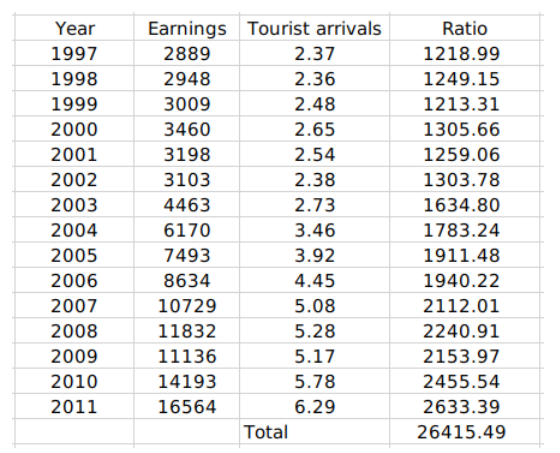
Let ‘R’ be the ratio of Foreign Exchange Earnings from Tourism in India (in US $ million) to Foreign Tourist Arrivals in India (in million). Assume that R increases linearly over the years. If we draw a pie chart of R for all the years, the angle subtended by the biggest sector in the pie chart would be approximately:
If we try to plot a pie chart using the values of R for all the years, 2011 will subtend maximum value since its R value is maximum among all the years.
Angle = $$\frac{2633.39}{26415.49}\times\ 360^0$$
=35.88 = $$36^{0}$$ approximately.
C is the correct answer.
Answer the questions based on the following information given below.
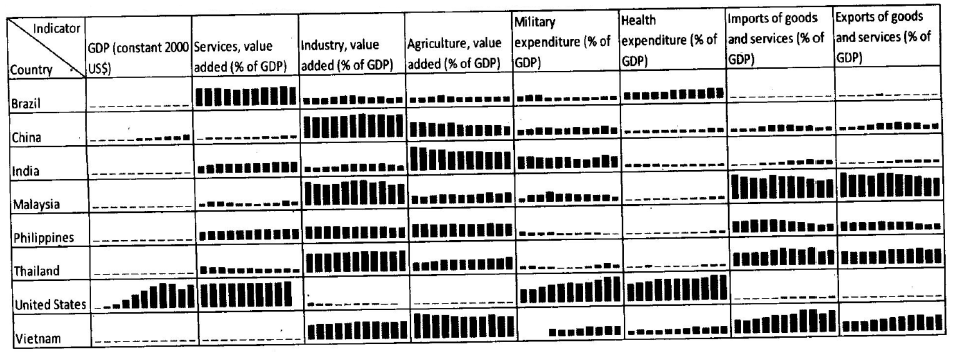
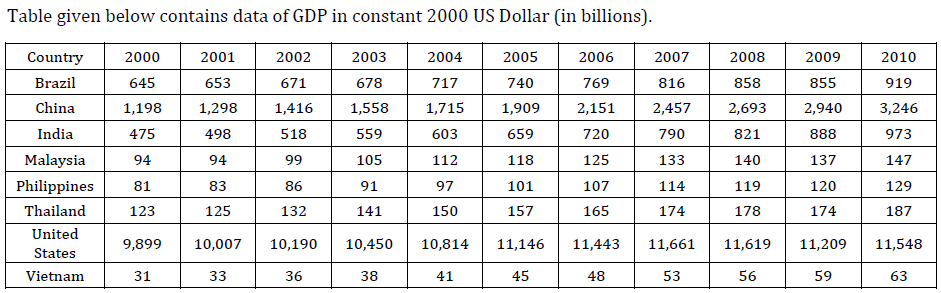
The exhibit given below compares the countries (first column) on different economic indicators (first row), from 2000-2010. A bar represents data for one year and a missing bar indicates missing data. Within an indicator, all countries have same scale.
Which of the following countries, after United States, has the highest spending on military as % of GDP, in the period 2000-2010?
After the USA, we have to find a country with the highest spending on the Military as a % of GDP.
From the chart for Military Expenditure, it can be easily seen that the bar graph for India is higher than any other country except the USA.
Hence, option C is the answer.
Which country (and which year) has witnessed maximum year-to-year decline in “industry as percentage of GDP”? Given that the maximum value of industry as percentage of GDP is 49.7% and the minimum value of industry as percentage of GDP is 20.02%, in the chart above.
This change can be observed by viewing the chart.
Where all other countries saw a gradual drop in their “industry as a % of GDP”, for Malaysia in 2008-09, the fall was sudden and had the maximum value among the options.
Hence, option D is the answer.
Which of the following countries has shown maximum increase in the “services, value added as % of GDP” from year 2000 to year 2010?
From the chart for “services, value-added as a % of GDP” we can see that every other country, except India, has a constant value or decrease from 2000-10, whereas India shows a slow but gradual increase.
Hence, option B is the answer.
Answer the questions based on the trends lines from the following graphs.
Note: Left side of X axis represents countries that are “poor” and right side of X axis represents countries that are “rich”, for each region. GDP is based on purchasing power parity (PPP).
These are World Bank (WB) estimates.

Which of the following could be the correct ascending order of democratic regions for poor?
We have to mark the option which displays an ascending order of democratic regions for the poor.
From the charts, we can see that the lowest value is displayed by C & E Europe (<5).
Option D has C & E Europe as the first name, so it could be the answer. Checking the remaining regions in option D, we get Africa (approx. 10), South America (14), Western Europe (19.99) and Scandinavia (20).
Thus, the order should be C&E Europe, Africa, South America, Western Europe and Scandinavia.
Hence, option D is the answer.
Which region has the highest disparity, of democratic participation, between rich and poor?
We have to find the region with the highest disparity in democratic participation between rich and poor. We can check this by calculating the difference between the highest and lowest values from the chart.
North America = 20 - 18 = 2
C&E Europe = 20 - 5 = 15
Africa = 11 - 10 = 1
South America = 20 - 14 = 6
Western Europe = 19.95 - 19.85 = 0.1
Thus, C&E Europe has the highest disparity between the rich and the poor.
Hence, option B is the answer.
The maximum GDP of African region is higher than the maximum GDP of South American region by factor of:
From the graph, we can say that the maximum GDP of African and South American region has the same value. i.e 9.5
So E is the correct answer.
Educational materials for CAT preparation