For the following questions answer them individually
A block is placed on a rough horizontal plane. A time dependent horizontal force $$F = kt$$ acts on the block, where k is a positive constant. The acceleration - time graph of the block is :
The maximum range of a bullet fired from a toy pistol mounted on a car at rest is $$R_0 = 40$$ m. What will be the acute angle of inclination of the pistol for maximum range when the car is moving in the direction of firing with uniform velocity $$v = 20$$ m/s on a horizontal surface? ($$g = 10$$ m/s$$^2$$)
A wind-powered generator converts wind energy into electrical energy. Assume that the generator converts a fixed fraction of the wind energy intercepted by its blades into electrical energy. For wind speed $$v$$, the electrical power output will be most likely proportional to
A ring of mass M and radius R is rotating about its axis with angular velocity $$\omega$$. Two identical bodies each of mass m are now gently attached at the two ends of a diameter of the ring. Because of this, the kinetic energy loss will be :
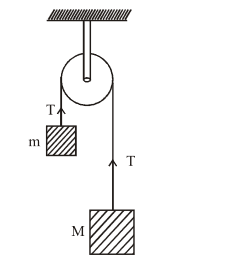
Two blocks of masses m and M are connected by means of a metal wire of cross-sectional area A passing over a frictionless fixed pulley as shown in the figure. The system is then released. If M = 2m, then the stress produced in the wire is:
In an experiment, a small steel ball falls through a liquid at a constant speed of 10 cm/s. If the steel ball is pulled upward with a force equal to twice its effective weight, how fast will it move upward?
A mass of 50 g of water in a closed vessel, with surroundings at a constant temperature from 30°C to 25°C takes 2 minutes to cool. A mass of 100 g of another liquid in an identical vessel with identical surroundings takes the same time to cool from 30°C to 25°C. The specific heat of the liquid is : (The water equivalent of the vessel is 30 g.)
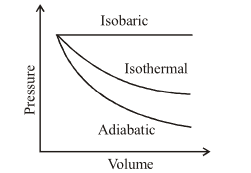
A sample of gas expands from $$V_1$$ to $$V_2$$. In which of the following, the work done will be greatest?
In the isothermal expansion of 10 g of gas from volume V to 2V the work done by the gas is 575 J. What is the root mean square speed of the molecules of the gas at that temperature?
A uniform cylinder of length L and mass M having cross-sectional area A is suspended, with its length vertical, from a fixed point by a massless spring, such that it is half submerged in a liquid of density $$\sigma$$ at equilibrium position. When the cylinder is given a downward push and released, it starts oscillating vertically with a small amplitude. The time period T of the oscillations of the cylinder will be :