
Join Our JEE Preparation Group
Prep with like-minded aspirants; Get access to free daily tests and study material.
Sign in
Please select an account to continue using cracku.in
↓ →
Join Our JEE Preparation Group
Prep with like-minded aspirants; Get access to free daily tests and study material.
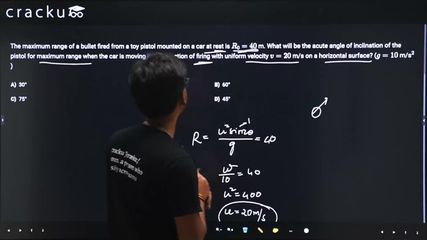
The maximum range of a bullet fired from a toy pistol mounted on a car at rest is $$R_0 = 40$$ m. What will be the acute angle of inclination of the pistol for maximum range when the car is moving in the direction of firing with uniform velocity $$v = 20$$ m/s on a horizontal surface? ($$g = 10$$ m/s$$^2$$)
The maximum range when the car is at rest is given as $$ R_0 = 40 $$ m, and gravity $$ g = 10 $$ m/s². For a projectile fired from ground level, the maximum range occurs at an angle of 45°. The range formula is $$ R = \frac{u^2 \sin 2\theta}{g} $$. At 45°, $$ \sin 90^\circ = 1 $$, so:
$$ R_0 = \frac{u^2}{g} $$
$$ 40 = \frac{u^2}{10} $$
$$ u^2 = 400 $$
$$ u = 20 \text{ m/s} $$
Thus, the initial speed of the bullet relative to the pistol is 20 m/s.
Now, the car moves with uniform velocity $$ v = 20 $$ m/s in the direction of firing. The pistol is mounted on the car, so the bullet's initial velocity relative to the ground has two components:
The time of flight $$ T $$ is determined by the vertical motion. The bullet lands at the same level, so vertical displacement is zero:
$$ s_y = v_y T - \frac{1}{2} g T^2 = 0 $$
$$ (20 \sin \theta) T - \frac{1}{2} \times 10 \times T^2 = 0 $$
$$ 20 \sin \theta T - 5 T^2 = 0 $$
$$ 5T (4 \sin \theta - T) = 0 $$
Ignoring $$ T = 0 $$ (initial time), we get:
$$ T = 4 \sin \theta \text{ seconds} $$
The horizontal range $$ R $$ is the product of horizontal velocity and time of flight:
$$ R = v_x \times T = (20 + 20 \cos \theta) \times (4 \sin \theta) $$
$$ R = 80 (1 + \cos \theta) \sin \theta $$
To maximize $$ R $$, we maximize the function $$ f(\theta) = (1 + \cos \theta) \sin \theta $$. Expanding:
$$ f(\theta) = \sin \theta + \sin \theta \cos \theta $$
Using $$ \sin \theta \cos \theta = \frac{1}{2} \sin 2\theta $$:
$$ f(\theta) = \sin \theta + \frac{1}{2} \sin 2\theta $$
Differentiate with respect to $$ \theta $$:
$$ f'(\theta) = \cos \theta + \frac{1}{2} \times 2 \cos 2\theta = \cos \theta + \cos 2\theta $$
Set the derivative to zero for maximum:
$$ \cos \theta + \cos 2\theta = 0 $$
Using the identity $$ \cos 2\theta = 2 \cos^2 \theta - 1 $$:
$$ \cos \theta + (2 \cos^2 \theta - 1) = 0 $$
$$ 2 \cos^2 \theta + \cos \theta - 1 = 0 $$
Substitute $$ x = \cos \theta $$:
$$ 2x^2 + x - 1 = 0 $$
Solve the quadratic equation:
$$ x = \frac{ -1 \pm \sqrt{1^2 - 4 \times 2 \times (-1)} }{4} = \frac{ -1 \pm \sqrt{9} }{4} = \frac{ -1 \pm 3 }{4} $$
So:
$$ x = \frac{2}{4} = \frac{1}{2} \quad \text{or} \quad x = \frac{-4}{4} = -1 $$
Thus, $$ \cos \theta = \frac{1}{2} $$ or $$ \cos \theta = -1 $$. Since $$ \theta $$ is acute (0° to 90°), we discard $$ \cos \theta = -1 $$ (which gives $$ \theta = 180^\circ $$, not acute). Therefore:
$$ \cos \theta = \frac{1}{2} \quad \Rightarrow \quad \theta = 60^\circ $$
Verification: At $$ \theta = 60^\circ $$, $$ v_x = 20 + 20 \cos 60^\circ = 20 + 20 \times 0.5 = 30 $$ m/s, $$ v_y = 20 \sin 60^\circ = 20 \times \frac{\sqrt{3}}{2} = 10\sqrt{3} $$ m/s, time of flight $$ T = 4 \sin 60^\circ = 4 \times \frac{\sqrt{3}}{2} = 2\sqrt{3} $$ s, and range $$ R = 30 \times 2\sqrt{3} = 60\sqrt{3} \approx 103.92 $$ m. At other angles like 45° and 90°, the range is less (approximately 96.59 m and 80 m, respectively), confirming that 60° gives the maximum range.
Hence, the correct answer is Option B.
Was this solution helpful?
Click on the Email ☝️ to Watch the Video Solution
Create a FREE account and get:
_1.webp)

Educational materials for JEE preparation

Ask our AI anything

AI can make mistakes. Please verify important information.
AI can make mistakes. Please verify important information.
