
Join Our JEE Preparation Group
Prep with like-minded aspirants; Get access to free daily tests and study material.
Sign in
Please select an account to continue using cracku.in
↓ →
Join Our JEE Preparation Group
Prep with like-minded aspirants; Get access to free daily tests and study material.
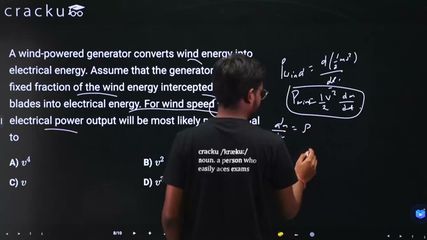
A wind-powered generator converts wind energy into electrical energy. Assume that the generator converts a fixed fraction of the wind energy intercepted by its blades into electrical energy. For wind speed $$v$$, the electrical power output will be most likely proportional to
The wind-powered generator converts a fixed fraction of the wind energy intercepted by its blades into electrical energy. To find how the electrical power output depends on wind speed $$ v $$, we need to determine the power available from the wind.
The kinetic energy of a mass $$ m $$ of air moving at speed $$ v $$ is given by $$ \frac{1}{2} m v^2 $$. Power is energy per unit time, so the power from the wind is the rate at which this kinetic energy is delivered to the blades. This can be expressed as:
$$ P_{\text{wind}} = \frac{d}{dt} \left( \frac{1}{2} m v^2 \right) $$
Since the wind speed $$ v $$ is constant, we can factor it out:
$$ P_{\text{wind}} = \frac{1}{2} v^2 \frac{dm}{dt} $$
Here, $$ \frac{dm}{dt} $$ is the mass flow rate of air passing through the blades per unit time. The mass flow rate depends on the density of air $$ \rho $$, the area $$ A $$ swept by the blades, and the wind speed $$ v $$. The volume of air passing through area $$ A $$ per unit time is $$ A v $$, so the mass flow rate is:
$$ \frac{dm}{dt} = \rho \times A v $$
Substituting this into the power expression:
$$ P_{\text{wind}} = \frac{1}{2} v^2 \times (\rho A v) = \frac{1}{2} \rho A v^3 $$
Thus, the power available from the wind is proportional to $$ v^3 $$.
The problem states that the generator converts a fixed fraction of this intercepted wind energy into electrical energy. Let this fixed fraction (efficiency) be $$ \eta $$. The electrical power output is then:
$$ P_{\text{electrical}} = \eta \times P_{\text{wind}} = \eta \times \frac{1}{2} \rho A v^3 $$
Since $$ \eta $$, $$ \rho $$, and $$ A $$ are constants for a given generator and location, the electrical power output is proportional to $$ v^3 $$.
Therefore, the electrical power output is most likely proportional to $$ v^3 $$. Comparing with the options:
A. $$ v^4 $$
B. $$ v^2 $$
C. $$ v $$
D. $$ v^3 $$
Hence, the correct answer is Option D.
Was this solution helpful?
Click on the Email ☝️ to Watch the Video Solution
Create a FREE account and get:
_1.webp)

Educational materials for JEE preparation

Ask our AI anything

AI can make mistakes. Please verify important information.
AI can make mistakes. Please verify important information.
