
Join Our JEE Preparation Group
Prep with like-minded aspirants; Get access to free daily tests and study material.
Sign in
Please select an account to continue using cracku.in
↓ →
Join Our JEE Preparation Group
Prep with like-minded aspirants; Get access to free daily tests and study material.
Consider the system of equations : $$x + ay = 0$$, $$y + az = 0$$ and $$z + ax = 0$$. Then the set of all real values of 'a' for which the system has a unique solution is:
We are given the system of equations:
This is a homogeneous system because all equations equal zero. For a homogeneous system to have a unique solution (which must be the trivial solution $$ x = 0 $$, $$ y = 0 $$, $$ z = 0 $$), the coefficient matrix must be invertible. This happens when its determinant is non-zero.
First, write the system in matrix form:
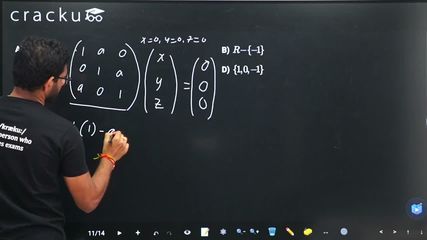
$$ \begin{pmatrix} 1 & a & 0 \\ 0 & 1 & a \\ a & 0 & 1 \\ \end{pmatrix} \begin{pmatrix} x \\ y \\ z \\ \end{pmatrix} = \begin{pmatrix} 0 \\ 0 \\ 0 \\ \end{pmatrix} $$
The coefficient matrix is:
$$ A = \begin{pmatrix} 1 & a & 0 \\ 0 & 1 & a \\ a & 0 & 1 \\ \end{pmatrix} $$
Now, compute the determinant of matrix $$ A $$. For a 3x3 matrix:
$$ \det(A) = a_{11}(a_{22}a_{33} - a_{23}a_{32}) - a_{12}(a_{21}a_{33} - a_{23}a_{31}) + a_{13}(a_{21}a_{32} - a_{22}a_{31}) $$
Substitute the elements:
So,
$$ \det(A) = 1 \cdot (1 \cdot 1 - a \cdot 0) - a \cdot (0 \cdot 1 - a \cdot a) + 0 \cdot (0 \cdot 0 - 1 \cdot a) $$
Simplify each part:
Therefore,
$$ \det(A) = 1 + a^3 + 0 = 1 + a^3 $$
For a unique solution, $$ \det(A) \neq 0 $$:
$$ 1 + a^3 \neq 0 $$
Solve:
$$ a^3 \neq -1 $$
$$ a \neq -1 $$
Now, verify the case when $$ a = -1 $$:
So, $$ x = y = z $$, meaning infinitely many solutions exist (not unique).
For any other real value of $$ a $$, such as $$ a = 0 $$ or $$ a = 1 $$, the system has only the trivial solution (as shown by substitution). Thus, the system has a unique solution for all real $$ a $$ except $$ a = -1 $$.
The set of all real values of $$ a $$ for which the system has a unique solution is $$ \mathbb{R} - \{-1\} $$.
Comparing with the options:
Hence, the correct answer is Option B.
Click on the Email ☝️ to Watch the Video Solution
Create a FREE account and get:
_1.webp)

Educational materials for JEE preparation

Ask our AI anything

AI can make mistakes. Please verify important information.
AI can make mistakes. Please verify important information.


