
Join Our JEE Preparation Group
Prep with like-minded aspirants; Get access to free daily tests and study material.
Sign in
Please select an account to continue using cracku.in
↓ →
Join Our JEE Preparation Group
Prep with like-minded aspirants; Get access to free daily tests and study material.
In an experiment on photoelectric effect, a student plots stopping potential $$V_0$$ against reciprocal of the wavelength $$\lambda$$ of the incident light for two different metals A and B. These are shown in the figure.
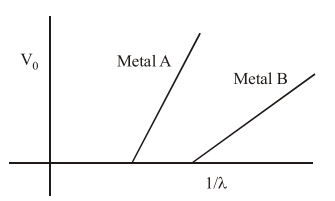
Looking at the graphs, you can most appropriately say that:
In the photoelectric effect, the stopping potential $$ V_0 $$ is related to the reciprocal of the wavelength $$ \lambda $$ of the incident light. The photoelectric equation is given by:
$$ eV_0 = h\nu - \phi $$
where $$ e $$ is the charge of an electron, $$ h $$ is Planck's constant, $$ \nu $$ is the frequency of the light, and $$ \phi $$ is the work function of the metal. The frequency $$ \nu $$ can be expressed in terms of wavelength $$ \lambda $$ using the speed of light $$ c $$:
$$ \nu = \frac{c}{\lambda} $$
Substituting this into the equation:
$$ eV_0 = h \cdot \frac{c}{\lambda} - \phi $$
Rearranging for $$ V_0 $$:
$$ eV_0 = \frac{hc}{\lambda} - \phi $$
$$ V_0 = \frac{hc}{e} \cdot \frac{1}{\lambda} - \frac{\phi}{e} $$
This equation shows that $$ V_0 $$ is linearly proportional to $$ \frac{1}{\lambda} $$. The slope of the line is $$ \frac{hc}{e} $$, which is a constant because $$ h $$, $$ c $$, and $$ e $$ are fundamental constants. Therefore, for any metal, the slope of the graph of $$ V_0 $$ versus $$ \frac{1}{\lambda} $$ must be the same.
When plotting this graph for two different metals A and B, the lines should be parallel because the slope $$ \frac{hc}{e} $$ is identical for both. The only difference between the metals is in the work function $$ \phi $$, which affects the intercept on the $$ V_0 $$-axis (which is $$ -\frac{\phi}{e} $$).
Now, examining the options:
Option A claims that the work function of metal B is greater than that of metal A. Option C claims the opposite. However, without knowing the relative positions of the lines (i.e., which line has a more negative intercept), we cannot determine which metal has a larger work function. Therefore, neither A nor C can be conclusively said.
Option B states that for light of a certain wavelength, the maximum kinetic energy of electrons emitted from metal A is greater than from metal B. The maximum kinetic energy $$ K_{\text{max}} $$ is given by $$ eV_0 $$, so it depends on the stopping potential. For a fixed wavelength, $$ K_{\text{max}} = h\nu - \phi $$. This means that the metal with the smaller work function will have a larger $$ K_{\text{max}} $$. Without knowing which metal has the smaller work function, we cannot say that A will always have a greater $$ K_{\text{max}} $$ than B. Thus, option B is not necessarily true.
Option D states that the student's data is not correct. Since the slope $$ \frac{hc}{e} $$ must be the same for both metals, the graphs should show two parallel lines. If the student's plots show lines with different slopes, this violates the fundamental photoelectric equation, indicating an error in the data or experiment. Therefore, if the graphs are not parallel, the data is incorrect.
Given that the question asks what we can most appropriately say by looking at the graphs, and without specific details on the lines' slopes or intercepts, the only universally applicable statement is that if the slopes differ, the data must be incorrect. Hence, option D is the most appropriate choice.
Hence, the correct answer is Option D.
Was this solution helpful?
Create a FREE account and get:
_1.webp)

Educational materials for JEE preparation

Ask our AI anything

AI can make mistakes. Please verify important information.
AI can make mistakes. Please verify important information.
