
Join Our JEE Preparation Group
Prep with like-minded aspirants; Get access to free daily tests and study material.
Sign in
Please select an account to continue using cracku.in
↓ →
Join Our JEE Preparation Group
Prep with like-minded aspirants; Get access to free daily tests and study material.
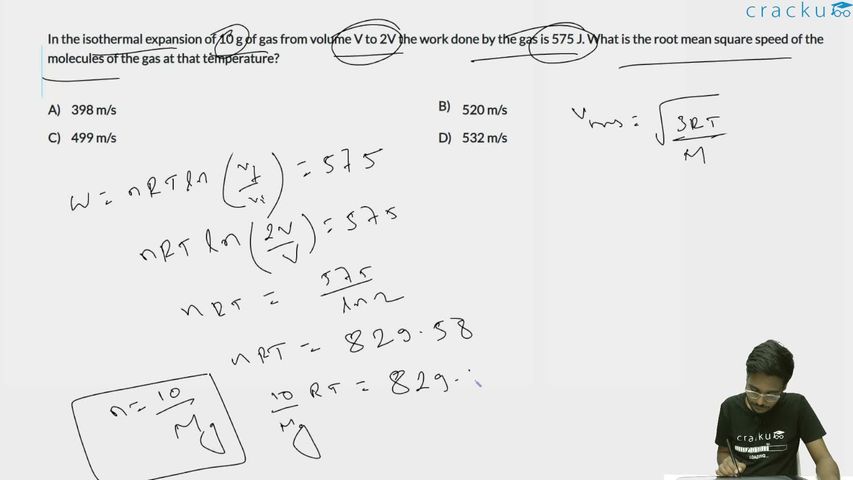
In the isothermal expansion of 10 g of gas from volume V to 2V the work done by the gas is 575 J. What is the root mean square speed of the molecules of the gas at that temperature?
In this problem, we are given that 10 grams of gas undergoes an isothermal expansion from volume $$V$$ to $$2V$$, and the work done by the gas is 575 J. We need to find the root mean square speed of the molecules at that temperature.
First, recall that in an isothermal process, the temperature remains constant. For an ideal gas, the work done $$W$$ during isothermal expansion is given by:
$$ W = nRT \ln\left(\frac{V_f}{V_i}\right) $$
Here, the initial volume $$V_i = V$$ and the final volume $$V_f = 2V$$, so $$\frac{V_f}{V_i} = 2$$. Therefore:
$$ W = nRT \ln(2) $$
We know $$W = 575$$ J and $$\ln(2) \approx 0.693147$$. Substituting these values:
$$ 575 = nRT \times 0.693147 $$
Solving for $$nRT$$:
$$ nRT = \frac{575}{0.693147} \approx 829.54986 \text{ J} $$
The number of moles $$n$$ is related to the mass and molar mass. The mass of the gas is 10 grams. Let $$M_g$$ be the molar mass in grams per mole. Then:
$$ n = \frac{\text{mass}}{M_g} = \frac{10}{M_g} $$
Substituting into the expression for $$nRT$$:
$$ \left(\frac{10}{M_g}\right) RT = 829.54986 $$
Solving for $$\frac{RT}{M_g}$$:
$$ \frac{RT}{M_g} = \frac{829.54986}{10} = 82.954986 \text{ J/g} $$
The root mean square speed $$v_{\text{rms}}$$ is given by:
$$ v_{\text{rms}} = \sqrt{\frac{3RT}{M_{\text{kg}}}} $$
where $$M_{\text{kg}}$$ is the molar mass in kilograms per mole. Since $$M_{\text{kg}} = \frac{M_g}{1000}$$ (because 1 kg = 1000 g), we can write:
$$ v_{\text{rms}} = \sqrt{\frac{3RT}{\frac{M_g}{1000}}} = \sqrt{\frac{3RT \times 1000}{M_g}} = \sqrt{1000 \times 3 \times \frac{RT}{M_g}} $$
Substituting $$\frac{RT}{M_g} = 82.954986$$ J/g:
$$ v_{\text{rms}} = \sqrt{1000 \times 3 \times 82.954986} = \sqrt{1000 \times 248.864958} = \sqrt{248864.958} $$
Now, calculate the square root of 248864.958. We know that $$498^2 = 248004$$ and $$499^2 = 249001$$. Since 248864.958 is between these values, we interpolate:
Difference from $$498^2$$: $$248864.958 - 248004 = 860.958$$
Difference between $$499^2$$ and $$498^2$$: $$249001 - 248004 = 997$$
The increment $$x$$ above 498 satisfies:
$$ (498 + x)^2 = 498^2 + 2 \times 498 \times x + x^2 = 248004 + 996x + x^2 = 248864.958 $$
So:
$$ 996x + x^2 = 860.958 $$
Approximating (since $$x^2$$ is small):
$$ 996x \approx 860.958 $$
$$ x \approx \frac{860.958}{996} \approx 0.864414 $$
Thus:
$$ v_{\text{rms}} \approx 498 + 0.864414 = 498.864414 \text{ m/s} $$
This value is approximately 498.86 m/s, which rounds to 499 m/s.
Comparing with the options:
A. 398 m/s
B. 520 m/s
C. 499 m/s
D. 532 m/s
The value 498.86 m/s is closest to 499 m/s.
Hence, the correct answer is Option C.
Click on the Email ☝️ to Watch the Video Solution
Create a FREE account and get:
_1.webp)

Educational materials for JEE preparation

Ask our AI anything

AI can make mistakes. Please verify important information.
AI can make mistakes. Please verify important information.


