
Join Our JEE Preparation Group
Prep with like-minded aspirants; Get access to free daily tests and study material.
Sign in
Please select an account to continue using cracku.in
↓ →
Join Our JEE Preparation Group
Prep with like-minded aspirants; Get access to free daily tests and study material.
If $$p$$ and $$q$$ are non-zero real numbers and $$\alpha^3 + \beta^3 = -p$$, $$\alpha\beta = q$$, then a quadratic equation whose roots are $$\frac{\alpha^2}{\beta}$$, $$\frac{\beta^2}{\alpha}$$ is :
We are given that $$p$$ and $$q$$ are non-zero real numbers, and we have the equations $$\alpha^3 + \beta^3 = -p$$ and $$\alpha\beta = q$$. We need to find a quadratic equation with roots $$\frac{\alpha^2}{\beta}$$ and $$\frac{\beta^2}{\alpha}$$.
For a quadratic equation with roots $$r$$ and $$s$$, it can be written as $$x^2 - (r+s)x + (rs) = 0$$. So, let $$r = \frac{\alpha^2}{\beta}$$ and $$s = \frac{\beta^2}{\alpha}$$. We need to find the sum $$r+s$$ and the product $$rs$$.
First, compute the product $$rs$$:
$$$ rs = \left( \frac{\alpha^2}{\beta} \right) \times \left( \frac{\beta^2}{\alpha} \right) = \frac{\alpha^2 \beta^2}{\alpha \beta} = \alpha \beta. $$$
Since $$\alpha\beta = q$$, we have $$rs = q$$.
Next, compute the sum $$r+s$$:
$$$ r + s = \frac{\alpha^2}{\beta} + \frac{\beta^2}{\alpha}. $$$
To add these fractions, find a common denominator, which is $$\alpha\beta$$:
$$$ \frac{\alpha^2}{\beta} = \frac{\alpha^2 \cdot \alpha}{\beta \cdot \alpha} = \frac{\alpha^3}{\alpha\beta}, \quad \frac{\beta^2}{\alpha} = \frac{\beta^2 \cdot \beta}{\alpha \cdot \beta} = \frac{\beta^3}{\alpha\beta}. $$$
So,
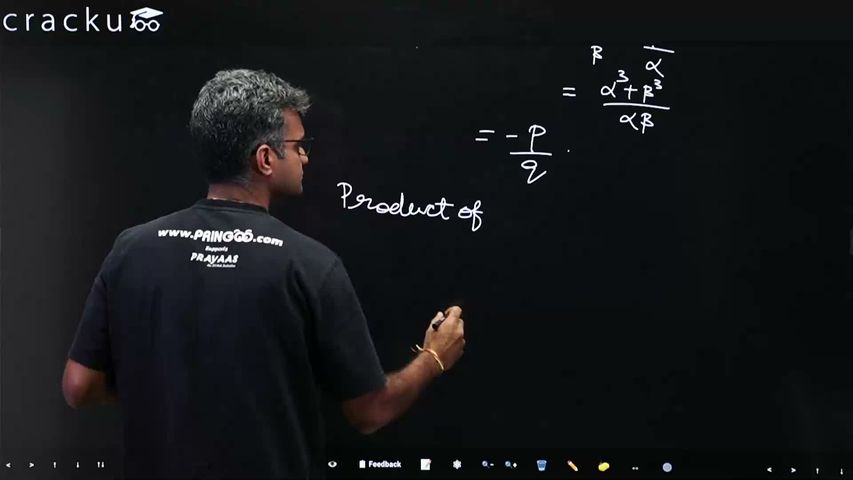
$$$ r + s = \frac{\alpha^3}{\alpha\beta} + \frac{\beta^3}{\alpha\beta} = \frac{\alpha^3 + \beta^3}{\alpha\beta}. $$$
Given $$\alpha^3 + \beta^3 = -p$$ and $$\alpha\beta = q$$, substitute:
$$$ r + s = \frac{-p}{q} = -\frac{p}{q}. $$$
Now, the quadratic equation with sum of roots $$-\frac{p}{q}$$ and product of roots $$q$$ is:
$$$ x^2 - \left( -\frac{p}{q} \right)x + q = 0 \quad \rightarrow \quad x^2 + \frac{p}{q}x + q = 0. $$$
To eliminate the fraction, multiply every term by $$q$$ (since $$q \neq 0$$):
$$$ q \cdot x^2 + q \cdot \frac{p}{q}x + q \cdot q = 0 \quad \rightarrow \quad qx^2 + px + q^2 = 0. $$$
Comparing with the options:
A. $$px^2 - qx + p^2 = 0$$
B. $$qx^2 + px + q^2 = 0$$
C. $$px^2 + qx + p^2 = 0$$
D. $$qx^2 - px + q^2 = 0$$
The equation $$qx^2 + px + q^2 = 0$$ matches option B.
Hence, the correct answer is Option B.
Was this solution helpful?
Click on the Email ☝️ to Watch the Video Solution
Create a FREE account and get:
_1.webp)

Educational materials for JEE preparation

Ask our AI anything

AI can make mistakes. Please verify important information.
AI can make mistakes. Please verify important information.
