NTA JEE Main 15th April 2018 Shift 2
For the following questions answer them individually
NTA JEE Main 15th April 2018 Shift 2 - Question 21
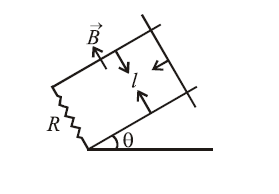
A copper rod of mass m slides under gravity on two smooth parallel rails, with separation l and set at an angle of $$\theta$$ with the horizontal. At the bottom, rails are joined by a resistance R. There is a uniform magnetic field B normal to the plane of the rails, as shown in the figure. The terminal speed of the copper rod is:
NTA JEE Main 15th April 2018 Shift 2 - Question 22
At the centre of a fixed large circular coil of radius R, a much smaller circular coil of radius r is placed. The two coils are concentric and are in the same plane. The larger coil carries a current I. The smaller coil is set to rotate with a constant angular velocity $$\omega$$ about an axis along their common diameter. Calculate the emf induced in the smaller coil after a time t of its start of rotation.
NTA JEE Main 15th April 2018 Shift 2 - Question 23
A plane polarized monochromatic EM wave is travelling a vacuum along z direction such that at t = t$$_1$$ it is found that the electric field is zero at a spatial point z$$_1$$. The next zero that occurs in its neighbourhood is at z$$_2$$. The frequency of the electromagnetic wave is:

NTA JEE Main 15th April 2018 Shift 2 - Question 24
A convergent doublet of separated lenses, corrected for spherical aberration, has resultant focal length of 10 cm. The separation between the two lenses is 2 cm. The focal lengths of the component lenses are:
NTA JEE Main 15th April 2018 Shift 2 - Question 25
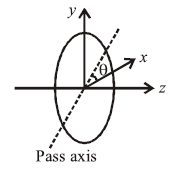
A plane polarized light is incident on a polariser with its pass axis making angle $$\theta$$ with x-axis, as shown in the figure. At four different values of $$\theta$$, $$\theta$$ = 8$$^\circ$$, 38$$^\circ$$, 188$$^\circ$$ and 218$$^\circ$$, the observed intensities are same. What is the angle between the direction of polarization and x-axis?
NTA JEE Main 15th April 2018 Shift 2 - Question 26
If the de Broglie wavelengths associated with a proton and an $$\alpha$$-particle are equal, then the ratio of velocities of the proton and the $$\alpha$$-particle will be:
NTA JEE Main 15th April 2018 Shift 2 - Question 27
Muon ($$\mu^{-1}$$) is negatively charged (|q| = |e|) with a mass m$$_\mu$$ = 200 m$$_e$$, where m$$_e$$ is the mass of the electron and e is the electronic charge. If $$\mu^{-1}$$ is bound to a proton to form a hydrogen like atom, identify the correct statements:
(A) Radius of the muonic orbit is 200 times smaller than that of the electron
(B) The speed of the $$\mu^{-1}$$ in the nth orbit is $$\frac{1}{200}$$ times that of the electron in the nth orbit
(C) The ionization energy of muonic atom is 200 times more than that of an hydrogen atom
(D) The momentum of the muon in the nth orbit is 200 times more than that of the electron
NTA JEE Main 15th April 2018 Shift 2 - Question 28
An unstable heavy nucleus at rest breaks into two nuclei which move away with velocities in the ratio of 8 : 27. The ratio of the radii of the nuclei (assumed to be spherical) is:
NTA JEE Main 15th April 2018 Shift 2 - Question 29
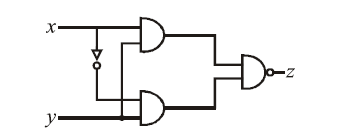
Truth table for the given circuit will be:
NTA JEE Main 15th April 2018 Shift 2 - Question 30
The carrier frequency of a transmitter is provided by a tank circuit of a coil of inductance 49$$\mu$$H and a capacitance of 2.5 nF. It is modulated by an audio signal of 12 kHz. The frequency range occupied by the side bands is: