
Join Our JEE Preparation Group
Prep with like-minded aspirants; Get access to free daily tests and study material.
Sign in
Please select an account to continue using cracku.in
↓ →
Join Our JEE Preparation Group
Prep with like-minded aspirants; Get access to free daily tests and study material.
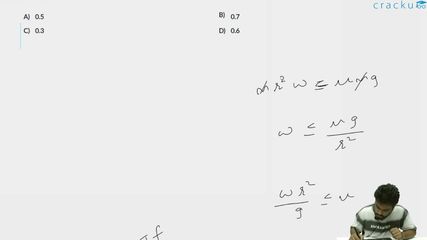
A disc rotates about its axis of symmetry in a horizontal plane at a steady rate of 3.5 revolutions per second. A coin placed at a distance of 1.25 cm from the axis of rotation remains at rest on the disc. The coefficient of friction between the coin and the disc is (g = 10 m/s$$^2$$)
We begin by noting that the coin can stay at rest on the rotating disc only if the static frictional force supplies the entire centripetal force required for circular motion.
First, let us write the expressions for the two forces.
Formula for the required centripetal force on a body of mass $$m$$ moving in a circle of radius $$r$$ with angular speed $$\omega$$ is
$$F_{\text{centripetal}} = m r \omega^{2}.$$
The maximum static frictional force that can act is given by
$$F_{\text{friction(max)}} = \mu_s \, N,$$
where $$\mu_s$$ is the coefficient of static friction and $$N$$ is the normal reaction. Because the disc is horizontal, the normal reaction equals the weight, so
$$N = m g.$$
Hence, the limiting value of static friction is
$$F_{\text{friction(max)}} = \mu_s \, m g.$$
For the coin not to slide, we must have
$$F_{\text{friction(max)}} \ge F_{\text{centripetal}}.$$
Substituting the formulae, we get
$$\mu_s \, m g \ge m r \omega^{2}.$$
The mass $$m$$ cancels out, giving
$$\mu_s \ge \dfrac{r \omega^{2}}{g}.$$
Because we need the minimum value that just satisfies the equality, we take
$$\mu_s = \dfrac{r \omega^{2}}{g}.$$
Now we insert the numerical values. The linear frequency of rotation is given as $$f = 3.5 \, \text{rev/s}.$$ Angular speed is related to frequency by the formula
$$\omega = 2\pi f.$$
So
$$\omega = 2\pi \times 3.5 = 7\pi \, \text{rad/s}.$$
Using $$\pi \approx 3.14$$, we find
$$\omega = 7 \times 3.14 \approx 21.98 \, \text{rad/s}.$$
Next, the radial distance is $$r = 1.25 \, \text{cm} = 0.0125 \, \text{m}.$$
Substituting these values in the expression for $$\mu_s$$, we have
$$\mu_s = \dfrac{0.0125 \times (21.98)^{2}}{10}.$$
First compute $$\omega^{2}$$:
$$(21.98)^{2} \approx 483.3.$$
Now evaluate the numerator:
$$0.0125 \times 483.3 \approx 6.041.$$
Finally, divide by $$g = 10 \, \text{m/s}^{2}$$:
$$\mu_s \approx \dfrac{6.041}{10} \approx 0.604.$$
Thus, the coefficient of static friction required is approximately $$0.6$$.
Hence, the correct answer is Option D.
Was this solution helpful?
Click on the Email ☝️ to Watch the Video Solution
Create a FREE account and get:
_1.webp)

Educational materials for JEE preparation

Ask our AI anything

AI can make mistakes. Please verify important information.
AI can make mistakes. Please verify important information.
