Join Our JEE Preparation Group
Prep with like-minded aspirants; Get access to free daily tests and study material.
Sign in
Please select an account to continue using cracku.in
↓ →
Join Our JEE Preparation Group
Prep with like-minded aspirants; Get access to free daily tests and study material.
The acidic strength of a carboxylic acid depends on how stable its conjugate base (carboxylate anion) is. Greater stability of the anion means stronger acidity because the equilibrium $$\ce{RCOOH \rightleftharpoons RCOO^- + H^+}$$ lies further to the right.
Stability of the anion is increased by electron-withdrawing groups (EWG, $$-I$$ effect) and decreased by electron-donating groups (EDG, $$+I$$ or $$+R$$ effects). Therefore:
• A strong EWG (-NO2) makes the anion most stable → strongest acid.
• A halogen (-Cl) has a strong $$-I$$ effect but a weak $$+R$$ effect; net result: more acidic than the unsubstituted compound.
• No substituent (-H) is taken as the reference, i.e. benzoic acid itself.
• A methyl group (-CH3) is an EDG due to its $$+I$$ effect; it destabilises the anion → weakest acid.
Assigning the given acids:
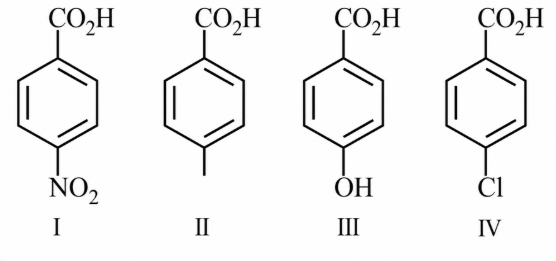
I : p-nitrobenzoic acid (strong EWG)
II: benzoic acid (no substituent)
III: p-methylbenzoic acid (EDG)
IV: p-chlorobenzoic acid (halogen EWG)
Accordingly, the stability of their conjugate bases (and hence their acidity) follows the order
$$\text{p-Me-C}_6\text{H}_4\text{COOH} \; \lt \; \text{C}_6\text{H}_5\text{COOH} \; \lt \; \text{p-Cl-C}_6\text{H}_4\text{COOH} \; \lt \; \text{p-NO}_2\text{-C}_6\text{H}_4\text{COOH}$$
That is, $$\text{III} \lt \text{II} \lt \text{IV} \lt \text{I}$$.
Hence the correct increasing order of acidity is Option A: III < II < IV < I.
Was this solution helpful?
Create a FREE account and get:


Educational materials for JEE preparation

Ask our AI anything

AI can make mistakes. Please verify important information.
AI can make mistakes. Please verify important information.