Join Our JEE Preparation Group
Prep with like-minded aspirants; Get access to free daily tests and study material.
Sign in
Please select an account to continue using cracku.in
↓ →
Join Our JEE Preparation Group
Prep with like-minded aspirants; Get access to free daily tests and study material.
During diazotisation, a primary aromatic amine $$ArNH_2$$ is first protonated to $$ArNH_3^{+}$$ in strong mineral acid and is then converted to the diazonium ion $$ArN_2^{+}$$ by $$NaNO_2$$ at $$0-5^{\circ}\text{C}$$.
The ease (rate) of diazotisation therefore follows the basicity of the amine: the more readily the nitrogen gets protonated, the faster the diazotisation step.
Basicity of an aromatic amine is governed by the electronic nature of the substituent attached to the benzene ring:
• Electron-withdrawing groups (−I and/or −R) pull electron density away from the ring and from the −NH₂ group, decreasing its basicity and hence retarding diazotisation.
• Electron-releasing groups (+I and/or +R) push electron density towards the −NH₂ group, increasing its basicity and hence facilitating diazotisation.
(A) contains the group $$−NHCOCH_3$$ (acetanilide). The carbonyl group draws electron density from nitrogen through a strong −R effect, making the lone pair on nitrogen least available for protonation. Hence (A) is the least basic and least reactive towards diazotisation.
Case D:(D) is $$p$$-chloroaniline. Chlorine shows a strong −I effect (electron withdrawal by induction) but a weak +R effect because of the poor overlap of the 3p orbital of Cl with the 2p orbital of the ring. Overall, the −I effect dominates and the amine is less basic than unsubstituted aniline, but not as deactivated as (A).
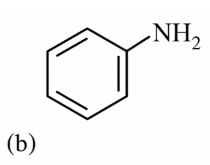
Case B:(B) is unsubstituted aniline. With no extra electron-withdrawing group, its basicity (and consequently its tendency to undergo diazotisation) is higher than that of (D) but lower than that of an amine bearing a strong electron-donating group.
Case C:(C) is $$p$$-methoxyaniline (or any aromatic amine with a strong +R donor such as −OCH₃). The methoxy group donates electron density to the ring and to the −NH₂ group through resonance, greatly increasing basicity. Therefore, it is the most easily diazotised among the four.
Collecting the above trends, the increasing order of ease of diazotisation is
$$(A) \lt (D) \lt (B) \lt (C).$$
Hence, the correct option is Option B which is: (A) < (D) < (B) < (C).
Was this solution helpful?
Create a FREE account and get:


Educational materials for JEE preparation

Ask our AI anything

AI can make mistakes. Please verify important information.
AI can make mistakes. Please verify important information.