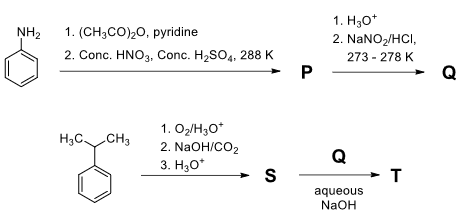
The given sequence starts from aniline and involves the standard reactions of aromatic amines containing a -$$NH_2$$ group.
Step 1 : Diazotisation
$$C_6H_5NH_2 \xrightarrow[\;0-5^{\circ}\text{C}\;]{NaNO_2/HCl} C_6H_5N_2^{+}Cl^{-}$$
The diazonium salt $$C_6H_5N_2^{+}Cl^{-}$$ is the first isolated product and is labelled P.
• P contains only one diazonium group and no $$NO_2$$ groups, hence it is not a dinitro compound. Therefore Option C is wrong.
Step 2 : Sandmeyer cyanation
$$C_6H_5N_2^{+}Cl^{-} \xrightarrow{CuCN/HCl} C_6H_5C\equiv N$$
The product of this Sandmeyer reaction is benzonitrile, designated Q.
Step 3 : Stephen reduction (SnCl2/HCl, ethanol)
In ethanol, stannous chloride and concentrated HCl reduce a nitrile to an iminium chloride (Stephen reaction):
$$C_6H_5C\equiv N \xrightarrow[\text{EtOH}]{SnCl_2/HCl} C_6H_5CH{=}NH\cdot HCl$$
The iminium chloride so obtained is compound S.
• S possesses no phenolic $$-OH$$ group, so it will not give the phthalein-dye (phenol) test. Hence Option B is wrong.
Step 4 : Hydrolysis of the iminium salt
$$C_6H_5CH{=}NH\cdot HCl \xrightarrow{H_2O,\; \Delta} C_6H_5CHO + NH_4Cl$$
The final product is benzaldehyde and is denoted T.
• Benzaldehyde is a colourless liquid, so T is not coloured; Option D is wrong.
Verification of the statements
A. Q (benzonitrile) on treatment with ethanol in the presence of $$SnCl_2/HCl$$ indeed furnishes benzaldehyde, an aromatic aldehyde. Correct.
B. False, as discussed.
C. False, P is a diazonium salt, not a dinitro compound.
D. False, benzaldehyde is colourless.
Hence the only correct choice is:
Option A which is: $$\mathbf{Q}$$ on treatment with ethanol generates an aromatic aldehyde.
 91- 6303239042