 JEE WhatsApp Group
Sign in
Please select an account to continue using cracku.in
↓ →
JEE WhatsApp Group

Join Our JEE Preparation Group
Prep with like-minded aspirants; Get access to free daily tests and study material.
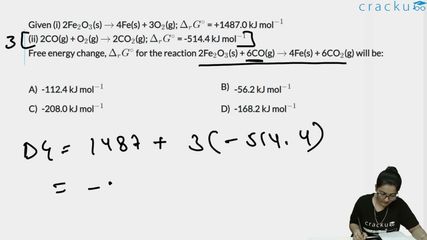
Given (i) 2Fe$$_2$$O$$_3$$(s) $$\rightarrow$$ 4Fe(s) + 3O$$_2$$(g); $$\Delta_r G^\circ$$ = +1487.0 kJ mol$$^{-1}$$
(ii) 2CO(g) + O$$_2$$(g) $$\rightarrow$$ 2CO$$_2$$(g); $$\Delta_r G^\circ$$ = -514.4 kJ mol$$^{-1}$$
Free energy change, $$\Delta_r G^\circ$$ for the reaction 2Fe$$_2$$O$$_3$$(s) + 6CO(g) $$\rightarrow$$ 4Fe(s) + 6CO$$_2$$(g) will be:
We have to find the standard Gibbs free-energy change, written as $$\Delta_r G^\circ,$$ for the target reaction
$$2\text{Fe}_2\text{O}_3(s) + 6\text{CO}(g) \;\longrightarrow\; 4\text{Fe}(s) + 6\text{CO}_2(g) \quad -(R)$$
First, we list the two elementary reactions given in the question along with their standard free-energy changes:
$$2\text{Fe}_2\text{O}_3(s) \;\longrightarrow\; 4\text{Fe}(s) + 3\text{O}_2(g), \qquad \Delta_r G_1^\circ = +1487.0\ \text{kJ mol}^{-1} \quad -(1)$$
$$2\text{CO}(g) + \text{O}_2(g) \;\longrightarrow\; 2\text{CO}_2(g), \qquad \Delta_r G_2^\circ = -514.4\ \text{kJ mol}^{-1} \quad -(2)$$
The laws of thermodynamics tell us that:
1. If a reaction is multiplied by an integer factor, its $$\Delta_r G^\circ$$ is multiplied by the same factor.
2. If reactions are added algebraically, their $$\Delta_r G^\circ$$ values add algebraically.
Our target reaction (R) contains $$6\text{CO}$$ and $$6\text{CO}_2$$, whereas reaction (2) involves only $$2\text{CO}$$ and $$2\text{CO}_2$$. So, to match the stoichiometry, we multiply reaction (2) by the integer $$3$$. Stating this explicitly:
We write “3 × (2)”:
$$3\Bigl[\,2\text{CO}(g) + \text{O}_2(g) \longrightarrow 2\text{CO}_2(g)\Bigr]$$
This gives
$$6\text{CO}(g) + 3\text{O}_2(g) \;\longrightarrow\; 6\text{CO}_2(g), \qquad \Delta_r G_{2,\text{multiplied}}^\circ = 3\times(-514.4)$$
$$\therefore\ \Delta_r G_{2,\text{multiplied}}^\circ = -1543.2\ \text{kJ mol}^{-1}$$
Now we add this new equation to reaction (1). Let us write them one below the other so that cancellation is clear:
Reaction (1): $$2\text{Fe}_2\text{O}_3(s) \;\longrightarrow\; 4\text{Fe}(s) + 3\text{O}_2(g)$$
3 × Reaction (2): $$6\text{CO}(g) + 3\text{O}_2(g) \;\longrightarrow\; 6\text{CO}_2(g)$$
Adding the left-hand sides and the right-hand sides, we obtain:
Left side: $$2\text{Fe}_2\text{O}_3(s) + 6\text{CO}(g) + 3\text{O}_2(g)$$
Right side: $$4\text{Fe}(s) + 3\text{O}_2(g) + 6\text{CO}_2(g)$$
The species $$3\text{O}_2(g)$$ appears on both sides, so it cancels out completely. After cancellation we are left with
$$2\text{Fe}_2\text{O}_3(s) + 6\text{CO}(g) \;\longrightarrow\; 4\text{Fe}(s) + 6\text{CO}_2(g)$$
which is exactly the desired overall reaction (R). Therefore, the correct $$\Delta_r G^\circ$$ for reaction (R) is simply the algebraic sum of the $$\Delta_r G^\circ$$ values we combined:
$$\Delta_r G^\circ(\text{R}) = \Delta_r G_1^\circ + \Delta_r G_{2,\text{multiplied}}^\circ$$
Substituting the numbers, we have
$$\Delta_r G^\circ(\text{R}) = (+1487.0)\ \text{kJ mol}^{-1} + (-1543.2)\ \text{kJ mol}^{-1}$$
$$\Delta_r G^\circ(\text{R}) = -56.2\ \text{kJ mol}^{-1}$$
Because the result is negative, the reaction is spontaneous under standard conditions. More importantly, we match this numerical value with the options given in the question.
Option B lists $$-56.2\ \text{kJ mol}^{-1}$$, which is exactly what we have calculated.
Hence, the correct answer is Option B.
Click on the Email ☝️ to Watch the Video Solution
Create a FREE account and get:
_1.webp)

Educational materials for JEE preparation

Ask our AI anything

AI can make mistakes. Please verify important information.
AI can make mistakes. Please verify important information.
