
Join Our JEE Preparation Group
Prep with like-minded aspirants; Get access to free daily tests and study material.
Sign in
Please select an account to continue using cracku.in
↓ →
Join Our JEE Preparation Group
Prep with like-minded aspirants; Get access to free daily tests and study material.
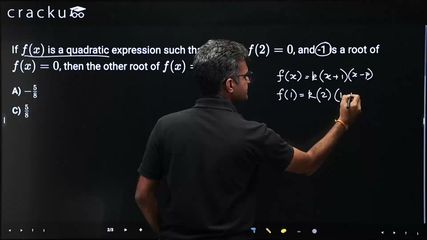
If $$f(x)$$ is a quadratic expression such that $$f(1) + f(2) = 0$$, and -1 is a root of $$f(x) = 0$$, then the other root of $$f(x) = 0$$ is:
Let us assume the quadratic expression can be written in its factored form as $$f(x)=k\,(x+1)(x-r)$$ where:
$$k\neq 0$$ is a non-zero constant (the leading coefficient),
$$x=-1$$ is one root given in the statement, so the factor $$x+1$$ is present, and
$$x=r$$ is the other root that we have to determine.
We now use the information $$f(1)+f(2)=0$$. First we evaluate $$f(1)$$:
$$f(1)=k\,(1+1)\,(1-r)=k\,(2)\,(1-r)=2k(1-r).$$
Next we evaluate $$f(2)$$:
$$f(2)=k\,(2+1)\,(2-r)=k\,(3)\,(2-r)=3k(2-r).$$
The condition $$f(1)+f(2)=0$$ therefore becomes
$$2k(1-r)+3k(2-r)=0.$$
Since $$k\neq 0$$, we can divide both sides by $$k$$, giving
$$2(1-r)+3(2-r)=0.$$
Expanding the brackets, we get
$$2-2r+6-3r=0.$$
Combining like terms, we have
$$(2+6)-(2r+3r)=0\;\;\Longrightarrow\;\;8-5r=0.$$
Now we isolate $$r$$:
$$8-5r=0\;\;\Longrightarrow\;\;5r=8\;\;\Longrightarrow\;\;r=\frac{8}{5}.$$
Thus, the other root of the quadratic $$f(x)=0$$ is $$\dfrac{8}{5}$$.
Hence, the correct answer is Option D.
Was this solution helpful?
Click on the Email ☝️ to Watch the Video Solution
Create a FREE account and get:
_1.webp)

Educational materials for JEE preparation

Ask our AI anything

AI can make mistakes. Please verify important information.
AI can make mistakes. Please verify important information.
