
Join Our JEE Preparation Group
Prep with like-minded aspirants; Get access to free daily tests and study material.
Sign in
Please select an account to continue using cracku.in
↓ →
Join Our JEE Preparation Group
Prep with like-minded aspirants; Get access to free daily tests and study material.
If a, b, c are in A.P. and $$a^2, b^2, c^2$$ are in G.P. such that $$a < b < c$$ and $$a + b + c = \frac{3}{4}$$, then the value of a is:
We are told that the real numbers $$a,\;b,\;c$$ satisfy two simultaneous conditions.
First, they lie in an arithmetic progression, so by the very definition of an A.P. we have
$$b=\dfrac{a+c}{2}\,. \quad -(1)$$
Secondly, the squares $$a^{2},\;b^{2},\;c^{2}$$ form a geometric progression. For any three positive terms $$x,y,z$$ to be in G.P. the middle term must be the geometric mean of the other two, that is
$$y^{2}=xz.$$
Applying this property to $$a^{2},\;b^{2},\;c^{2}$$ gives
$$(b^{2})^{2}=a^{2}c^{2}\ \Longrightarrow\ b^{4}=a^{2}c^{2}. \quad -(2)$$
We are also given the sum
$$a+b+c=\dfrac{3}{4}. \quad -(3)$$
Because $$a<b<c$$ we are certain that the common difference of the A.P. is positive. Let us employ equations (1), (2) and (3) one by one.
From (1) we may express $$c$$ solely in terms of $$a$$ and $$b$$:
$$c=2b-a. \quad -(4)$$
Substituting (4) into the G.P. condition (2) yields
$$b^{4}=a^{2}(2b-a)^{2}=a^{2}(4b^{2}-4ab+a^{2}).$$
Re-arranging every term to the left we obtain the quartic relation
$$b^{4}-4a^{2}b^{2}+4a^{3}b-a^{4}=0. \quad -(5)$$
The sum (3) can now be simplified with the help of (4):
$$a+b+c=a+b+(2b-a)=3b=\dfrac{3}{4}\;\Longrightarrow\;b=\dfrac14. \quad -(6)$$
Because $$b$$ is known, equation (5) now becomes a pure equation in $$a$$. Substituting $$b=\dfrac14$$ we get
$$\left(\dfrac14\right)^{4}-4a^{2}\left(\dfrac14\right)^{2}+4a^{3}\left(\dfrac14\right)-a^{4}=0.$$
Evaluating the numerical powers of $$\dfrac14$$ step by step:
$$\dfrac{1}{256}-\dfrac{a^{2}}{4}+a^{3}-a^{4}=0.$$
Multiplying every term by $$256$$ clears the denominator:
$$1-64a^{2}+256a^{3}-256a^{4}=0.$$
Multiplying by $$-1$$ (for convenience) gives the cleaner quartic
$$256a^{4}-256a^{3}+64a^{2}-1=0. \quad -(7)$$
At this stage a very helpful observation is to scale the variable. Put $$x=4a$$ (that is $$a=\dfrac{x}{4}$$). Replacing $$a$$ with $$\dfrac{x}{4}$$ in (7) and simplifying power by power:
$$256\left(\dfrac{x}{4}\right)^{4}-256\left(\dfrac{x}{4}\right)^{3}+64\left(\dfrac{x}{4}\right)^{2}-1=0$$ $$\Longrightarrow\;x^{4}-4x^{3}+4x^{2}-1=0. \quad -(8)$$
The first three terms on the left-hand side can be recognised as the perfect square $$\bigl(x^{2}-2x\bigr)^{2}$$, because
$$(x^{2}-2x)^{2}=x^{4}-4x^{3}+4x^{2}.$$
Using this fact, equation (8) factorises beautifully:
$$(x^{2}-2x)^{2}-1=0$$ $$\Longrightarrow\;(x^{2}-2x)^{2}=1.$$
Taking square roots we get two quadratic possibilities:
$$x^{2}-2x=1\quad\text{or}\quad x^{2}-2x=-1.$$
Solving each quadratic separately:
(i) For $$x^{2}-2x=1$$:
$$x^{2}-2x-1=0 \;\Longrightarrow\;x=\dfrac{2\pm\sqrt{4+4}}{2}=1\pm\sqrt2.$$
(ii) For $$x^{2}-2x=-1$$:
$$x^{2}-2x+1=0\;\Longrightarrow\;(x-1)^{2}=0\;\Longrightarrow\;x=1$$ (a double root).
Collecting all values of $$x$$:
$$x=1,\;1+\sqrt2,\;1-\sqrt2.$$
Remembering that $$a=\dfrac{x}{4}$$ we translate each $$x$$ back to $$a$$:
$$a_{1}=\dfrac14,\qquad a_{2}=\dfrac{1+\sqrt2}{4},\qquad a_{3}=\dfrac{1-\sqrt2}{4}.$$
We must respect the original ordering $$a<b<c$$ with $$b=\dfrac14$$ already fixed. Hence $$a$$ must be strictly less than $$\dfrac14$$, ruling out $$a_{1}$$ which equals $$b$$ and $$a_{2}$$ which is even larger. The only admissible value is therefore
$$a=\dfrac{1-\sqrt2}{4}=\dfrac14-\dfrac{1}{2\sqrt2}.$$
This matches Option D.
Hence, the correct answer is Option D.
Was this solution helpful?
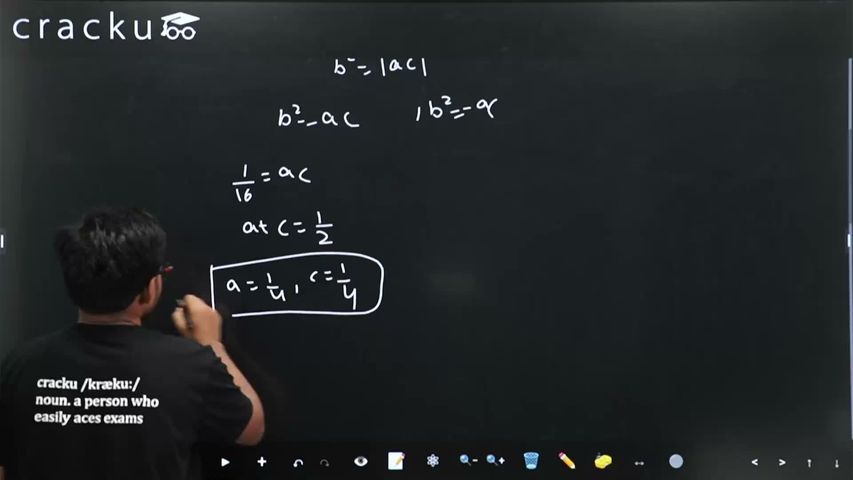
Click on the Email ☝️ to Watch the Video Solution
Create a FREE account and get:
_1.webp)

Educational materials for JEE preparation

Ask our AI anything

AI can make mistakes. Please verify important information.
AI can make mistakes. Please verify important information.
