
Join Our JEE Preparation Group
Prep with like-minded aspirants; Get access to free daily tests and study material.
Sign in
Please select an account to continue using cracku.in
↓ →
Join Our JEE Preparation Group
Prep with like-minded aspirants; Get access to free daily tests and study material.
A man in a car at location Q on a straight highway is moving with speed v. He decides to reach a point P in a field at a distance d from highway (point M) as shown in the figure. Speed of the car in the field is half to that on the highway. What should be the distance RM, so that the time taken to reach P is minimum?
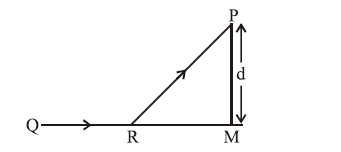
Let the distance $$RM$$ be $$x$$. And let the distance $$QM$$ be $$L$$. We have, $$PR= \sqrt{x^2+d^2}$$
The total time taken to travel $$PR$$ will be $$\dfrac{\sqrt{x^2+d^2}}{v\div 2} = \dfrac{2\sqrt{x^2+d^2}}{v}$$
Time taken to cover the remaining distance $$L-x$$ from $$Q$$ to $$R$$ will be $$\dfrac{L-x}{v}$$
Thus, the total time,
$$T= \dfrac{L-x}{v} + \dfrac{2\sqrt{x^2+d^2}}{v}$$
$$\Rightarrow T = \dfrac{L-x+2\sqrt{x^2+d^2}}{v}$$
To minimise time, we will take the derivative of $$T$$ with respect to $$x$$, and equate it to $$0$$, we get,
$$\dfrac{dT}{dx} = \dfrac{d}{dx}\left[\dfrac{L-x + 2{(x^2+d^2)}^{1/2}}{v}\right]$$
$$\dfrac{dT}{dx} = 0 - \dfrac{1}{v} + \dfrac{2}{v}\cdot \dfrac{2x}{2}(x^2+d^2)^{-1/2}$$
$$\Rightarrow \dfrac{dT}{dx} = -\dfrac{1}{v}+ \dfrac{2x}{v}\cdot (x^2+d^2)^{-1/2}$$
Equating $$\dfrac{dT}{dx}$$ to zero to get the minimum value, we have,
$$\dfrac{2x}{v}\cdot (x^2+d^2)^{-1/2} = \dfrac{1}{v}$$
$$\dfrac{2x}{\sqrt{x^2+d^2}} = 1$$
$$\Rightarrow {(2x)}^2 = x^2+d^2$$
Which gives $$3x^2 = d^2$$ or $$x=\dfrac{d}{\sqrt{3}}$$
Was this solution helpful?
Create a FREE account and get:
_1.webp)

Educational materials for JEE preparation

Ask our AI anything

AI can make mistakes. Please verify important information.
AI can make mistakes. Please verify important information.
