
Join Our JEE Preparation Group
Prep with like-minded aspirants; Get access to free daily tests and study material.
Sign in
Please select an account to continue using cracku.in
↓ →
Join Our JEE Preparation Group
Prep with like-minded aspirants; Get access to free daily tests and study material.
A capacitor C$$_1$$ is charged up to a voltage V = 60 V by connecting it to battery B through switch (1). Now C$$_1$$ is disconnected from battery and connected to a circuit consisting of two uncharged capacitors C$$_2$$ = 3.0$$\mu$$F and C$$_3$$ = 6.0$$\mu$$F through a switch (2) as shown in the figure. The sum of final charges on C$$_2$$ and C$$_3$$ is:
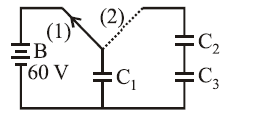
With switch (1) closed and switch (2) open, the battery charges the capacitor $$C_1$$ to the voltage $$V = 60\;\text{V}$$. The charge stored on $$C_1$$ just before the battery is removed is
$$Q_0 = C_1\,V \qquad -(1)$$
After the battery is disconnected, the system is isolated; hence the algebraic sum of charges on all conductors will remain constant.
Closing switch (2) inserts the two initially uncharged capacitors $$C_2 = 3.0\;\mu\text{F}$$ and $$C_3 = 6.0\;\mu\text{F}$$ in series between the two plates of $$C_1$$ (see figure in the question).
This series chain provides a continuous conducting path between the plates of $$C_1$$. Any residual potential difference across $$C_1$$ would drive a current through that path until the two plates of $$C_1$$ reached the same potential. Consequently, in the final steady state the potential difference across $$C_1$$ is zero and therefore
$$Q_{1,\text{final}} = 0 \qquad -(2)$$
Because the system is isolated, the charge that initially resided on $$C_1$$ must now be present on the other two capacitors. Hence, from charge conservation,
$$Q_2 + Q_3 = Q_0 \qquad -(3)$$
The figure supplied with the question shows $$C_1 = 0.60\;\mu\text{F}$$, so from $$(1)$$
$$Q_0 = 0.60\;\mu\text{F}\times 60\;\text{V} = 36\;\mu\text{C}$$
Substituting this value in $$(3)$$ gives
$$Q_2 + Q_3 = 36\;\mu\text{C}$$
Therefore, the sum of the final charges on $$C_2$$ and $$C_3$$ is $$36\;\mu\text{C}$$.
Answer (Option A): 36 $$\mu$$C
Was this solution helpful?
Create a FREE account and get:
_1.webp)

Educational materials for JEE preparation

Ask our AI anything

AI can make mistakes. Please verify important information.
AI can make mistakes. Please verify important information.
