NSEP 2026 22nd Nov Question Paper

For the following questions answer them individually

A spherical bob of mass $$0.20\ \text{kg}$$ and diameter $$2.0\ \text{cm}$$, having uniform density, is attached to the end of a string of length $$100\ \text{cm}$$. This pendulum so formed is suspended from the ceiling of an elevator. The elevator is moving upward with an acceleration of $$5.4\ \text{m s}^{-2}$$ along an incline which makes an angle of $$60^\circ$$ with vertical. The pendulum is made to oscillate about its mean position. Assuming that there is no aerial friction, the time period of oscillation of the pendulum is (given that acceleration due to gravity is $$9.8\ \text{m s}^{-2}$$)
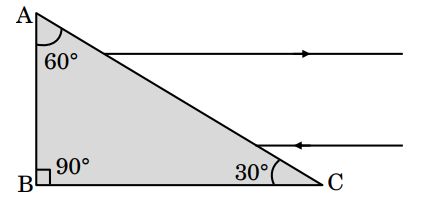

When light is incident on an interface between two media at an angle greater than $$\theta_c = \sin^{-1}\frac{1}{\mu}$$ (where $$\mu$$ is the relative refractive index of the two media), it is totally reflected - a phenomenon known as total internal reflection. If the angle of incidence is smaller than $$\theta_c$$, light is partly reflected and partly refracted. A ray of light incident, parallel to the base, on a $$30^\circ\text{-}90^\circ\text{-}60^\circ$$ prism, as shown, suffers two total internal reflections before emerging parallel but reversed in direction.

image


The condition on the critical angle for this to be possible is

A moving coil galvanometer has a coil with 175 turns and area $$1\ \text{cm}^2$$. It uses a torsion band of torsion constant $$10^{-6}\ \text{N m rad}^{-1}$$. The coil is placed in a magnetic field $$B$$ parallel to its plane. The coil deflects by $$1^\circ$$ for a current of $$1\ \text{mA}$$. The value of the magnetic field $$B$$ (in tesla) is approximately

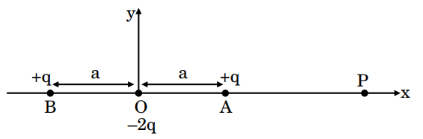
The figure shows an arrangement of charges [$$-2q$$ at $$O(0, 0)$$, $$+q$$ at $$A(a, 0)$$ and $$+q$$ at $$B(-a, 0)$$]. The electric field $$\vec{E}$$ at point $$P(r, 0)$$ can be expressed as (for $$r \gg a$$) $$\vec{E} = \frac{1}{4\pi\varepsilon_0}\frac{\alpha Q}{r^n}\hat{r}$$ (where $$Q = qa^2$$). Choose the correct option.

image

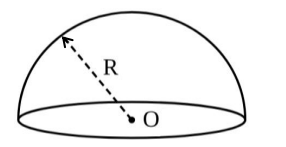
Charge $$Q$$ coulomb is uniformly distributed throughout the volume of a solid hemisphere of radius $$R$$ metre. The potential at the centre O of the hemisphere in volts is

image

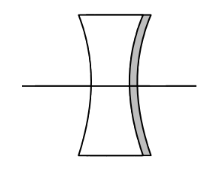
The rear surface of an equi-concave lens of radius of curvature $$R$$ and refractive index $$\mu$$ has been silvered; the lens behaves as a mirror. The focal length and the nature of the resulting mirror are

image

In Millikan's oil drop experiment, a charged drop falls vertically down with a terminal velocity $$v$$. If an electric field $$E$$ is applied vertically upward, it moves with terminal velocity $$2v$$ in the upward direction. If the electric field reduces to $$\frac{E}{2}$$, then the terminal velocity of the drop becomes

Seven equal positive charges of magnitude $$q$$ each are placed at the seven corners of a cube of side $$\ell$$. The force experienced by a charge $$Q$$ placed at the centre of the cube is (given $$K = \frac{1}{4\pi\varepsilon_0}$$)

The magnetic moment $$(p_m)$$ and the moment of inertia $$(I)$$ of a magnetic needle are $$p_m = 8.7 \times 10^{-2}\ \text{A m}^2$$ and $$I = 11.5 \times 10^{-6}\ \text{kg m}^2$$ respectively. The magnetic needle performs 10 complete oscillations in $$6.70\ \text{s}$$ when suspended in a uniform horizontal magnetic field $$B$$. The magnitude of the magnetic field is

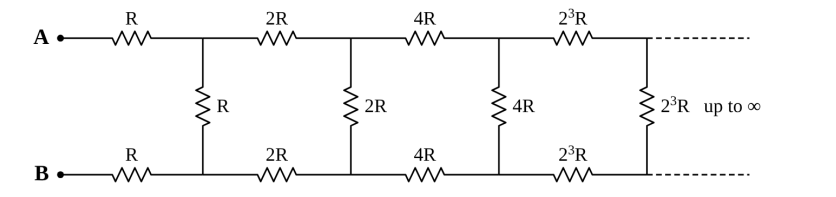
The resistance between the points A and B in the infinite circuit shown, in terms of $$R$$, is

image

Work function of metal A is equal to the ionisation energy of the hydrogen atom in the first excited state. Work function of metal B is equal to the ionisation energy of singly-ionised helium atom in the second orbit. Photons of the same energy $$E$$ are incident on the two metals A and B. Maximum kinetic energy of photoelectrons emitted from metal A is twice that of the photoelectrons emitted from metal B. The value of the photon energy $$E$$ is

During an excavation in the ancient volcanic caves, an archaeologist discovered a sample of a rare mineral trapped inside a sealed rock chamber. Laboratory analysis of the sample showed that the mineral originally contained a radioactive isotope X, which decays into a stable element Y. The radioactive isotope has a half-life $$T = 10^4$$ year. Due to contamination from underground water, 20% of the stable element got washed away before the sample was analysed. At the time of the analysis, the ratio of remaining (undecayed) radioactive isotope X to stable element Y in the sample is found to be $$1 \colon 5.6$$. Assuming that no radioactive material X was lost from the sample, the archaeologist claimed that the actual age of the rock is

Two identical particles of mass $$m$$ each are moving in circular orbits under a central potential given by $$V(r) = \frac{K}{r^n}$$, where $$K$$ is a constant. If the radii of their orbits are $$r_1$$ and $$r_2$$ while the time periods are $$T_1$$ and $$T_2$$ respectively, the correct mathematical relation is

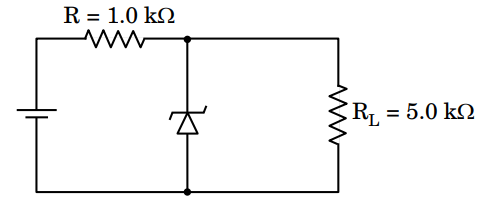
The figure represents a voltage regulator circuit using a zener diode. The breakdown voltage of the zener diode is $$5.5\ \text{V}$$ and the load resistance is $$5\ \text{k}\Omega$$. The series resistance $$R$$ is $$1\ \text{k}\Omega$$. If the battery voltage varies from $$8\ \text{V}$$ to $$14\ \text{V}$$, then what is the minimum and maximum value of current through the zener diode?

image

Two coherent electromagnetic plane waves, of exactly equal amplitude, propagating with a very small angle of divergence $$\psi$$, fall almost normally on a distant screen to produce interference fringes with a separation (fringe width) $$\bar{x} = 1.0\ \text{mm}$$ between neighbouring maxima. The wavelength of light is $$\lambda = 6000\ \mathring{\text{A}}$$. The angle of divergence $$\psi$$

In a line-of-sight radio communication, there is a distance of about $$50\ \text{km}$$ between transmitting and receiving antennas. If the height of the receiving antenna is $$70\ \text{m}$$, then the minimum height of the transmitting antenna should be (Radius of the Earth $$= 6400\ \text{km}$$)

In an arrangement, three polarisers P, Q and S have been set up in sequence such that transmission axis of S is crossed with respect to that of P. The transmission axis of Q is inclined at $$60^\circ$$ to the transmission axis of S. When a beam of unpolarised light of intensity $$I_0$$ is incident on P, the intensity of light transmitted by the three polarisers in succession is $$I$$. The ratio $$I \colon I_0$$ is equal to

A solid sphere of mass $$m$$ and radius $$R$$ rolls without slipping on a horizontal surface. It collides with a light spring of stiffness constant $$K$$ with kinetic energy $$E$$. If the surface under the spring is smooth (frictionless), then the maximum compression of the spring is

When a mass of $$9.0\ \text{kg}$$ is suspended vertically from the free end of the wire of a sonometer, it resonates with a given tuning fork forming standing waves with five antinodes between the two bridges. When the $$9.0\ \text{kg}$$ mass is replaced by another unknown mass $$M$$, the wire resonates with the same tuning fork forming three antinodes for the same positions of the bridges. The mass $$M$$ is

A thin rectangular metal plate of surface area $$0.1\ \text{m}^2$$ is placed on a large horizontal table. There are a few drops of a liquid between the metal plate and the table forming a thin liquid layer of $$0.3\ \text{mm}$$ thickness. The plate is pulled horizontally with the help of a string passing over a massless and frictionless fixed pulley. When a mass of $$10\ \text{g}$$ is attached to the vertically hanging free end of the string, the plate is observed to move gently towards the pulley with a constant speed of $$8.5\ \text{cm s}^{-1}$$. The coefficient of viscosity of the liquid is approximately

In an experiment for determination of the focal length of a thin convex lens, the object distance is measured as $$15\ \text{cm}$$ with 1% error and the image distance is measured as $$30\ \text{cm}$$ with 2% error. From the given data, the focal length of the lens is estimated with $$n\%$$ error. The value of $$n$$ is

The Earth is revolving around the Sun in a circular orbit with a period of revolution equal to 1 year. Suppose that during its motion around the Sun, the mass of the Sun doubles suddenly, the time period of revolution of the Earth will then become

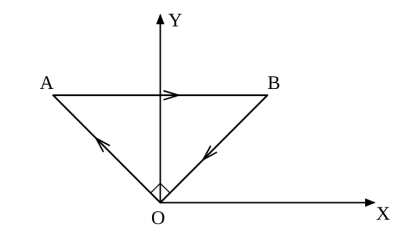
Three metallic wires form an isosceles right angled triangle AOB with wire AB parallel to x-axis and the vertex O at the origin. The length of the wire OA = length OB = $$2\sqrt{2}\ \text{m}$$. A current of $$10\ \text{A}$$ flows in the loop along OABO. A magnetic field $$\vec{B} = 2.5(\hat{i} - \hat{k})\ \text{T}$$ exists in the region $$y \geq 1$$. The force acting on the triangle due to this field is

image

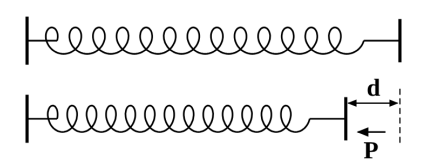
A spring is in a compressed state under the action of a constant force $$P$$. Compression of the spring is $$d$$. Suppose direction of the force is reversed suddenly with its magnitude changed to $$2P$$; the maximum extension of the spring will now be

image

In a process, one mole of a monoatomic gas is heated from initial temperature $$27^\circ\text{C}$$, in such a way that its molar heat capacity is constant equal to $$2R$$. During the process, volume of the gas is doubled. The final temperature of the gas becomes

When placed in a liquid of density $$d_1$$, a solid sphere sinks displacing a volume $$V$$ of the liquid. When placed in a second liquid of density $$d_2$$, the same sphere floats with half of its volume appearing over the surface of the liquid. When placed in a third liquid of density $$d_3$$, the same sphere floats with $$\frac{1}{4}$$th of its volume over the surface of the liquid. The buoyant force exerted by the liquid of density $$d_3$$ on the sphere is

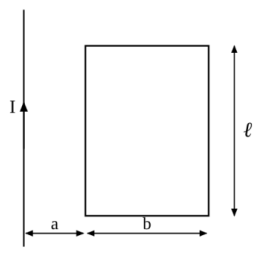
A flat rectangular $$\ell \times b$$ loop and a long straight wire lie in the same plane (see figure). Current in the wire varies according to $$I = I_0\sin\omega t$$. The amplitude of emf induced in the loop is (Given $$b = 2a$$)

image

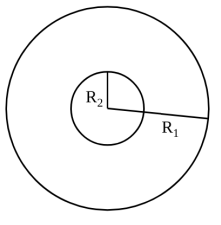
There are two concentric and coplanar coils of radii $$R_1$$ and $$R_2$$ $$(R_1 \gg R_2)$$, and number of turns $$N_1$$ and $$N_2$$ respectively. The current in the second (smaller) coil is changing at a constant rate $$\frac{dI_2}{dt} = k$$. The magnitude of induced emf in the first (larger) coil will be

image

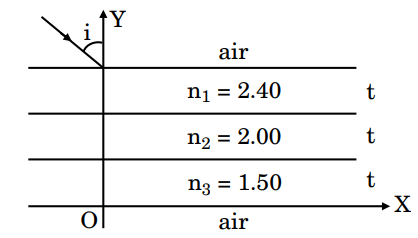
A beam of light in air is incident at an angle of incidence $$i = 75^\circ$$ on a large block made of three parallel layers of different transparent materials stacked on top of each other, as shown. The thickness of each layer is $$t = 10.0\ \text{cm}$$. Refractive indices of the three successive layers with respect to air are $$n_1 = 2.40$$, $$n_2 = 2.00$$ and $$n_3 = 1.50$$ respectively. The beam of light emerges from the third medium on the X axis at a distance $$\xi$$ from O. The value of $$\xi$$ is

image

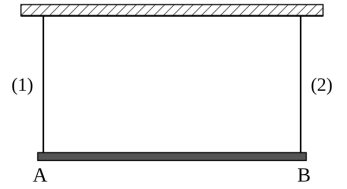
A uniform rod AB of weight $$W$$ is symmetrically suspended with the help of two identical un-stretchable light strings (1) and (2) of equal length from a rigid horizontal support. The rod is horizontal. The tension in the string (1), immediately after the string (2) is burnt, would be

image

Speed of sound is measured in a confined gas and found to be 0.632 times the RMS velocity $$(V_{rms})$$ of the gas molecules as determined from the temperature. The degree of freedom $$f$$ and molar heat capacity $$C_v$$ at constant volume of the gas are

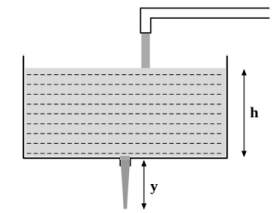
In a wide container, water is always filled up to a height $$h$$. There is a nozzle (hole) of radius $$r_0$$ at its bottom. For some distance below the nozzle, water falls in a laminar stream. Radius $$r$$ of stream as a function of $$y$$ below the nozzle is expressed as [ignore the viscosity of water]

image

A point object of mass $$m$$ starts moving from rest along $$x$$ axis from the origin, under the action of a force which delivers a constant power $$P$$. The position $$x$$ of the object at time $$t$$ is

A black body, maintained at absolute temperature $$T$$, is emitting radiations of wavelength $$\lambda$$ with maximum (peak) intensity. The emitted photons are capable of exciting the electron in a Bohr-model hydrogen atom from ground state $$(E_g = -13.60\ \text{eV})$$ to the third excited state. Using Wien's constant $$b = 2.90 \times 10^{-3}\ \text{m K}$$, the estimated value of temperature $$T$$ is nearly

In order to form standing waves in a medium, the following two waves are superposed

$$y_1 = A\sin\pi(5x + 100t + 0.8)$$

$$y_2 = A\sin\pi(5x - 100t)$$

the variables $$x$$ and $$y$$ are in metre and $$t$$ in second. The correct statement is that the

The density $$\rho$$ of a solid sphere, of mass $$M$$ and radius $$R$$, varies radially according to $$\rho = \rho_0\left(1 - \frac{r}{2R}\right)$$, where $$\rho_0$$ is a constant. The moment of inertia of this sphere about a diameter is $$I = \alpha MR^2$$ with $$\alpha$$ equal to

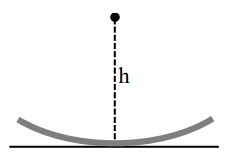
A concave mirror of radius of curvature $$R = 1.00\ \text{m}$$ is placed on the floor as shown. A small, light-weight ball falls from a height $$h = 1.20\ \text{m}$$ vertically along the principal axis towards the mirror. If the ball loses 16% of its energy after each collision with the mirror, the distance between the ball and its image formed by the mirror, when the ball reaches its maximum height after the 2nd collision, is nearly

image

The magnetic field vector in a plane electromagnetic wave is given by $$\vec{B} = 2 \times 10^{-7}\sin(kx + \omega t)\,\hat{j}\ \text{T}$$. It is given that speed of wave is $$c = 3.00 \times 10^8\ \text{m s}^{-1}$$ and $$\omega = 1.50 \times 10^{11}\ \text{s}^{-1}$$.

An astronomical telescope is used to view an object of size $$4\ \text{cm}$$ kept at a distance of $$20\ \text{m}$$. The focal lengths of the objective and the eyepiece are $$80\ \text{cm}$$ and $$5\ \text{cm}$$ respectively. The final image is $$25\ \text{cm}$$ from the eyepiece (with the eye close to the eyepiece).

Statement 1 - The size of the final image is $$1.0\ \text{cm}$$.

Statement 2 - The angular magnification is numerically 20.

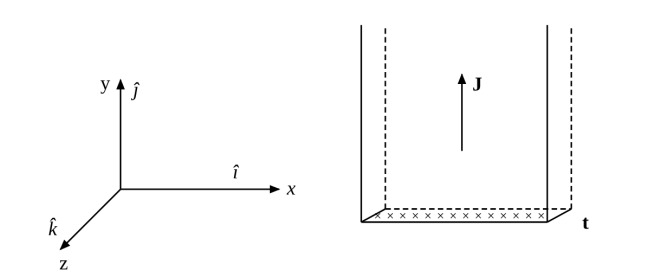
A thin metal plate of infinite length extending in positive $$y$$ direction carries a current of current density $$J$$ all along its length as shown. The very small thickness of the plate is $$t$$. The breadth (much larger than thickness) of the plate lies exactly along the $$x$$ axis. The magnetic field produced at a small distance $$a$$ above and very close to the surface of the plate is

image

A uniform rod of mass $$M$$ and length $$L$$ is hinged freely on a horizontal peg at a variable distance $$\xi$$ from one of its ends, so as to execute SHM with small angular amplitude in a vertical plane about the horizontal axis with time period $$T$$. If the minimum value of its time period $$T_{min} = 1.0$$ second, the approximate value of $$L$$ is

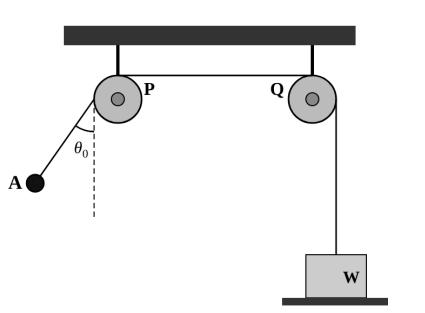
P and Q are two smooth weightless pulleys attached to the ceiling as shown. An un-stretchable, light string passes over both the pulleys. A weight $$W = 40\ \text{kg}$$, resting on the floor, is tied to one end of the string. A ball of mass $$20\ \text{kg}$$ is attached at the other end A. The string PA is deflected by angle $$\theta_0$$ when the ball A is released from rest. The ball at the end A is capable of just lifting up the weight $$W$$ for the value of $$\theta_0$$

image

The position vector $$\vec{r}$$ of a particle of mass $$m$$ moving in XY plane is given as a function of time by $$\vec{r} = R(\omega t - \sin\omega t)\hat{i} + R(1 - \cos\omega t)\hat{j}$$, where $$R$$ and $$\omega$$ are positive constants. The particle is momentarily at rest when

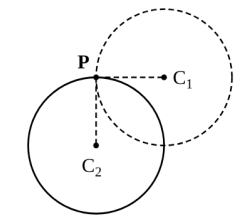
A thin circular disk of mass $$m$$ and radius $$R$$ can rotate freely in a vertical plane about a pivot P on its rim (as in the figure). It is released when its centre is at $$C_1$$ at the level of the pivot in a vertical plane. The speed of the lowest point of the disk when the centre is vertically below the pivot P at $$C_2$$ is

image

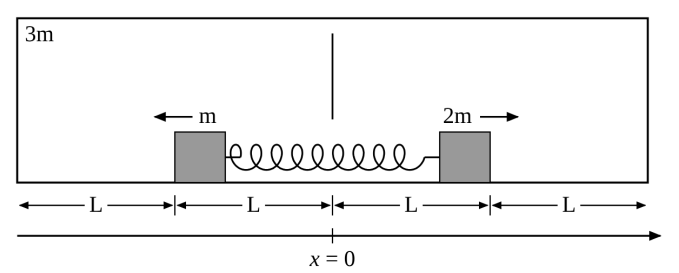
Two rectangular blocks of masses $$m$$ and $$2m$$ are held against a massless compressed spring within a box of mass $$3m$$ and length $$4L$$. The box as well as the two blocks are free to move on a horizontal frictionless surface along the x-axis. Just when the blocks leave contact with the spring, each block is at a distance $$L$$ from the wall of the box in front of it and the centre of the box is at origin $$x = 0$$ (see figure). When released, each block moves its own way, collides with the front wall and immediately sticks to it. The position of the centre of the box in the process shifts to

image

A charge $$q$$ is uniformly distributed over the surface of a thin circular disk of radius $$R$$. The disk rotates about its own axis with an angular velocity $$\omega\ \text{rad s}^{-1}$$, maintaining its axis normal to a uniform magnetic field $$B$$. The magnitude of the torque acting on the charged disk is

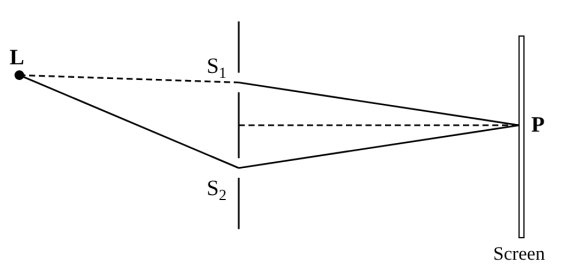
A line source L (perpendicular to the plane of the paper) emitting light of wavelength $$5625\ \mathring{\text{A}}$$ is placed $$1.00\ \text{m}$$ away directly in front of the slit $$S_1$$ in an opaque wall (see figure). A second slit $$S_2$$ in the same wall is parallel to slit $$S_1$$ and at distance $$d$$ from it; both the slits are parallel to each other and to the line source L. Intensity of light is measured at the position P, equidistant from each of the slits $$S_1$$ and $$S_2$$ on the screen, for three different conditions. When $$S_2$$ is covered it is $$I_1$$, when $$S_1$$ is covered it is $$I_2$$. When both slits are open it is $$I$$. If $$I = I_1 + I_2$$, the distance $$d$$ between the two slits is

image

$${}_{1}\text{H}^{3}$$ and $${}_{2}\text{He}^{3}$$ have almost same atomic mass. $${}_{1}\text{H}^{3}$$ contains one proton, one electron and 2 neutrons while $${}_{2}\text{He}^{3}$$ has two protons, two electrons and one neutron. Knowing that the mass of a neutron is slightly greater than that of the proton, the estimation of the nuclear binding energy in the two cases reveals that

Charge $$Q$$ is distributed in non-uniform but spherically symmetric manner with charge density $$\rho(r)$$ such that

$$\rho(r) = \rho_0\left(1 - \frac{r}{R}\right)$$ for $$r \leq R$$

$$\rho(r) = 0$$ for $$r \geq R$$

The correct statement(s) is/are

A proton of mass $$m$$ is released from rest at $$x_0 = \frac{\alpha}{\beta}$$ and starts moving along $$x$$ axis under the influence of a conservative force $$F(x)$$. Its potential energy function is $$U(x) = \frac{\alpha}{x^2} - \frac{\beta}{x}$$, where $$\alpha$$ and $$\beta$$ are positive constants. Rigorous calculations predict that

A long horizontal thin metal wire under tension is attached at one end to a vibrator, which causes transverse oscillations in the wire when the other end of the wire is fastened rigidly. The vibration produces a travelling wave in the wire, which is described by $$y = y_0\sin\pi(\alpha t - \beta x)$$, where $$x$$ is measured in metre along the wire from the vibrator end. Here $$\alpha$$ and $$\beta$$ are known positive constants. The linear density of the wire is $$\mu\ \text{kg m}^{-1}$$. Then

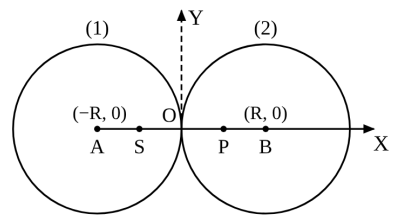
Two non-conducting solid spheres (1) and (2), with uniformly distributed charge throughout their volumes, are held at positions A and B, as shown in the figure. Each sphere has radius $$R$$. The centres A and B of the spheres (1) and (2) lie on $$x$$ axis with the point of contact O at the origin. Given that the total charge on sphere (1) is $$Q$$ and the electric field $$\vec{E}$$ at point $$P\left(\frac{R}{2}, 0\right)$$ is zero. The correct statement(s) is/are

image

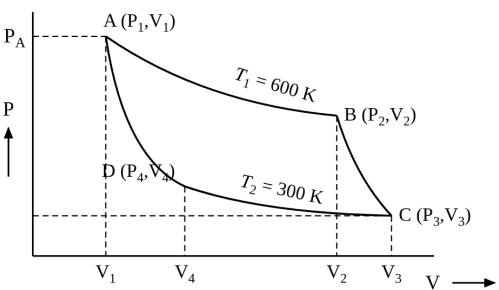
Two moles of a mixture of a monoatomic gas and a diatomic gas are being used as the working substance in a reversible Carnot cycle as shown in figure. For the mixture of gases, the value of $$\gamma_{mixture} = \frac{C_P}{C_V} = \frac{3}{2}$$. The cycle operates between the source temperature $$600\ \text{K}$$ and the sink temperature $$300\ \text{K}$$. The highest and lowest pressures during the cycle are $$1600\ \text{kPa}$$ and $$100\ \text{kPa}$$. The correct statement(s) is/are

image

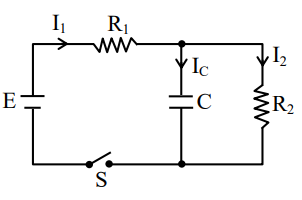
In the circuit shown, $$E$$ is the emf of an ideal battery. Capacitor $$C$$ is initially uncharged. Switch S is closed at time $$t = 0$$. The time dependent current through the resistances $$R_1$$ and $$R_2$$ are $$I_1$$ and $$I_2$$ respectively. At any moment $$t$$, the charging current through the capacitor is $$I_C(t)$$. Choose correct option(s)

image

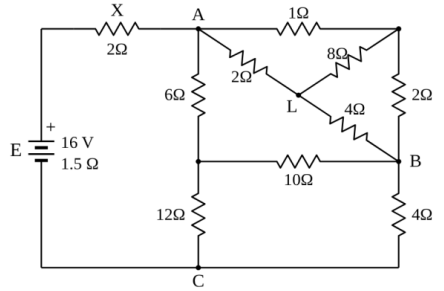
In the given circuit, the emf $$E$$ of the battery is $$16\ \text{V}$$ and its internal resistance is $$r = 1.5\ \Omega$$. The correct option(s) is/are : 

image

A train, moving in a straight line with an initial speed $$u\ \text{m s}^{-1}$$ at $$t = 0$$, is given a constant acceleration $$a\ \text{m s}^{-2}$$ to attain a maximum speed $$V_m = \frac{7}{3}u$$. The driver runs the train at that maximum speed for some duration and then decelerates at a rate of $$a\ \text{m s}^{-2}$$ to attain the same initial speed $$u\ \text{m s}^{-1}$$ at $$t = T$$. The average speed of the train for the entire journey (from time $$t = 0$$ to $$t = T$$) is $$2u$$. Choose the correct statement(s)

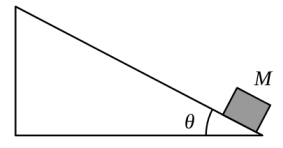
A rectangular block of mass $$M$$ projected up an inclined plane, set at an angle $$\theta$$ with the horizontal, comes to a stop at a certain height and slides back down the incline. The down trip takes exactly twice as long as the up trip. The observations reveal that

image

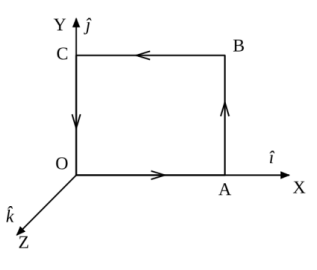
A wire loop OABC, with corners at $$O(0, 0)$$, $$A(L, 0)$$, $$B(L, L)$$ and $$C(0, L)$$ lying in XY plane, carries a current $$I$$ in anti-clockwise direction as shown. The correct statement(s) is/are

image

A rocket is fired from Earth at $$60^\circ$$ to the local vertical with an initial speed $$v_0 = \sqrt{gR}$$, where $$R$$ is radius of the Earth and $$g$$ is the acceleration due to gravity at the surface of the Earth. Choose correct option(s) [Assume the Earth to be a uniform solid sphere. Also ignore the rotation of the Earth]

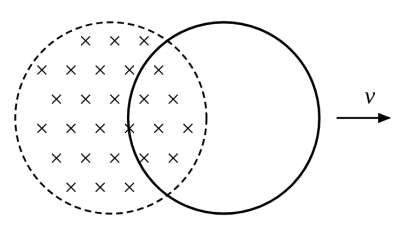
A uniform magnetic field $$B = 0.5\ \text{T}$$ exists in a circular region of radius $$R = 5\ \text{m}$$. A wire loop of radius $$R = 5\ \text{m}$$ completely encloses the magnetic field at $$t = 0$$. The loop is pulled at uniform speed $$v = 2\ \text{m s}^{-1}$$ in the plane of the paper as shown.

image

50,000+ JEE Students Trusted Our Score Calculator

Predict your JEE Main percentile, rank & performance in seconds