Sign in
Please select an account to continue using cracku.in
↓ →

Join Our JEE Preparation Group
Prep with like-minded aspirants; Get access to free daily tests and study material.
P and Q are two smooth weightless pulleys attached to the ceiling as shown. An un-stretchable, light string passes over both the pulleys. A weight $$W = 40\ \text{kg}$$, resting on the floor, is tied to one end of the string. A ball of mass $$20\ \text{kg}$$ is attached at the other end A. The string PA is deflected by angle $$\theta_0$$ when the ball A is released from rest. The ball at the end A is capable of just lifting up the weight $$W$$ for the value of $$\theta_0$$
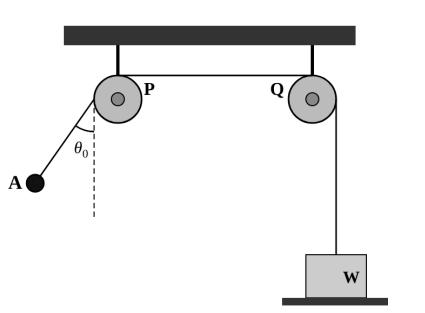
While $$W$$ stays on the floor the ball swings as a pendulum about P, and the string tension is largest at the lowest point. There $$T = mg + \frac{mv^2}{\ell}$$ with $$v^2 = 2g\ell(1 - \cos\theta_0)$$, so $$T = mg(3 - 2\cos\theta_0)$$. To lift $$W$$ we need $$T \geq Wg$$, i.e. $$20(3 - 2\cos\theta_0) \geq 40$$. This gives $$\cos\theta_0 \leq \frac{1}{2}$$, so $$\theta_0 \geq 60^\circ$$.
Was this solution helpful?


Predict your JEE Main percentile, rank & performance in seconds

Educational materials for JEE preparation

Ask our AI anything

AI can make mistakes. Please verify important information.
AI can make mistakes. Please verify important information.
 91- 6303239042