Sign in
Please select an account to continue using cracku.in
↓ →

Join Our JEE Preparation Group
Prep with like-minded aspirants; Get access to free daily tests and study material.
Two non-conducting solid spheres (1) and (2), with uniformly distributed charge throughout their volumes, are held at positions A and B, as shown in the figure. Each sphere has radius $$R$$. The centres A and B of the spheres (1) and (2) lie on $$x$$ axis with the point of contact O at the origin. Given that the total charge on sphere (1) is $$Q$$ and the electric field $$\vec{E}$$ at point $$P\left(\frac{R}{2}, 0\right)$$ is zero. The correct statement(s) is/are
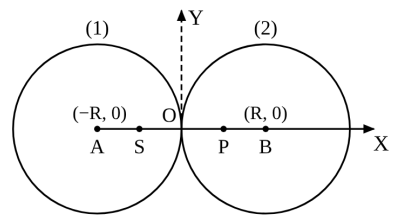
Let $$k = \frac{1}{4\pi\varepsilon_0}$$. At P, sphere 1 (centre at distance $$\frac{3R}{2}$$) gives $$\frac{4kQ}{9R^2}$$ along $$+x$$, and sphere 2 (P inside it, $$\frac{R}{2}$$ from B) gives $$\frac{kQ_2}{2R^2}$$ along $$-x$$; these cancel when $$Q_2 = \frac{8Q}{9}$$, so (a) is correct. At O, $$E_O = \frac{k(Q - Q_2)}{R^2} = \frac{kQ}{9R^2}$$, and at B only sphere 1 contributes, $$E_B = \frac{kQ}{4R^2}$$, so the ratio is $$4 \colon 9$$ and (b) is correct. $$V_B = \frac{kQ}{2R} + \frac{3kQ_2}{2R} = \frac{11kQ}{6R}$$, so (c) is wrong. At S, sphere 1 gives $$\frac{kQ}{2R^2}$$ along $$+x$$ and sphere 2 gives $$\frac{32kQ}{81R^2}$$ along $$-x$$, a net $$\frac{17kQ}{162R^2}$$ along $$+x$$, so (d) is correct.
Was this solution helpful?


Predict your JEE Main percentile, rank & performance in seconds

Educational materials for JEE preparation

Ask our AI anything

AI can make mistakes. Please verify important information.
AI can make mistakes. Please verify important information.
 91- 6303239042