Sign in
Please select an account to continue using cracku.in
↓ →

Join Our JEE Preparation Group
Prep with like-minded aspirants; Get access to free daily tests and study material.
When light is incident on an interface between two media at an angle greater than $$\theta_c = \sin^{-1}\frac{1}{\mu}$$ (where $$\mu$$ is the relative refractive index of the two media), it is totally reflected - a phenomenon known as total internal reflection. If the angle of incidence is smaller than $$\theta_c$$, light is partly reflected and partly refracted. A ray of light incident, parallel to the base, on a $$30^\circ\text{-}90^\circ\text{-}60^\circ$$ prism, as shown, suffers two total internal reflections before emerging parallel but reversed in direction.
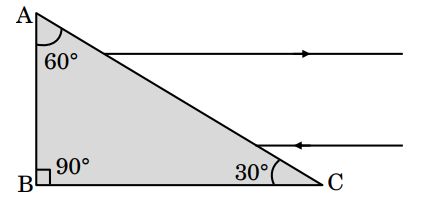
The condition on the critical angle for this to be possible is
The hypotenuse AC makes $$30^\circ$$ with the base BC, so a ray parallel to BC strikes AC at an angle of incidence $$i = 60^\circ$$. Refraction gives $$\sin r = \frac{\sin 60^\circ}{\mu} = \frac{\sqrt{3}}{2}\sin\theta_c$$. Inside, the ray meets the two perpendicular faces AB and BC with angles of incidence $$60^\circ - r$$ and $$30^\circ + r$$, and the binding condition for total reflection is $$60^\circ - r > \theta_c$$ (the other one is then automatically satisfied). So $$\sin r < \sin(60^\circ - \theta_c)$$, i.e. $$\frac{\sqrt{3}}{2}\sin\theta_c < \frac{\sqrt{3}}{2}\cos\theta_c - \frac{1}{2}\sin\theta_c$$, which gives $$\tan\theta_c < \frac{\sqrt{3}}{1 + \sqrt{3}}$$.
Was this solution helpful?


Predict your JEE Main percentile, rank & performance in seconds

Educational materials for JEE preparation

Ask our AI anything

AI can make mistakes. Please verify important information.
AI can make mistakes. Please verify important information.
 91- 6303239042