Sign in
Please select an account to continue using cracku.in
↓ →

Join Our JEE Preparation Group
Prep with like-minded aspirants; Get access to free daily tests and study material.
In a wide container, water is always filled up to a height $$h$$. There is a nozzle (hole) of radius $$r_0$$ at its bottom. For some distance below the nozzle, water falls in a laminar stream. Radius $$r$$ of stream as a function of $$y$$ below the nozzle is expressed as [ignore the viscosity of water]
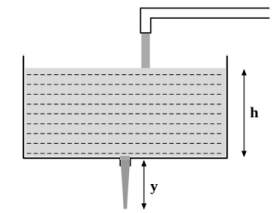
By Torricelli's law the speed at the nozzle is $$v_0 = \sqrt{2gh}$$, and a distance $$y$$ below it the speed is $$v = \sqrt{2g(h + y)}$$. Continuity gives $$\pi r^2 v = \pi r_0^2 v_0$$, so $$r = r_0\left(\frac{v_0}{v}\right)^{1/2} = r_0\left(\frac{h}{h + y}\right)^{1/4} = \frac{r_0}{\left(1 + \frac{y}{h}\right)^{1/4}}$$.
Was this solution helpful?


Predict your JEE Main percentile, rank & performance in seconds

Educational materials for JEE preparation

Ask our AI anything

AI can make mistakes. Please verify important information.
AI can make mistakes. Please verify important information.
 91- 6303239042