Sign in
Please select an account to continue using cracku.in
↓ →

Join Our JEE Preparation Group
Prep with like-minded aspirants; Get access to free daily tests and study material.
The figure shows an arrangement of charges [$$-2q$$ at $$O(0, 0)$$, $$+q$$ at $$A(a, 0)$$ and $$+q$$ at $$B(-a, 0)$$]. The electric field $$\vec{E}$$ at point $$P(r, 0)$$ can be expressed as (for $$r \gg a$$) $$\vec{E} = \frac{1}{4\pi\varepsilon_0}\frac{\alpha Q}{r^n}\hat{r}$$ (where $$Q = qa^2$$). Choose the correct option.
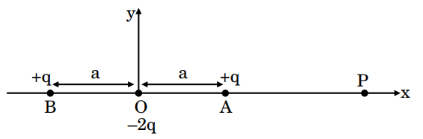
On the axis at $$P(r, 0)$$, $$E = kq\left[\frac{1}{(r - a)^2} + \frac{1}{(r + a)^2} - \frac{2}{r^2}\right]$$. For $$r \gg a$$, $$\frac{1}{(r \mp a)^2} \approx \frac{1}{r^2}\left(1 \pm \frac{2a}{r} + \frac{3a^2}{r^2}\right)$$, so the bracket reduces to $$\frac{6a^2}{r^4}$$. Hence $$E = \frac{1}{4\pi\varepsilon_0}\frac{6qa^2}{r^4}$$ (a linear quadrupole), giving $$\alpha = 6$$ and $$n = 4$$.
Was this solution helpful?


Predict your JEE Main percentile, rank & performance in seconds

Educational materials for JEE preparation

Ask our AI anything

AI can make mistakes. Please verify important information.
AI can make mistakes. Please verify important information.
 91- 6303239042