Sign in
Please select an account to continue using cracku.in
↓ →

Join Our JEE Preparation Group
Prep with like-minded aspirants; Get access to free daily tests and study material.
A line source L (perpendicular to the plane of the paper) emitting light of wavelength $$5625\ \mathring{\text{A}}$$ is placed $$1.00\ \text{m}$$ away directly in front of the slit $$S_1$$ in an opaque wall (see figure). A second slit $$S_2$$ in the same wall is parallel to slit $$S_1$$ and at distance $$d$$ from it; both the slits are parallel to each other and to the line source L. Intensity of light is measured at the position P, equidistant from each of the slits $$S_1$$ and $$S_2$$ on the screen, for three different conditions. When $$S_2$$ is covered it is $$I_1$$, when $$S_1$$ is covered it is $$I_2$$. When both slits are open it is $$I$$. If $$I = I_1 + I_2$$, the distance $$d$$ between the two slits is
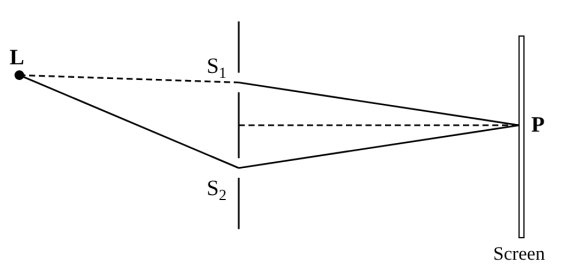
P is equidistant from $$S_1$$ and $$S_2$$, so the phase difference comes only from the source side, $$LS_2 - LS_1 = \sqrt{D^2 + d^2} - D \approx \frac{d^2}{2D}$$. The condition $$I = I_1 + I_2$$ means the interference term vanishes, so the phase difference is $$\frac{\pi}{2}$$ and the path difference is $$\frac{\lambda}{4}$$. Then $$\frac{d^2}{2D} = \frac{\lambda}{4}$$, so $$d = \sqrt{\frac{D\lambda}{2}} = \sqrt{\frac{1.00 \times 5.625 \times 10^{-7}}{2}} \approx 0.53\ \text{mm}$$.
Was this solution helpful?


Predict your JEE Main percentile, rank & performance in seconds

Educational materials for JEE preparation

Ask our AI anything

AI can make mistakes. Please verify important information.
AI can make mistakes. Please verify important information.
 91- 6303239042