Sign in
Please select an account to continue using cracku.in
↓ →

Join Our JEE Preparation Group
Prep with like-minded aspirants; Get access to free daily tests and study material.
A concave mirror of radius of curvature $$R = 1.00\ \text{m}$$ is placed on the floor as shown. A small, light-weight ball falls from a height $$h = 1.20\ \text{m}$$ vertically along the principal axis towards the mirror. If the ball loses 16% of its energy after each collision with the mirror, the distance between the ball and its image formed by the mirror, when the ball reaches its maximum height after the 2nd collision, is nearly
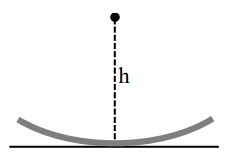
Each bounce keeps 84% of the energy, so the maximum height after two collisions is $$1.20 \times 0.84^2 \approx 0.847\ \text{m}$$. For the mirror $$f = \frac{R}{2} = 0.50\ \text{m}$$, so $$\frac{1}{v} = \frac{1}{0.5} - \frac{1}{0.847}$$, giving a real image at $$v \approx 1.221\ \text{m}$$ in front of the mirror. Both the ball and its image are on the same side of the mirror, so the distance between them is $$1.221 - 0.847 \approx 0.37\ \text{m}$$.
Was this solution helpful?


Predict your JEE Main percentile, rank & performance in seconds

Educational materials for JEE preparation

Ask our AI anything

AI can make mistakes. Please verify important information.
AI can make mistakes. Please verify important information.
 91- 6303239042