91- 6303239042
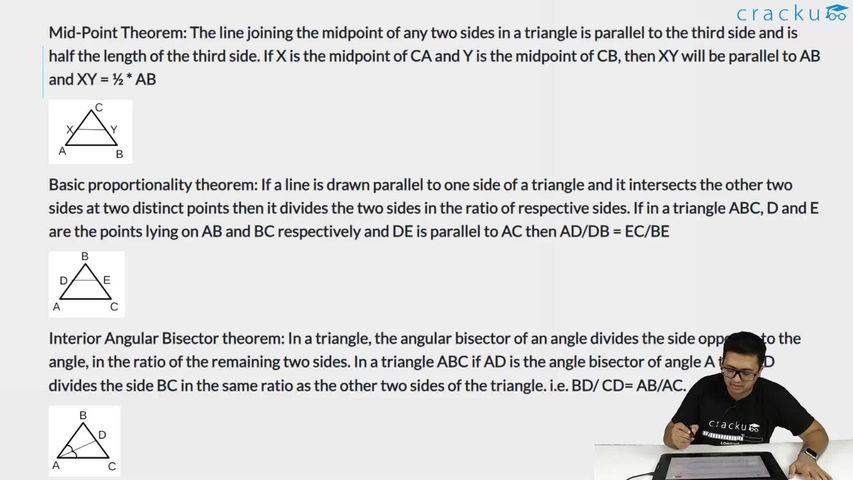
Mid-Point Theorem: The line joining the midpoint of any two sides in a triangle is parallel to the third side and is half the length of the third side. If X is the midpoint of CA and Y is the midpoint of CB, then XY will be parallel to AB and XY = ½ * AB

Basic proportionality theorem: If a line is drawn parallel to one side of a triangle and it intersects the other two sides at two distinct points then it divides the two sides in the ratio of respective sides. If in a triangle ABC, D and E are the points lying on AB and BC respectively and DE is parallel to AC then AD/DB = EC/BE

Interior Angular Bisector theorem: In a triangle, the angular bisector of an angle divides the side opposite to the angle, in the ratio of the remaining two sides. In a triangle ABC if AD is the angle bisector of angle A then AD divides the side BC in the same ratio as the other two sides of the triangle. i.e. BD/ CD= AB/AC.

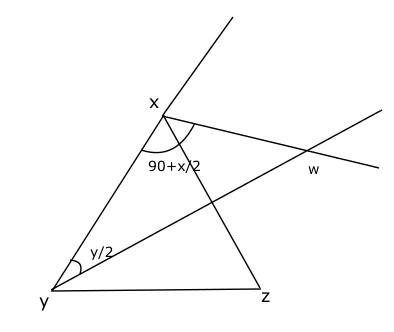
Exterior Angular Bisector theorem: The angular bisector of the exterior angle of a triangle divides the opposite side externally in the ratio of the sides containing the angle. In a triangle ABC, if CE is the angular bisector of exterior
angle BCD of a triangle, then AE/BE = AC/BC

Apollonius theorem states that in a triangle ABC if AD is a median to BC then $$AB^2+AC^2=2\cdot\left(AD^2+BD^2\right)$$.