91- 6303239042
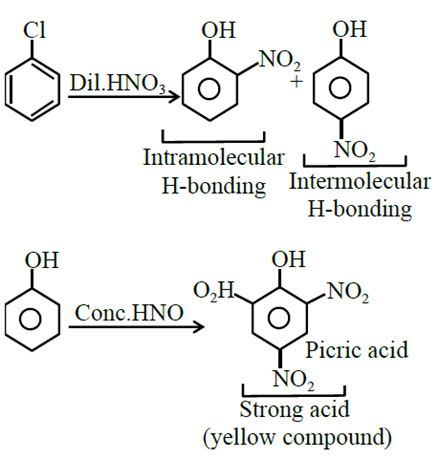
Reaction Equations
- With Dilute Nitric Acid ($$298\text{ K}$$):
$$\text{C}_6\text{H}_5\text{OH} + \text{Dil. HNO}_3 \xrightarrow{298\text{ K}} o\text{--}\text{HO--C}_6\text{H}_4\text{--NO}_2 + p\text{--}\text{HO--C}_6\text{H}_4\text{--NO}_2 + \text{H}_2\text{O}$$ - With Concentrated Nitric Acid:
$$\text{C}_6\text{H}_5\text{OH} + 3\text{Conc. HNO}_3 \xrightarrow{\text{Conc. H}_2\text{SO}_4} \text{C}_6\text{H}_2(\text{OH})(\text{NO}_2)_3 + 3\text{H}_2\text{O} \quad (2,4,6\text{-Trinitrophenol / Picric Acid})$$
Concept: The hydroxyl group ($$\text{--OH}$$) in phenol strongly activates the aromatic ring toward electrophilic aromatic substitution ($$S_E\text{Ar}$$) via resonance ($$+M$$ effect) and directs incoming electrophiles to the ortho and para positions. Because of this high reactivity, phenol undergoes nitration under mild conditions with dilute nitric acid at room temperature without requiring sulfuric acid catalyst, yielding a mixture of ortho- and para-nitrophenols.