 91- 6303239042
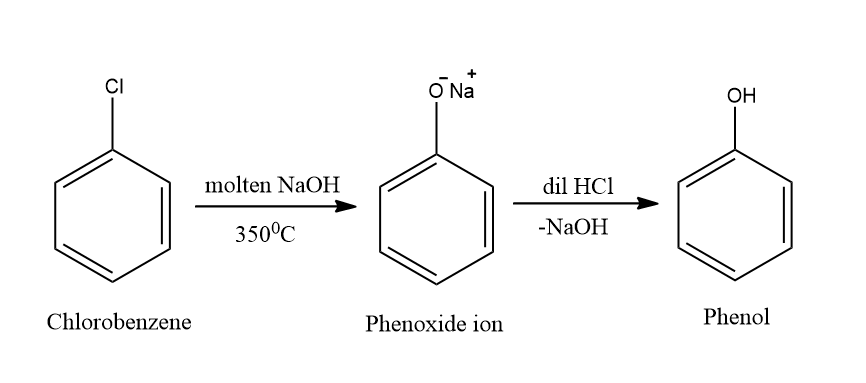
$$\text{C}_6\text{H}_5\text{Cl} + \text{NaOH} \xrightarrow{623\text{K}, \, 300\text{atm}} \text{C}_6\text{H}_5\text{ONa} \xrightarrow{\text{H}^+} \text{Phenol}$$
Concept: Chlorobenzene undergoes nucleophilic aromatic substitution under drastic conditions (high temperature of $$623\text{ K}$$ and high pressure of $$300\text{ atm}$$) with aqueous sodium hydroxide. The chlorine atom is replaced by a hydroxyl group via a benzyne (elimination-addition) intermediate pathway, initially yielding sodium phenoxide, which produces phenol upon acidification.

