 91- 6303239042
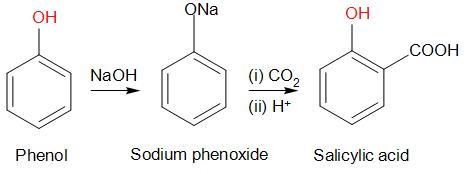
$$\text{Phenol} \xrightarrow{\text{1) NaOH}} \text{Phenoxide} \xrightarrow{\text{2) CO}_2, \, 400\text{K}, \, 4\text{-}7\text{atm} \quad \text{3) H}^+} \text{2-hydroxybenzoic acid (Salicylic Acid)}$$
Concept: Phenol is treated with sodium hydroxide to form the phenoxide ion, which is significantly more reactive than phenol toward electrophilic aromatic substitution. The phenoxide ion undergoes electrophilic attack by carbon dioxide ($$\text{CO}_2$$, a weak electrophile) at high temperature and pressure, yielding sodium salicylate, which upon acidification yields 2-hydroxybenzoic acid (salicylic acid).

