91- 6303239042
Shared Intermediate Step
Both pathways start by reacting an alkene with ozone to form an unstable molozonide, which quickly rearranges into a stable ozonide ring structure:
$$\text{R}_1\text{R}_2\text{C=CR}_3\text{R}_4 + \text{O}_3 \longrightarrow \text{Ozonide Intermediate Ring}$$
Reductive Ozonolysis (Stops at Aldehydes / Ketones)
Reagents:
$$\text{1. } \text{O}_3 \quad \text{2. } \text{Zn / H}_2\text{O} \quad \text{or} \quad \text{CH}_3\text{-S-CH}_3 \, (\text{DMS})$$
Reaction Matrix:
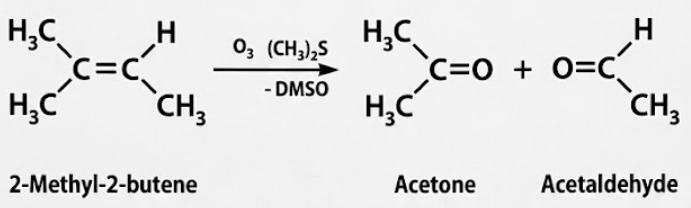
$$\text{R-CH=C(R')}_2 \xrightarrow{\text{1. O}_3 \quad \text{2. Zn / H}_2\text{O}} \text{R-CHO} + \text{R'-CO-R'} + \text{ZnO}$$
Mechanistic Role of Zinc: The ozonide cleavage yields aldehydes along with hydrogen peroxide ($$\text{H}_2\text{O}_2$$). Zinc acts as a reducing agent to destroy the $$\text{H}_2\text{O}_2$$, converting it to dead $$\text{ZnO}$$ and preventing the oxidation of aldehydes into carboxylic acids.
Oxidative Ozonolysis (Oxidizes Aldehydes to Acids)
Reagents:
$$\text{1. } \text{O}_3 \quad \text{2. } \text{H}_2\text{O} \quad (\text{or with } \text{H}_2\text{O}_2 \, / \, \text{KMnO}_4)$$
Reaction Matrix:
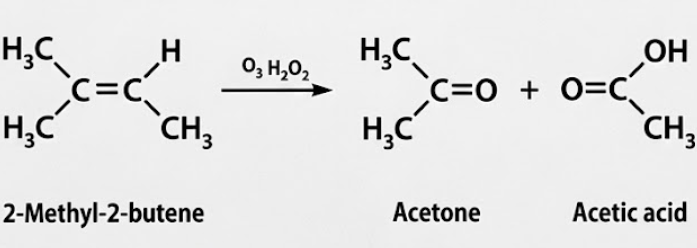
$$\text{R-CH=C(R')}_2 \xrightarrow{\text{1. O}_3 \quad \text{2. H}_2\text{O}} \text{R-COOH} + \text{R'-CO-R'}$$
Mechanistic Outcome: In the absence of a metal reducing agent like zinc, the co-product $$\text{H}_2\text{O}_2$$ actively oxidizes any formed aldehydes into carboxylic acids. Ketones remain completely untouched because they lack a highly reactive hydrogen atom directly attached to the carbonyl carbon.