A container holds 200 litres of a solution of acid and water, having 30% acid by volume. Atul replaces 20% of this solution with water, then replaces 10% of the resulting solution with acid, and finally replaces 15% of the solution thus obtained, with water. The percentage of acid by volume in the final solution obtained after these three replacements, is nearest to
CAT Mixtures and Solutions Questions
200 L with (30%) acid $$\Rightarrow$$ acid = $$0.30\times200=60 L$$
Replace 20% with water: remaining acid $$=60\times(1-0.20)=60\times0.8=48 L$$.
Replace 10% with pure acid: After removing 10% of the mixture, the acid becomes $$48\times0.9=43.2 L$$, then adding back 20 L pure acid $$\Rightarrow acid =43.2+20=63.2 L$$.
Replace 15 with water: acid left $$= 63.2\times(1-0.15)=63.2\times0.85=53.72 L$$.
Final concentration $$= \dfrac{53.72}{200}=0.2686\approx26.86%$$.
The answer is 27%
A mixture of coffee and cocoa, 16% of which is coffee, costs Rs 240 per kg. Another mixture of coffee and cocoa, of which 36% is coffee, costs Rs 320 per kg. If a new mixture of coffee and cocoa costs Rs 376 per kg, then the quantity, in kg, of coffee in 10 kg of this new mixture is
Let coffee price = C Rs/kg and cocoa price = K Rs/kg.
From the two given mixtures:
$$0.16C + 0.84K = 240$$
$$0.36C + 0.64K = 320$$
Multiply both equations by 100 to remove decimals:
$$16C + 84K = 24000$$
$$36C + 64K = 32000$$
Subtract the first from the second:
$$(36C+64K)-(16C+84K)=32000-24000$$
$$20C - 20K = 8000 \implies C - K = 400$$
Put $$C=K+400$$ into $$16C+84K=24000$$:
$$16(K+400)+84K=24000 $$
$$16K+6400+84K=24000 $$
$$100K = 17600 \implies K = 176$$
So $$C = 176 + 400 = 576$$ (Rs/kg).
For the new mixture priced at Rs 376/kg, let the coffee fraction be p. Then
$$ p\cdot 576 + (1-p)\cdot 176 = 376$$
Upon solving $$p = \tfrac{1}{2}$$
Thus, coffee is (50%) of the new mixture. In 10 kg of this mixture, coffee = $$10\times 0.5 = 5\text{kg}$$
Vessels A and B contain 60 litres of alcohol and 60 litres of water, respectively. A certain volume is taken out from A and poured into B. After stirring, the same volume is taken out from B and poured into A. If the resultant ratio of alcohol and water in A is 15 : 4, then the volume, in litres, initially taken out from A is
Vessel A contains $$60$$ litres of pure alcohol, and Vessel B contains $$60$$ litres of pure water. Let the amount taken out from vessel A be $$x$$ litres. The contents in Vessel A now are $$60-x$$ litres of alcohol, and in Vessel B now are $$60$$ litres of water and $$x$$ litres of alcohol.
After mixing, when the same quantity $$x$$ is taken out from Vessel B, the alcohol that would be taken out would be $${\left(\dfrac{x}{60+x}\right)}^{\text{th}}$$ of $$x$$, which is $$\dfrac{x^2}{60+x}$$ litres.
The initial total quantity of $$60$$ litres has been restored in A after replacement. The total amount of alcohol in Vessel A after the process is complete is:
$$60 - x + \dfrac{x^2}{60+x} = \dfrac{(60+x)(60-x) + x^2}{60+x} = \dfrac{3600}{60+x}$$
The total quantity in vessel A is $$60$$ litres where the ratio of alcohol to total quantity is $$\dfrac{15}{15+4} = \dfrac{15}{19}$$
Therefore,
$$\dfrac{3600\div (60+x)}{60} = \dfrac{15}{19}$$
$$\Rightarrow \dfrac{60}{60+x} = \dfrac{15}{19}$$
$$\Rightarrow x = 16$$
Thus, the quantity taken out and replaced in the two iterations is $$16$$ litres.
A certain amount of water was poured into a 300 litre container and the remaining portion of the container was filled with milk. Then an amount of this solution was taken out from the container which was twice the volume of water that was earlier poured into it, and water was poured to refill the container again. If the resulting solution contains 72% milk, then the amount of water, in litres, that was initially poured into the container was
Let us assume the amount of Milk in the container to be X and the amount of water in the container to be Y.
We are told that X+Y=300.
Now, an operation is given where "an amount of this solution was taken out from the container which was twice the volume of water that was earlier poured into it, and water was poured to refill the container again"
Volume of the water initially is Y. If twice that amount is taken out, the percentage of the solution that is taken out will be, $$\frac{2Y}{X+Y}$$
That means the quantity of milk that will remain in the solution will be, $$X\left(1-\frac{2Y}{X+Y}\right)$$
This value is given to be 72%, 72% of 300 will be 216
$$X\left(1-\frac{2Y}{X+Y}\right)=216$$
$$X\left(\frac{X+Y-2Y}{X+Y}\right)=216$$
Writing $$X=300-Y$$
$$\left(300-Y\right)\left(300-2Y\right)=64800$$
Expanding this we have,
$$2Y^2-900Y+25200=0$$
Factorising this equation we have,
$$2\left(Y-30\right)\left(Y-420\right)=0$$
Y is either 30 or 420.
Given that the capacity of the container itself is 300, Y has to be 30.
Hence the amount of water initially is 30 Litres.
A glass is filled with milk. Two-thirds of its content is poured out and replaced with water. If this process of pouring out two-thirds the content and replacing with water is repeated three more times, then the final ratio of milk to water in the glass, is
Let us say the capacity of the glass is X, and it is completely filled with milk,
If two-thirds of its content is poured out and replaced with water, the remaining fraction of the milk will be one third.
And this is said to be done three more times, that means a total of 4 times.
So the contents of Milk initially being X,
And after 4 times the contents will be, $$X\left(1-\frac{2}{3}\right)^4=\frac{X}{81}$$
Since the total contents is X, and the milk contents is X/81, the water contents will be 80X/81.
Ratio of milk to water will be $$\frac{X}{81}:\ \frac{80X}{81}$$
Answer is $$1:80$$
A vessel contained a certain amount of a solution of acid and water. When 2 litres of water was added to it, the new solution had 50% acid concentration. When 15 litres of acid was further added to this new solution, the final solution had 80% acid concentration. The ratio of water and acid in the original solution was
Let's start from the step when there was 50% concentration.
Let's take there to ee 2T solution: T acid and T water.
Adding 15 litres of acid increases the acid concentration to 80%, giving the equation $$\frac{T+15}{2T+15}=\frac{4}{5}$$
Solving this would give us T=5
This means that there were 5 litres of acid and 5 litres of water after mixing 2 litres of water.
Therefore, there would be 5 litres of acid and 3 litres of water before adding the water.
We are asked the ratio of water to acid, which would be 3:5
Therefore, Option B is the correct answer.
A mixture P is formed by removing a certain amount of coffee from a coffee jar and replacing the same amount with cocoa powder. The same amount is again removed from mixture P and replaced with same amount of cocoa powder to form a new mixture Q. If the ratio of coffee and cocoa in the mixture Q is 16 : 9, then the ratio of cocoa in mixture P to that in mixture Q is
Given that in the final mixture, the ratio of coffee and cocoa is 16:9
Let us assume coffee is 16 units and cocoa is 9 units.
=> Initially, there are 25 units of coffee and 0 units of cocoa
Let's say x units of the mixture is removed and replaced with cocoa
=> Now, we have (25-x) coffee and x units of cocoa. => Mixture P
Now, if x units of the mixture is removed:
Amount of coffee present = (25-x) - $$\dfrac{\left(25-x\right)}{25}\times\ x$$
=> $$\left(25-x\right)\left(1-\dfrac{x}{25}\right)=16$$
=> $$\left(25-x\right)^2=16\times\ 25$$
=> 25 - x = 20 => x = 5.
In mixture P, cocoa = x = 5
In mixture Q, cocoa = 9 units.
=> Required ratio = 5:9
Anil mixes cocoa with sugar in the ratio 3 : 2 to prepare mixture A, and coffee with sugar in the ratio 7 : 3 to prepare mixture B. He combines mixtures A and B in the ratio 2 : 3 to make a new mixture C. If he mixes C with an equal amount of milk to make a drink, then the percentage of sugar in this drink will be
Let the volume of mixture A be 200 ml, which implies the quantity of cocoa in the mixture is 120 ml, and the quantity of sugar In the mixture 80 ml.
Similarly, let the volume of the mixture be 300 ml, which implies the quantity of coffee, and sugar in the mixture is 210, and 90 ml, respectively.
Now we combine mixture A, and B in the ratio of 2:3 (if 200 ml mixture A, then 300 ml of mixture B).
Hence, the volume of the mixture C is (200+300) = 500 ml, and the quantity of the sugar is (90+80) = 170 ml.
Now he mixes C with an equal amount of milk to make a drink, which implies the quantity of the final mixture is (500+500) = 1000 ml.
The quantity of sugar in the final mixture is 170 ml.
Hence, the percentage is 17%
The correct option is A
A container has 40 liters of milk. Then, 4 liters are removed from the container and replaced with 4 liters of water. This process of replacing 4 liters of the liquid in the container with an equal volume of water is continued repeatedly. The smallest number of times of doing this process, after which the volume of milk in the container becomes less than that of water, is
Let's assume that after n iteration, the volume of the milk will be less than 50%, which is less than 20 liters.
Initially, the amount of milk is 40 liters, after the first iteration, the volume of milk is$$40\cdot\frac{9}{10}$$
After the second iteration, the volume of milk is $$40\times\left(\frac{9}{10}\right)^{^2}$$
Similarly, after the n iterations, the volume of milk is $$40\times\left(\frac{9}{10}\right)^{^n}$$
Now,
$$40\times\left(\frac{9}{10}\right)^{^n}\ \le\ 20$$
=> $$\left(\frac{9}{10}\right)^{^n}\ \le\ \frac{1}{2}$$
=> $$n\ge\ 7$$
Hence, the correct answer is 7
Ankita buys 4 kg cashews, 14 kg peanuts and 6 kg almonds when the cost of 7 kg cashews is the same as that of 30 kg peanuts or 9 kg almonds. She mixes all the three nuts and marks a price for the mixture in order to make a profit of ₹1752. She sells 4 kg of the mixture at this marked price and the remaining at a 20% discount on the marked price, thus making a total profit of ₹744. Then the amount, in rupees, that she had spent in buying almonds is
It is given,
7C = 30P = 9A and Ankita bought 4C, 14P and 6A.
Let 7C = 30P = 9A = 630k
C = 90k, P = 21k, and A = 70k
Cost price of 4C, 14P and 6A = 4(90k)+14(21k)+6(70k) = 1074k
Marked up price = 1074k + 1752
S.P = $$\frac{1}{6}\left(1074k+1752\right)+\left(\frac{4}{5}\right)\left(\frac{5}{6}\right)\left(1074k+1752\right)$$ = $$\frac{5}{6}\left(1074k+1752\right)$$
S.P - C.P = profit
$$1460-\frac{1074k}{6}=744$$
$$\frac{1074k}{6}=716$$
k = 4
Money spent on buying almonds = 420k = 420*4 = Rs 1680
The answer is option A.
A glass contains 500 cc of milk and a cup contains 500 cc of water. From the glass, 150 cc of milk is transferred to the cup and mixed thoroughly. Next, 150 cc of this mixture is transferred from the cup to the glass. Now, the amount of water in the glass and the amount of milk in the cup are in the ratio
Initially: a glass 500cc milk and a cup 500cc water
Step 1: 150 cc of milk is transferred to the cup from glass
After step 1: Glass - 350 cc milk, Cup - 150 cc milk and 500 cc water
Step 2: 150 cc of this mixture is transferred from the cup to the glass
After step 2:
Glass - 350 cc milk + 150 cc mixture with milk:water ratio 3:10
Cup - 500 cc mixture with milk:water ratio 3:10
water in glass : milk in cup = $$\frac{10}{13}\times150\ :\ \frac{3}{13}\times500=1:1$$
The answer is option A.
A mixture contains lemon juice and sugar syrup in equal proportion. If a new mixture is created by adding this mixture and sugar syrup in the ratio 1 : 3, then the ratio of lemon juice and sugar syrup in the new mixture is
Lemon juice : sugar syrup in the mixture is 1:1, i.e. 50% Lemon juice and 50% sugar syrup.
In sugar syrup, 100% is sugar syrup.
These two are mixed in the ratio 1:3.
Lemon juice = $$\ \dfrac{\ 1\left(50\%\right)}{1+3}$$
Sugar syrup = $$\ \dfrac{\ 1\left(50\%\right)+3\left(100\%\right)}{1+3}=\dfrac{350}{4}$$
Required ratio = 50:350 = 1:7
The answer is option D.
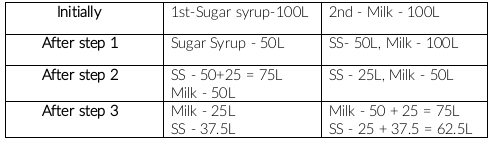
There are two containers of the same volume, first container half-filled with sugar syrup and the second container half-filled with milk. Half the content of the first container is transferred to the second container, and then the half of this mixture is transferred back to the first container. Next, half the content of the first container is transferred back to the second container. Then the ratio of sugar syrup and milk in the second container is
Step 1: Half the content of the first container is transferred to the second container
Step 2: Half of the mixture of second container is transferred back to the first container
Step 3: Half the content of the first container is transferred back to the second container
Sugar syrup : Milk in second container = 62.5 : 75 = 5 : 6
The answer is option D.
From a container filled with milk, 9 litres of milk are drawn and replaced with water. Next, from the same container, 9 litres are drawn and again replaced with water. If the volumes of milk and water in the container are now in the ratio of 16 : 9, then the capacity of the container, in litres, is
Let initial volume be V, final be F for milk.
The formula is given by : $$F\ =\ V\cdot\left(1-\frac{K}{V}\right)^n$$ n is the number of times the milk is drawn and replaced.
so we get $$F=\ V\left(1-\frac{K}{V}\right)^{^2}$$
here K =9
we get
$$\frac{16}{25}V\ =\ V\ \left(1-\frac{9}{V}\right)^{^2}$$
we get $$1-\frac{9}{V}=\ \frac{4}{5}or\ -\frac{4}{5}$$
If considering $$1-\frac{9}{V}=-\frac{4}{5}$$
V =5, but this is not possible because 9 liters is drawn every time.
Hence : $$1-\frac{9}{V}=\frac{4}{5},\ V\ =\ 45\ liters$$
If a certain weight of an alloy of silver and copper is mixed with 3 kg of pure silver, the resulting alloy will have 90% silver by weight. If the same weight of the initial alloy is mixed with 2 kg of another alloy which has 90% silver by weight, the resulting alloy will have 84% silver by weight. Then, the weight of the initial alloy, in kg, is
Let the alloy contain x Kg silver and y kg copper
Now when mixed with 3Kg Pure silver
we get $$\frac{\left(x+3\right)}{x+y+3}=\frac{9}{10}$$
we get 10x+30 =9x+9y+27
9y-x=3 (1)
Now as per condition 2
silver in 2nd alloy = 2(0.9) =1.8
so we get$$\frac{\left(x+1.8\right)}{x+y+2}=\frac{21}{25}$$
we get 21y-4x =3 (2)
solving (1) and (2) we get y= 0.6 and x =2.4
so x+y = 3
A person buys tea of three different qualities at ₹ 800, ₹ 500, and ₹ 300 per kg, respectively, and the amounts bought are in the proportion 2 : 3 : 5. She mixes all the tea and sells one-sixth of the mixture at ₹ 700 per kg. The price, in INR per kg, at which she should sell the remaining tea, to make an overall profit of 50%, is
Considering the three kinds of tea are A, B, and C.
The price of kind A = Rs 800 per kg.
The price of kind B = Rs 500 per kg.
The price of kind C = Rs 300 per kg.
They were mixed in the ratio of 2 : 3: 5.
1/6 of the total mixture is sold for Rs 700 per kg.
Assuming the ratio of mixture to A = 12kg, B = 18kg, C =30 kg.
The total cost price is 800*12+500*18+300*30 = Rs 27600.
Selling 1/6 which is 10kg for Rs 700/kg the revenue earned is Rs 7000.
In order to have an overall profit of 50 percent on Rs 27600.
Thes selling price of the 60 kg is Rs 27600*1.5 = Rs 41400.
Hence he must sell the remaining 50 kg mixture for Rs 41400 - Rs 7000 = 34400.
Hence the price per kg is Rs 34400/50 = Rs 688
The strength of an indigo solution in percentage is equal to the amount of indigo in grams per 100 cc of water. Two 800 cc bottles are filled with indigo solutions of strengths 33% and 17%, respectively. A part of the solution from the first bottle is thrown away and replaced by an equal volume of the solution from the second bottle. If the strength of the indigo solution in the first bottle has now changed to 21% then the volume, in cc, of the solution left in the second bottle is
Let Bottle A have an indigo solution of strength 33% while Bottle B have an indigo solution of strength 17%.
The ratio in which we mix these two solutions to obtain a resultant solution of strength 21% : $$\frac{A}{B}=\frac{21-17}{33-21}=\frac{4}{12}or\ \frac{1}{3}$$
Hence, three parts of the solution from Bottle B is mixed with one part of the solution from Bottle A. For this process to happen, we need to displace 600 cc of solution from Bottle A and replace it with 600 cc of solution from Bottle B {since both bottles have 800 cc, three parts of this volume = 600cc}.As a result, 200 cc of the solution remains in Bottle B.
Hence, the correct answer is 200 cc.
Two alcohol solutions, A and B, are mixed in the proportion 1:3 by volume. The volume of the mixture is then doubled by adding solution A such that the resulting mixture has 72% alcohol. If solution A has 60% alcohol, then the percentage of alcohol in solution B is
Initially let's consider A and B as one component
The volume of the mixture is doubled by adding A(60% alcohol) i.e they are mixed in 1:1 ratio and the resultant mixture has 72% alcohol.
Let the percentage of alcohol in component 1 be 'x'.
Using allegations , $$\frac{\left(72-60\right)}{x-72}=\frac{1}{1}$$ => x= 84
Percentage of alcohol in A = 60% => Let's percentage of alcohol in B = x%
The resultant mixture has 84% alcohol. ratio = 1:3
Using allegations , $$\frac{\left(x-84\right)}{84-60}=\frac{1}{3}$$
=> x= 92%
A solution, of volume 40 litres, has dye and water in the proportion 2 : 3. Water is added to the solution to change this proportion to 2 : 5. If one fourths of this diluted solution is taken out, how many litres of dye must be added to the remaining solution to bring the proportion back to 2 : 3?
Initially the amount of Dye and Water are 16,24 respectively.
To make the ratio of Dye to Water to 2:5 the amount of water should be 40l for 16l of Dye=> 16l of water is added.
Now, the Dye and Water arr 16,40 respectively.
After removing 1/4th of solution the amount of Dye and Water will be 12,30l respectively.
To have Dye and Water in the ratio of 2:3, for 30l of water we need 20l of Dye => 8l of Dye should be added.
Hence , 8 is correct answer.
An alloy is prepared by mixing three metals A, B and C in the proportion 3 : 4 : 7 by volume. Weights of the same volume of the metals A. B and C are in the ratio 5 : 2 : 6. In 130 kg of the alloy, the weight, in kg. of the metal C is
Let the volume of Metals A,B,C we 3x, 4x, 7x
Ratio weights of given volume be 5y,2y,6y
.'. 15xy+8xy+42xy=130 => 65xy=130 => xy=2.
.'.`The weight, in kg. of the metal C is 42xy=84.
The strength of a salt solution is p% if 100 ml of the solution contains p grams of salt. Each of three vessels A, B, C contains 500 ml of salt solution of strengths 10%, 22%, and 32%, respectively. Now, 100 ml of the solution in vessel A is transferred to vessel B. Then, 100 ml of the solution in vessel B is transferred to vessel C. Finally, 100 ml of the solution in vessel C is transferred to vessel A. The strength, in percentage, of the resulting solution in vessel A is
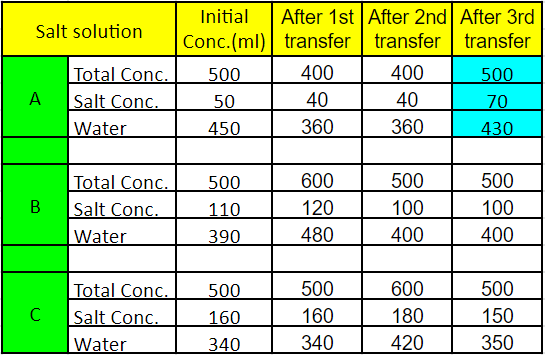
Each of three vessels A, B, C contains 500 ml of salt solution of strengths 10%, 22%, and 32%, respectively.
The amount of salt in vessels A, B, C = 50 ml, 110 ml, 160 ml respectively.
The amount of water in vessels A, B, C = 450 ml, 390 ml, 340 ml respectively.
In 100 ml solution in vessel A, there will be 10ml of salt and 90 ml of water
Now, 100 ml of the solution in vessel A is transferred to vessel B. Then, 100 ml of the solution in vessel B is transferred to vessel C. Finally, 100 ml of the solution in vessel C is transferred to vessel A
i.e after the first transfer, the amount of salt in vessels A, B, C = 40, 120, 160 ml respectively.
after the second transfer, the amount of salt in vessels A, B, C =40, 100, 180 ml respectively.
After the third transfer, the amount of salt in vessels A, B, C = 70, 100, 150 respectively.
Each transfer can be captured through the following table.
Percentage of salt in vessel A =$$\ \frac{\ 70}{500}\times\ 100$$
=14%
A chemist mixes two liquids 1 and 2. One litre of liquid 1 weighs 1 kg and one litre of liquid 2 weighs 800 gm. If half litre of the mixture weighs 480 gm, then the percentage of liquid 1 in the mixture, in terms of volume, is
The weight/volume(g/L) for liquid 1 = 1000
The weight/volume(g/L) for liquid 2 = 800
The weight/volume(g/L) of the mixture = 480/(1/2) = 960
Using alligation the ratio of liquid 1 and liquid 2 in the mixture = (960-800)/(1000-960) = 160/40 = 4:1
Hence the percentage of liquid 1 in the mixture = 4*100/(4+1)=80
A 20% ethanol solution is mixed with another ethanol solution, say, S of unknown concentration in the proportion 1:3 by volume. This mixture is then mixed with an equal volume of 20% ethanol solution. If the resultant mixture is a 31.25% ethanol solution, then the unknown concentration of S is
Let the volume of the first and the second solution be 100 and 300.
When they are mixed, quantity of ethanol in the mixture
= (20 + 300S)
Let this solution be mixed with equal volume i.e. 400 of third solution in which the strength of ethanol is 20%.
So, the quantity of ethanol in the final solution
= (20 + 300S + 80) = (300S + 100)
It is given that, 31.25% of 800 = (300S + 100)
or, 300S + 100 = 250
or S = $$\frac{1}{2}$$ = 50%
Hence, 50 is the correct answer.
Two types of tea, A and B, are mixed and then sold at Rs. 40 per kg. The profit is 10% if A and B are mixed in the ratio 3 : 2, and 5% if this ratio is 2 : 3. The cost prices, per kg, of A and B are in the ratio
The selling price of the mixture is Rs.40/kg.
Let a be the price of 1 kg of tea A in the mixture and b be the price per kg of tea B.
It has been given that the profit is 10% if the 2 varieties are mixed in the ratio 3:2
Let the cost price of the mixture be x.
It has been given that 1.1x = 40
x = 40/1.1
Price per kg of the mixture in ratio 3:2 = $$\frac{3a+2b}{5} $$
$$\frac{3a+2b}{5} = \frac{40}{1.1}$$
$$3.3a+2.2b=200$$ --------(1)
The profit is 5% if the 2 varieties are mixed in the ratio 2:3.
Price per kg of the mixture in ratio 2:3 = $$\frac{2a+3b}{5}$$
$$\frac{2a+3b}{5} = \frac{40}{1.05}$$
$$2.1a+3.15b=200$$ ------(2)
Equating (1) and (2), we get,
$$3.3a+2.2b = 2.1a+3.15b$$
$$1.2a=0.95b$$
$$\frac{a}{b} = \frac{0.95}{1.2}$$
$$\frac{a}{b} = \frac{19}{24}$$
Therefore, option C is the right answer.
A wholesaler bought walnuts and peanuts, the price of walnut per kg being thrice that of peanut per kg. He then sold 8 kg of peanuts at a profit of 10% and 16 kg of walnuts at a profit of 20% to a shopkeeper. However, the shopkeeper lost 5 kg of walnuts and 3 kg of peanuts in transit. He then mixed the remaining nuts and sold the mixture at Rs. 166 per kg, thus making an overall profit of 25%. At what price, in Rs. per kg, did the wholesaler buy the walnuts?
Let the price of peanuts be Rs. 100x per kg
Then, the price of walnuts = Rs. 300x per kg
Cost price of peanuts for the shopkeeper = Rs. 110x per kg
Cost price of walnuts for the shopkeeper = Rs. 360x per kg
Total cost incurred to the shopkeeper while buying = Rs.(8 * 110x + 16 * 360x) = Rs. 6640x
Since, 5kg walnut and 3kg peanuts are lost in transit, the shopkeeper will be remained with (16-5)+(8-3)=16kgs of nuts
Total selling price that the shopkeeper got = Rs. (166 * 16) = Rs. 2656
Profit = 25%
So, cost price = Rs. 2124.80
Therefore, 6640x = 2124.80
On solving, we get x = 0.32
Therefore, price of walnuts = Rs. (300 * 0.32) = Rs. 96 per kg.
Hence, option A is the correct answer
A trader sells 10 litres of a mixture of paints A and B, where the amount of B in the mixture does not exceed that of A. The cost of paint A per litre is Rs. 8 more than that of paint B. If the trader sells the entire mixture for Rs. 264 and makes a profit of 10%, then the highest possible cost of paint B, in Rs. per litre, is
Let the price of paint B be x.
Price of paint A = x+8
We know that the amount of paint B in the mixture does not exceed the amount of paint A. Therefore, paint B can at the maximum compose 50% of the mixture.
The seller sells 10 litres of paint at Rs.264 earning a profit of 10%.
=> The cost price of 10 litres of the paint mixture = Rs. 240
Therefore, the cost of 1 litre of the mixture = Rs.24
We have to find the highest possible cost of paint B.
When we increase the cost of paint B, the cost of paint A will increase too. If the cost price of the mixture is closer to the cost of paint B, then the amount of paint B present in the mixture should be greater than the amount of paint A present in the mixture.
The highest possible cost of paint B will be obtained when the volumes of paint A and paint B in the mixture are equal.
=> (x+x+8)/2 = 24
2x = 40
x = Rs. 20
Therefore, option C is the right answer.
A jar contains a mixture of 175 ml water and 700 ml alcohol. Gopal takes out 10% of the mixture and substitutes it by water of the same amount. The process is repeated once again. The percentage of water in the mixture is now
Final quantity of alcohol in the mixture = $$\dfrac{700}{700+175}*(\dfrac{90}{100})^2*[700+175]$$ = 567 ml
Therefore, final quantity of water in the mixture = 875 - 567 = 308 ml
Hence, we can say that the percentage of water in the mixture = $$\dfrac{308}{875}\times 100$$ = 35.2 %
There are two drums, each containing a mixture of paints A and B. In drum 1, A and B are in the ratio 18 : 7. The mixtures from drums 1 and 2 are mixed in the ratio 3 : 4 and in this final mixture, A and B are in the ratio 13 : 7. In drum 2, then A and B were in the ratio
It is given that in drum 1, A and B are in the ratio 18 : 7.
Let us assume that in drum 2, A and B are in the ratio x : 1.
It is given that drums 1 and 2 are mixed in the ratio 3 : 4 and in this final mixture, A and B are in the ratio 13 : 7.
By equating concentration of A
$$\Rightarrow$$ $$\dfrac{3*\dfrac{18}{18+7}+4*\dfrac{x}{x+1}}{3+4} = \dfrac{13}{13+7}$$
$$\Rightarrow$$ $$\dfrac{54}{25}+\dfrac{4x}{x+1} = \dfrac{91}{20}$$
$$\Rightarrow$$ $$\dfrac{4x}{x+1} = \dfrac{239}{100}$$
$$\Rightarrow$$ $$x = \dfrac{239}{161}$$
Therefore, we can say that in drum 2, A and B are in the ratio $$\dfrac{239}{161}$$ : 1 or 239 : 161.
The strength of a salt solution is p% if 100 ml of the solution contains p grams of salt. If three salt solutions A, B, C are mixed in the proportion 1 : 2 : 3, then the resulting solution has strength 20%. If instead the proportion is 3 : 2 : 1, then the resulting solution has strength 30%. A fourth solution, D, is produced by mixing B and C in the ratio 2 : 7. The ratio of the strength of D to that of A is
Let 'a', 'b' and 'c' be the concentration of salt in solutions A, B and C respectively.
It is given that three salt solutions A, B, C are mixed in the proportion 1 : 2 : 3, then the resulting solution has strength 20%.
$$\Rightarrow$$ $$\dfrac{a+2b+3c}{1+2+3} = 20$$
$$\Rightarrow$$ $$a+2b+3c = 120$$ ... (1)
If instead the proportion is 3 : 2 : 1, then the resulting solution has strength 30%.
$$\Rightarrow$$ $$\dfrac{3a+2b+c}{1+2+3} = 30$$
$$\Rightarrow$$ $$3a+2b+c = 180$$ ... (2)
From equation (1) and (2), we can say that
$$\Rightarrow$$ $$b+2c = 45$$
$$\Rightarrow$$ $$b = 45 - 2c$$
Also, on subtracting (1) from (2), we get
$$a - c = 30$$
$$\Rightarrow$$ $$a = 30 + c$$
In solution D, B and C are mixed in the ratio 2 : 7
So, the concentration of salt in D = $$\dfrac{2b + 7c}{9}$$ = $$\dfrac{90 - 4c + 7c}{9}$$ = $$\dfrac{90 + 3c}{9}$$
Required ratio = $$\dfrac{90 + 3c}{9a}$$ = $$\dfrac{90 + 3c}{9 (30 + c)}$$ = $$1 : 3$$
Hence, option B is the correct answer.
Bottle 1 contains a mixture of milk and water in 7: 2 ratio and Bottle 2 contains a mixture of milk and water in 9: 4 ratio. In what ratio of volumes should the liquids in Bottle 1 and Bottle 2 be combined to obtain a mixture of milk and water in 3:1 ratio?
The ratio of milk and water in Bottle 1 is 7:2 and the ratio of milk and water in Bottle 2 is 9:4
Therefore, the proportion of milk in Bottle 1 is $$\frac{7}{9}$$ and the proportion of milk in Bottle 2 is $$\frac{9}{13}$$
Let the ratio in which they should be mixed be equal to X:1.
Hence, the total volume of milk is $$\frac{7X}{9}+\frac{9}{13}$$
The total volume of water is $$\frac{2X}{9}+\frac{4}{13}$$
They are in the ratio 3:1
Hence, $$\frac{7X}{9}+\frac{9}{13} = 3*(\frac{2X}{9}+\frac{4}{13})$$
Therefore, $$91X+81=78X+108$$
Therefore $$X = \frac{27}{13}$$
Consider three mixtures — the first having water and liquid A in the ratio 1:2, the second having water and liquid B in the ratio 1:3, and the third having water and liquid C in the ratio 1:4. These three mixtures of A, B, and C, respectively, are further mixed in the proportion 4: 3: 2. Then the resulting mixture has
The proportion of water in the first mixture is $$\frac{1}{3}$$
The proportion of Liquid A in the first mixture is $$\frac{2}{3}$$
The proportion of water in the second mixture is $$\frac{1}{4}$$
The proportion of Liquid B in the second mixture is $$\frac{3}{4}$$
The proportion of water in the third mixture is $$\frac{1}{5}$$
The proportion of Liquid C in the third mixture is $$\frac{4}{5}$$
As they are mixed in the ratio 4:3:2, the final amount of water is $$4 \times \frac{1}{3} + 3 \times \frac{1}{4} + 2 \times \frac{1}{5} = \frac{149}{60}$$
The final amount of Liquid A in the mixture is $$4\times\frac{2}{3} = \frac{8}{3}$$
The final amount of Liquid B in the mixture is $$3\times\frac{3}{4} = \frac{9}{4}$$
The final amount of Liquid C in the mixture is $$2\times\frac{4}{5} = \frac{8}{5}$$
Hence, the ratio of Water : A : B : C in the final mixture is $$\frac{149}{60}:\frac{8}{3}:\frac{9}{4}:\frac{8}{5} = 149:160:135:96$$
From the given choices, only option C is correct.
A milkman mixes 20 litres of water with 80 litres of milk. After selling one-fourth of this mixture, he adds water to replenish the quantity that he had sold. What is the current proportion of water to milk?
After selling 1/4th of the mixture, the remaining quantity of water is 15 liters and milk is 60 liters. So the milkman would add 25 liters of water to the mixture. The total amount of water now is 40 liters and milk is 60 liters. Therefore, the required ratio is 2:3.
Fresh grapes contain 90% water by weight while dried grapes contain 20% water by weight and the remaining proportion being pulp. What is the weight of dry grapes available from 20 kg of fresh grapes?
Fresh grapes contain 90% water so water in 20kg of fresh pulp = (90/100)x20= 18kg.
In 20kg fresh grapes, the weight of water is 18kg and the weight of pulp is 2kg.
The concept that we apply in this question is that the weight of pulp will remain the same in both dry and fresh grapes. If this grape is dried, the water content will change but pulp content will remain the same.
Suppose the weight of the dry grapes be D.
80% of the weight of dry grapes = weight of the pulp = 2 kg
(80/100) x D =2 kg.
D = 2.5 kg
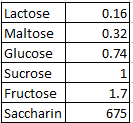
DIRECTIONS for the following two questions: The following table presents the sweetness of different items relative to sucrose, whose sweetness is taken to be 1.00.
What is the maximum amount of sucrose (to the nearest gram) that can be added to one-gram of saccharin such that the final mixture obtained is atleast 100 times as sweet as glucose?
For the mixture to be 100 times as sweet as glucose, its sweetness relative to the mixture should be at least 74.
1 gm of saccharin = 675
Let the number of grams of sucrose to be added be N. Thus, the total weight of the mixture = N + 1.
So, (675 + N) / (N+1) = 74
=> 675 + N = 74N + 74
=> 601 = 73N => N = 8.23
When N=9, sweetness will be S = (675+9)/10 = 684/10 = 68.4
When N=8, sweetness will be S = (675+8)/9 = 683/9 = 75.8
So, option b) is the correct answer.
DIRECTIONS for the following two questions: The following table presents the sweetness of different items relative to sucrose, whose sweetness is taken to be 1.00.
Approximately how many times sweeter than sucrose is a mixture consisting of glucose, sucrose and fructose in the ratio of 1: 2: 3?
The relative sweetness of the mixture is (1*0.74 + 2*1 + 3*1.7) / (1+2+3) = 7.84/6 = 1.30
Option a) is the correct answer.
There are two containers: the first contains 500 ml of alcohol, while the second contains 500 ml of water. Three cups of alcohol from the first container is taken out and is mixed well in the second container. Then three cups of this mixture is taken out and is mixed in the first container. Let A denote the proportion of water in the first container and B denote the proportion of alcohol in the second container. Then,
Let the volume of the cup be V.
Hence, after removing three cups of alcohol from the first container,
Volume of alcohol in the first container is 500-3V
Volume of water in the second container is 500 and volume of alcohol in the second container is 3V.
So, in each cup, the amount of water contained is $$\frac{500}{500+3V}*V$$
Hence, after adding back 3 cups of the mixture, amount of water in the first container is $$0+\frac{1500V}{500+3V} $$
Amount of alcohol contained in the second container is $$3V - \frac{9V^2}{500+3V} = \frac{1500V}{500+3V}$$
So, the required proportion of water in the first container and alcohol in the second container are equal.
Fresh grapes contain 90% water while dry grapes contain 20% water. What is the weight of dry grapes obtained from 20 kg fresh grapes?
Let the total weight of fresh grapes be 100 gm.
=> Fresh grapes have 90 gm of water and 10 gm of fruit.
When these grapes are dried, the amount of fruit does not change.
=> 10 grams will become 80% of the content in dry grapes
=> Weight of dry grapes = $$\frac{10}{0.8}$$ = 12.5 gm
So, the weight of fresh grapes reduces to 1/8th of its original weight.
=> 20 kg of fresh grapes give 2.5 kg of dry grapes.
Two liquids A and B are in the ratio 5 : 1 in container 1 and 1 : 3 in container 2. In what ratio should the contents of the two containers be mixed so as to obtain a mixture of A and B in the ratio 1 : 1?
Fraction of A in contained 1 = $$\frac{5}{6}$$
Fraction of A in contained 2 = $$\frac{1}{4}$$
Let the ratio of liquid required from containers 1 and 2 be x:1-x
x($$\frac{5}{6}$$) + (1-x)($$\frac{1}{4}$$) = $$\frac{1}{2}$$
$$\frac{7x}{12}$$ = $$\frac{1}{4}$$
=> x = $$\frac{3}{7}$$
=> Ratio = 3:4