91- 6303239042
 CAT WhatsApp Group


 Preferred Source

 Google Discover
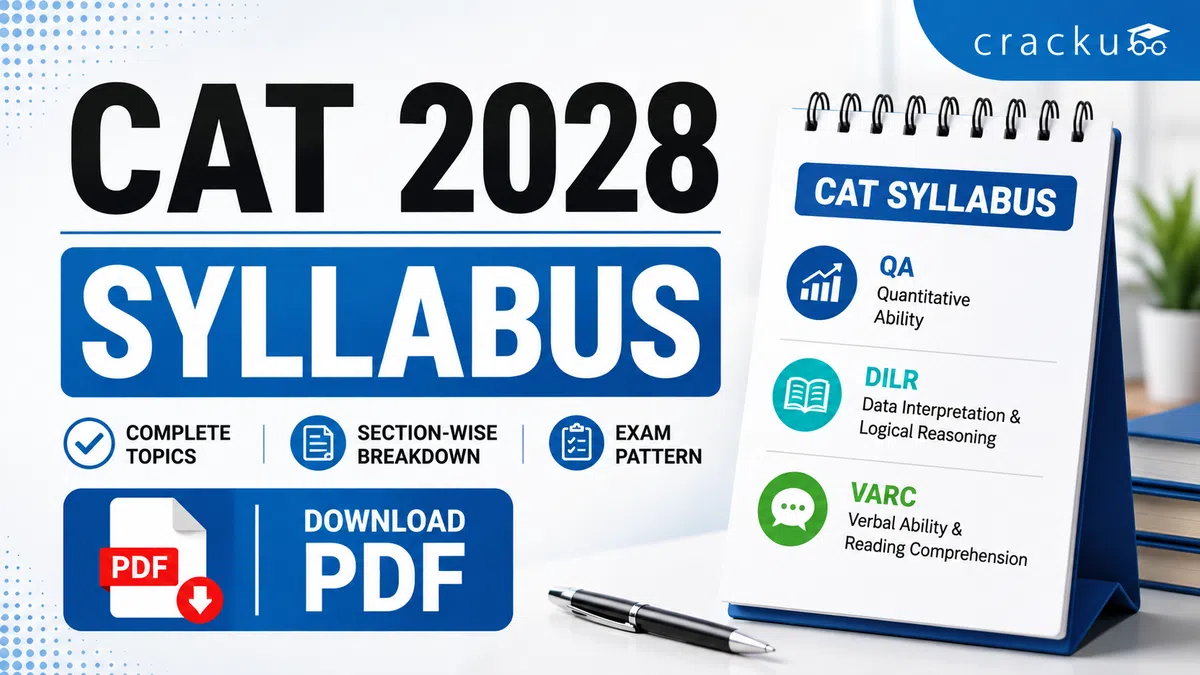
The CAT 2028 syllabus is the starting point for aspirants planning to target IIMs and other leading MBA colleges through the Common Admission Test. Starting early can be useful, but only when preparation is built around the right topics instead of trying to study everything with equal intensity.
An important point for CAT 2028 aspirants is that IIMs do not traditionally release a detailed chapter-by-chapter CAT syllabus. The syllabus is inferred from previous CAT papers and recurring question types. Based on the current CAT structure, CAT 2028 is expected to contain three sections: Verbal Ability and Reading Comprehension (VARC), Data Interpretation and Logical Reasoning (DILR), and Quantitative Ability (QA).
Since CAT 2028 is still more than two years away, the exact number of questions, section-wise distribution and marking scheme should be treated as expected until the official CAT 2028 notification is released.
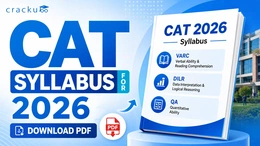
CAT 2028 Syllabus PDF
The CAT 2028 syllabus PDF can be used as a section-wise preparation checklist containing important VARC, DILR and Quant topics.
A useful syllabus PDF should help aspirants track three stages of preparation: understanding the concept, practising CAT-level questions and testing the topic through sectional tests or mocks.
For example, learning percentages is only the first step. You should also be comfortable applying percentages to Profit and Loss, Ratios, Mixtures and Data Interpretation questions.
Cracku's current CAT syllabus resources similarly organise the syllabus section-wise and provide downloadable material based on topics repeatedly tested in previous CAT exams.
CAT 2028 Syllabus Overview
The CAT syllabus tests three very different abilities. VARC checks reading and interpretation, DILR tests structured problem-solving, while Quant measures mathematical reasoning.
Here is the expected section-wise CAT 2028 syllabus:
CAT Section | Major Areas | Key Skill Tested |
VARC | Reading Comprehension, Para Summary, Para Jumbles, Para Completion, Odd Sentence | Reading, inference and verbal reasoning |
DILR | Arrangements, Games and Tournament, Puzzles, Tables, Charts, Caselets, Selection, Routes and Networks, Scheduling, Venn Diagrams | Logical analysis and set selection |
Quantitative Ability | Arithmetic, Algebra, Geometry, Number Systems, Modern Maths | Mathematical reasoning and problem-solving |
The goal should not be to simply finish this list. CAT frequently combines concepts and presents familiar ideas in unfamiliar ways. A topic is truly complete only when you can recognise and solve its questions under time pressure.
CAT Section-wise Syllabus Analysis
Based on the current CAT pattern referenced by Cracku, the exam contains 68 questions divided across three sections, with 40 minutes available for each section. The present structure has 24 VARC questions, 22 DILR questions and 22 Quant questions.
Section | Current Reference Pattern | Preparation Focus for CAT 2028 |
VARC | 24 questions | RC accuracy and option elimination |
DILR | 22 questions | Set selection and diverse puzzle practice |
QA | 22 questions | Arithmetic and Algebra foundation followed by full syllabus coverage |
Total | 68 questions | Balanced sectional preparation |
These figures should not be considered confirmed for CAT 2028. CAT has changed its question count in the past, so aspirants should follow the official notification released for their exam year.
CAT VARC Syllabus and Important Topics
The CAT VARC syllabus consists mainly of Reading Comprehension and Verbal Ability. In the recent CAT structure, Reading Comprehension has occupied the largest portion of the section. Cracku's current syllabus analysis uses a reference distribution of around 16 RC questions in a 24-question VARC section.
VARC Topic | CAT 2028 Preparation Priority |
Reading Comprehension | Very High |
Para Summary | High |
Para Completion/Insertion | High |
Para Jumbles | High |
Odd Sentence/Odd One Out | Moderate to High |
RC passages can come from unfamiliar areas such as philosophy, science, economics, literature, society and history. Therefore, memorising vocabulary lists alone is not enough. CAT VARC preparation should focus on identifying the author's argument, understanding tone, drawing valid inferences and eliminating attractive but incorrect options.
CAT DILR Syllabus and Important Topics
The CAT DILR syllabus is difficult to define chapter by chapter because the exam can combine several reasoning concepts within a single set.
Important areas include arrangements, games and tournaments, selection problems, scheduling, Venn diagrams, logical puzzles, tables, graphs, caselets, missing-value problems and other constraint-based sets.
DILR Area | Preparation Priority |
Puzzles and Arrangements | Very High |
Tables, Graphs and Caselets | Very High |
Selection and Distribution | High |
Games and Tournaments | High |
Scheduling and Sequencing | High |
Venn Diagrams and Networks | Moderate to High |
The biggest DILR lesson is that set selection matters as much as solving ability. Practising only one familiar type of arrangement can create false confidence. CAT may present a completely new-looking set, so aspirants should develop the ability to identify constraints and estimate whether a set is worth attempting.
CAT Quant Syllabus and Important Topics
The CAT Quant syllabus can broadly be divided into Arithmetic, Algebra, Geometry, Number Systems and Modern Mathematics. Cracku's recent CAT syllabus analysis identifies Arithmetic and Algebra as particularly important areas based on past papers.
Quant Area | Important Topics | Priority |
Arithmetic | Percentages, Ratios, Averages, Profit and Loss, Simple Interest and Compound Interest, Time and Work, Time Speed and Distance, Mixtures and Solution | Very High |
Algebra | Linear Equations, Inequalities, Polynomials, Functions and Graph, Logarithms, Surds and Indices | Very High |
Geometry | Triangles, Circles, Quadrilaterals, Coordinate Geometry, Mensuration | High |
Number Systems | Divisibility, Factors, Remainders, HCF and LCM | Medium to High |
Modern Maths | Progression and Series (Sequences), Permutation & Combination, Probability and Combinatorics | Medium |
Arithmetic is usually the best starting point because its concepts overlap heavily. Algebra should follow closely rather than being postponed until the end. Geometry, Numbers and Modern Maths may contribute fewer questions in some papers, but leaving them completely untouched can cost easy marks.
CAT 2028 Topic-Wise Weightage & Important Topics
There is no guaranteed CAT 2028 topic-wise weightage. Any website claiming an exact number of questions from each chapter years before the exam should be treated cautiously.
Recent CAT trends can, however, help determine preparation priority. Cracku's current analysis highlights Reading Comprehension in VARC, Arithmetic and Algebra in Quant, and puzzles, arrangements and DI-based sets in DILR as major areas.
Topic/Area | Recent Trend | CAT 2028 Priority |
Reading Comprehension | Largest VARC component | Very High |
Para-based VA Questions | Regular presence | High |
Puzzles and Arrangements | Frequently tested | Very High |
DI Tables/Graphs/Caselets | Frequently tested | Very High |
Arithmetic | High QA contribution | Very High |
Algebra | High QA contribution | Very High |
Geometry | Regular presence | High |
Numbers and Modern Maths | Variable presence | Medium to High |
Weightage should decide what you study first, not what you completely skip. CAT changes from slot to slot, and a supposedly low-weightage chapter could still contain one of the easiest questions in your paper.
Also Read: CAT Topic-wise Weightage, Section-wise Important Topics
CAT 2028 Exam Pattern & Marking Scheme
The official CAT 2028 exam pattern and marking scheme have not yet been announced. As a preparation reference, the current CAT structure followed by Cracku consists of a computer-based test with three sections and a total duration of 120 minutes. Each section receives 40 minutes.
Particular | Current Pattern for Reference |
Exam Mode | Computer-Based Test |
Sections | VARC, DILR and QA |
Total Questions | 68 |
VARC | 24 questions |
DILR | 22 questions |
QA | 22 questions |
Total Duration | 120 minutes |
Sectional Time | 40 minutes each |
Correct Answer | +3 marks |
Incorrect MCQ | -1 mark |
Incorrect TITA | No negative marking |
Question Types | MCQ and TITA |
The current format awards +3 marks for a correct response and -1 for an incorrect MCQ, while TITA questions do not carry negative marking. These rules may continue, but CAT 2028 aspirants should verify the pattern once the official notification is released.
For someone starting CAT 2028 preparation early, the most effective sequence is simple: build fundamentals, practice topic-wise CAT questions, move to mixed sets and sectionals, and finally use full-length mocks to develop exam strategy. Completing the syllabus gives you knowledge, but learning when to attempt, skip and move on is what converts that knowledge into a competitive CAT score.
Also Read: CAT Exam Details: Date, Eligibility, Syllabus & Form Fees
CAT 2028 Syllabus: Conclusion
Understanding the CAT 2028 syllabus early gives aspirants enough time to build strong fundamentals across VARC, DILR and Quant. Instead of trying to complete every topic at the same pace, prioritise frequently tested areas such as Reading Comprehension, Arithmetic, Algebra, puzzles and Data Interpretation while gradually covering the complete syllabus. If you're planning to prepare for CAT 2028 and want to cracku CAT, Check out Cracku's CAT 2028 Course.
Since the official CAT 2028 pattern has not yet been announced, use recent Previous Year CAT papers and the current CAT Exam Pattern as preparation references rather than fixed rules. Focus on concepts first, progress to CAT-level practice questions and sectional tests, and eventually use full-length mocks to develop speed, accuracy and question-selection skills. The strongest CAT preparation is not just about completing the syllabus, but learning how to apply it under exam pressure.