Following from the passage, which one of the following may be seen as a characteristic of a utopian society?
 CAT WhatsApp Group
Sign in
Please select an account to continue using cracku.in
↓ →
CAT WhatsApp Group
The passage below is accompanied by a set of questions. Choose the best answer to each question.
We cannot travel outside our neighbourhood without passports. We must wear the same plain clothes. We must exchange our houses every ten years. We cannot avoid labour. We all go to bed at the same time . . . We have religious freedom, but we cannot deny that the soul dies with the body, since ‘but for the fear of punishment, they would have nothing but contempt for the laws and customs of society'. . . . In More’s time, for much of the population, given the plenty and security on offer, such restraints would not have seemed overly unreasonable. For modern readers, however, Utopia appears to rely upon relentless transparency, the repression of variety, and the curtailment of privacy. Utopia provides security: but at what price? In both its external and internal relations, indeed, it seems perilously dystopian.
Such a conclusion might be fortified by examining selectively the tradition which follows More on these points. This often portrays societies where . . . 'it would be almost impossible for man to be depraved, or wicked'. . . . This is achieved both through institutions and mores, which underpin the common life. . . . The passions are regulated and inequalities of wealth and distinction are minimized. Needs, vanity, and emulation are restrained, often by prizing equality and holding riches in contempt. The desire for public power is curbed. Marriage and sexual intercourse are often controlled: in Tommaso Campanella’s The City of the Sun (1623), the first great literary utopia after More’s, relations are forbidden to men before the age of twenty-one and women before nineteen. Communal child-rearing is normal; for Campanella, this commences at age two. Greater simplicity of life, ‘living according to nature’, is often a result: the desire for simplicity and purity are closely related. People become more alike in appearance, opinion, and outlook than they often have been. Unity, order, and homogeneity thus prevail at the cost of individuality and diversity. This model, as J. C. Davis demonstrates, dominated early modern utopianism. . . . And utopian homogeneity remains a familiar theme well into the twentieth century.
Given these considerations, it is not unreasonable to take as our starting point here the hypothesis that utopia and dystopia evidently share more in common than is often supposed. Indeed, they might be twins, the progeny of the same parents. Insofar as this proves to be the case, my linkage of both here will be uncomfortably close for some readers. Yet we should not mistake this argument for the assertion that all utopias are, or tend to produce, dystopias. Those who defend this proposition will find that their association here is not nearly close enough. For we have only to acknowledge the existence of thousands of successful intentional communities in which a cooperative ethos predominates and where harmony without coercion is the rule to set aside such an assertion. Here the individual’s submersion in the group is consensual (though this concept is not unproblematic). It results not in enslavement but voluntary submission to group norms. Harmony is achieved without . . . harming others.
Following from the passage, which one of the following may be seen as a characteristic of a utopian society?
Option A: The author does not discuss a utopian narrative that involves a society without laws or social structure. Instead, he talks about regulations that curb individuality and promote homogeneity. Hence, we can eliminate Option A as a potential choice.
Option B: The second paragraph relays the following idea: "The passions are regulated, and inequalities of wealth and distinction are minimized. Needs, vanity, and emulation are restrained, often by prizing equality and holding riches in contempt. The desire for public power is curbed" Given that public power is not looked at favourably, the entire debate on the mechanism to attain this facet (public power) becomes irrelevant. Thus, we can eliminate Option B.
Option C: "Such a conclusion might be fortified by examining selectively the tradition which follows More on these points. This often portrays societies where . . . 'it would be almost impossible for man to be depraved, or wicked'. . . . This is achieved both through institutions and mores, which underpin the common life" From the above excerpt, it is clarified that the utopian doctrines are enforced by institutions present in the society; additionally, the author mentions in the preceding paragraph that security in a utopian setting is attained through the curtailment of privacy. Hence, Option C is likely to be the correct choice.
Option D: There is no mention of regulating homogeneity through promoting competitive heterogeneity. We can, therefore, eliminate this choice.
Hence, Option C is the correct choice.
All of the following arguments are made in the passage EXCEPT that:
Option A: The statement here appears to be a distortion. The author says: "In More’s time, for much of the population, given the plenty and security on offer, such restraints would not have seemed overly unreasonable." It is being conveyed that the form of restrictions discussed at the beginning of the passage would not seem unreasonable to the citizens/members of More's utopia. However, the author feels that the opinions of modern readers would be drastically different.
Option B: "For we have only to acknowledge the existence of thousands of successful intentional communities in which a cooperative ethos predominates and where harmony without coercion is the rule to set aside such an assertion. Here the individual’s submersion in the group is consensual (though this concept is not unproblematic). It results not in enslavement but voluntary submission to group norms. Harmony is achieved without . . . harming others." Towards the end of the discussion, the author indicates that homogeneity and stability (that often constitute a utopian universe) need not be achieved via coercion. Members of many communities voluntarily concede to the group's norms at the cost of their individuality.
Option C: The statement here correlates to the assertion made by the author in the second paragraph: "Such a conclusion might be fortified by examining selectively the tradition which follows More on these points. This often portrays societies where . . . 'it would be almost impossible for man to be depraved, or wicked'. . . . This is achieved both through institutions and mores, which underpin the common life."
Option D: The introductory segment of the discussion highlights the restraints placed on individual freedom in a utopian society. Furthermore, the author mentions that many most utopian narratives in literary history are built on a premise devoid of individuality or diversity, as stated in the following excerpt: "People become more alike in appearance, opinion, and outlook than they often have been. Unity, order, and homogeneity thus prevail at the cost of individuality and diversity. This model, as J. C. Davis demonstrates, dominated early modern utopianism. . . . And utopian homogeneity remains a familiar theme well into the twentieth century."
Hence, Option A is the correct choice.
Which sequence of words below best captures the narrative of the passage?
The passage begins by portraying a utopian society. The author then discusses the difference in perspective concerning the underlying elements of such a society. A disagreement originates about the perception of security - while the people part of the utopia might find the shackles on their freedom to be reasonable, modern readers perceive this as suppression of heterogeneity and violation of privacy. This is presented with the intention to direct attention towards the tradeoff that exists between security and certain other essential variables. It additionally puts the spotlight on the thin line that exists between a utopia and a dystopia. The author then cites other works in literary history that depict a utopian setting along with certain key attributes that one might stumble upon in such narratives. Homogeneity comes across as a prominent idea (a set of beliefs are considered acceptable, and the masses are expected to conform to the same). Towards the end of the discussion, the author reiterates the thin film that separates a utopia from a dystopia. He adds that while many individuals might be tempted to use these two ideas interchangeably, this shouldn't be the case. According to the author, the assertion that "all utopias are, or tend to produce, dystopias" is fallacious. He presents justification concerning the same: there are many utopian settings wherein conformity to doctrines or sacrifice of individuality is intentional - the person voluntarily submits to the group's norms for the greater good. This resonates with the term intentional community stated in the options. Option A aptly captures these principal themes.

All of the following statements can be inferred from the passage EXCEPT that:
Option A:
Indeed, they might be twins, the progeny of the same parents. Insofar as this proves to be the case, my linkage of both here will be uncomfortably close for some readers.
The above excerpt implies that utopia and dystopia might be twins. The level of certainty is not absolute. However, Option A goes one step further to assert that they are twins and the progeny of the same parents. Hence, A cannot be inferred and is the answer.
'Insofar as this proves to be the case' can cause confusion while answering. But note that the case the author is talking about is the level of similarity between the two. Hence, what is being proven is that the two are quite similar to each other, and hence some would presume that they are twins. The excerpt, however, does not support that they actually are.
Option B: The whole passage supports the inference that utopias can be perceived as dystopias by different people. E.g. The author mentions that where some people push for relentless transparency so that they are secure, some people would perceive this as a breach of their privacy. Hence, a utopia for the former would be a dystopia for the latter.
Option C:
People become more alike in appearance, opinion, and outlook than they often have been. Unity, order, and homogeneity thus prevail at the cost of individuality and diversity. This model, as J. C. Davis demonstrates, dominated early modern utopianism. . . . And utopian homogeneity remains a familiar theme well into the twentieth century.
Option C is a direct inference from the above excerpt. It has been mentioned that this theme of homogeneity and uniformity dominated early modern utopianism.
Option D: Throughout the passage, the author deals with conceptions of utopian societies as dealt with in literary works. We can infer that utopian societies do exist in literature where the characters practice traditions that the author made up to portray a utopian society.
The passage below is accompanied by a set of questions. Choose the best answer to each question.
For the Maya of the Classic period, who lived in Southern Mexico and Central America between 250 and 900 CE, the category of ‘persons’ was not coincident with human beings, as it is for us. That is, human beings were persons - but other, nonhuman entities could be persons, too. . . . In order to explore the slippage of categories between ‘humans’ and ‘persons’, I examined a very specific category of ancient Maya images, found painted in scenes on ceramic vessels. I sought out instances in which faces (some combination of eyes, nose, and mouth) are shown on inanimate objects. . . . Consider my iPhone, which needs to be fed with electricity every night, swaddled in a protective bumper, and enjoys communicating with other fellow-phone-beings. Does it have personhood (if at all) because it is connected to me, drawing this resource from me as an owner or source? For the Maya (who did have plenty of other communicating objects, if not smartphones), the answer was no. Nonhuman persons were not tethered to specific humans, and they did not derive their personhood from a connection with a human. . . . It’s a profoundly democratising way of understanding the world. Humans are not more important persons - we are just one of many kinds of persons who inhabit this world. . . .
The Maya saw personhood as ‘activated’ by experiencing certain bodily needs and through participation in certain social activities. For example, among the faced objects that I examined, persons are marked by personal requirements (such as hunger, tiredness, physical closeness), and by community obligations (communication, interaction, ritual observance). In the images I examined, we see, for instance, faced objects being cradled in humans’ arms; we also see them speaking to humans. These core elements of personhood are both turned inward, what the body or self of a person requires, and outward, what a community expects of the persons who are a part of it, underlining the reciprocal nature of community membership. .
Personhood was a nonbinary proposition for the Maya. Entities were able to be persons while also being something else. The faced objects I looked at indicate that they continue to be functional, doing what objects do (a stone implement continues to chop, an incense burner continues to do its smoky work). Furthermore, the Maya visually depicted many objects in ways that indicated the material category to which they belonged - drawings of the stone implement show that a person-tool is still made of stone. One additional complexity: the incense burner (which would have been made of clay, and decorated with spiky appliques representing the sacred ceiba tree found in this region) is categorised as a person - but also as a tree. With these Maya examples, we are challenged to discard the person/nonperson binary that constitutes our basic ontological outlook. . . . The porousness of boundaries that we have seen in the Maya world points towards the possibility of living with a certain uncategorisability of the world.
Which one of the following, if true about the Classic Maya, would invalidate the purpose of the iPhone example in the passage?
The author supplements the example of the i-phone with a pertinent question: "Does it have personhood (if at all) because it is connected to me, drawing this resource from me as an owner or source?" He proceeds to then highlight the key takeaway from the example: "For the Maya (who did have plenty of other communicating objects, if not smartphones), the answer was no. Nonhuman persons were not tethered to specific humans, and they did not derive their personhood from a connection with a human." The end idea: the personhood of an object is not a function of its utility or attachment to humans {an object can be categorised as a person based on certain distinct variables aside from its relation to a human}. The only relevant information invalidating this portrayal is in Option D: if the personhood of the incense burner or stone chopper is dependent on their usefulness to humans, the purpose of presenting the example and the associated idea is undermined.
It is unclear how Options A and B invalidate the purpose of the example. Option C aligns with the author's assertions and does not touch upon the idea emphasised by the example.
Hence, Option D is the correct choice.
Which one of the following best explains the “additional complexity” that the example of the incense burner illustrates regarding personhood for the Classic Maya?
One additional complexity: the incense burner (which would have been made of clay, and decorated with spiky appliques representing the sacred ceiba tree found in this region) is categorised as a person - but also as a tree.
The additional complexity that the author talks about here is the addition of another layer in the non-binary understanding of personhood. The incense burner was already classified as a person, but now it has also been classified as a tree. Hence, we have Options A and C. Note that the third category, that is tree, has a relation with the previous two categories. The boundary separating tree and person is porous. And since the incense burner has been categorized as a tree too, the relationship between them is porous too. Hence, we can infer that the third category shares a similar relationship with the previous two categories, and A is the correct answer.
The author is not exemplifying an exception but citing an additional complexity that is present in the definition. Hence, B can be eliminated.
The author does not establish the porosity of the divine and the profane. Hence, Option D is out of the scope of the passage.

On the basis of the passage, which one of the following worldviews can be inferred to be closest to that of the Classic Maya?
The author highlights multiple elements that constitute the Classic Mayan worldview pertaining to personhood:
Inspecting the options using the above ideas as filters, we notice that Option B is closest to the Classic Mayan worldview. A tribe that "perceives plants as person-plants because they form an ecosystem and are marked by needs of nutrition" acknowledges the two elementary variables for defining personhood - personal requirements and community obligations.
Options A and C tether the personhood of the objects to their utility to humans - this does not coincide with the Classic Mayan belief. Although Option D mentions bodily needs, the interpretation of the term 'functionality' remains unclear. Hence, we can eliminate Option D.
Which one of the following, if true, would not undermine the democratising potential of the Classic Maya worldview?
The idea concerning the democratising potential can be retraced to the first paragraph wherein the author states: "Nonhuman persons were not tethered to specific humans, and they did not derive their personhood from a connection with a human. . . . It’s a profoundly democratising way of understanding the world. Humans are not more important persons - we are just one of many kinds of persons who inhabit this world"
Option A: Considering proximity as an idea would undermine the portrayal of the Classic Mayan worldview. The author presents the example of the I-phone to convey how the personhood of an object is not a function of its utility or attachment to humans. If true, the statement in A would counter the premise of this example. Hence, we can eliminate this choice.
Option B: the assessment here is quite similar to Option A; if we create distinctions within the realm of inanimate objects, this will weaken the Mayan worldview. It would diminish the democratising potential of such a viewpoint by introducing specific barriers or criteria for the classification of personhood.
Option C: The claim here runs against the Mayan idea of personhood being nonbinary. Thus, we can eliminate it since it undermines the democratising potential of the Classic Mayan worldview.
Hence, Option D is the correct choice.
The passage below is accompanied by a set of questions. Choose the best answer to each question.
The sleights of hand that conflate consumption with virtue are a central theme in A Thirst for Empire, a sweeping and richly detailed history of tea by the historian Erika Rappaport. How did tea evolve from an obscure “China drink” to a universal beverage imbued with civilising properties? The answer, in brief, revolves around this conflation, not only by profit-motivated marketers but by a wide variety of interest groups. While abundant historical records have allowed the study of how tea itself moved from east to west, Rappaport is focused on the movement of the idea of tea to suit particular purposes.
Beginning in the 1700s, the temperance movement advocated for tea as a pleasure that cheered but did not inebriate, and industrialists soon borrowed this moral argument in advancing their case for free trade in tea (and hence more open markets for their textiles). Factory owners joined in, compelled by the cause of a sober workforce, while Christian missionaries discovered that tea “would soothe any colonial encounter”. During the Second World War, tea service was presented as a social and patriotic activity that uplifted soldiers and calmed refugees.
But it was tea’s consumer-directed marketing by importers and retailers - and later by brands - that most closely portends current trade debates. An early version of the “farm to table” movement was sparked by anti-Chinese sentiment and concerns over trade deficits, as well as by the reality and threat of adulterated tea containing dirt and hedge clippings. Lipton was soon advertising “from the Garden to Tea Cup” supply chains originating in British India and supervised by “educated Englishmen”. While tea marketing always presented direct consumer benefits (health, energy, relaxation), tea drinkers were also assured that they were participating in a larger noble project that advanced the causes of family, nation and civilization. . . .
Rappaport’s treatment of her subject is refreshingly apolitical. Indeed, it is a virtue that readers will be unable to guess her political orientation: both the miracle of markets and capitalism’s dark underbelly are evident in tea’s complex story, as are the complicated effects of British colonialism. . . . Commodity histories are now themselves commodities: recent works investigate cotton, salt, cod, sugar, chocolate, paper and milk. And morality marketing is now a commodity as well, applied to food, “fair trade” apparel and eco-tourism. Yet tea is, Rappaport makes clear, a world apart - an astonishing success story in which tea marketers not only succeeded in conveying a sense of moral elevation to the consumer but also arguably did advance the cause of civilisation and community.
I have been offered tea at a British garden party, a Bedouin campfire, a Turkish carpet shop and a Japanese chashitsu, to name a few settings. In each case the offering was more an idea - friendship, community, respect - than a drink, and in each case the idea then created a reality. It is not a stretch to say that tea marketers have advanced the particularly noble cause of human dialogue and friendship.
Today, “conflat[ing] consumption with virtue” can be seen in the marketing of:
Although mildly subjective, the question tests our understanding of the central idea. Across the passage, we notice the 'conflation' of tea consumption with particular virtues: it was not merely limited to benefits to the consumer but served a greater purpose. The narrative was that by drinking tea, people were/are advancing the cause of civilisation and community {thereby, imparting a sense of moral elevation}. Thus, the welfare highlighted is two-fold: both the consumer and society is benefitted. Towards the end, the author supports the narrative as follows: "It is not a stretch to say that tea marketers have advanced the particularly noble cause of human dialogue and friendship." Any choice showcasing this dual benefit might be the potential answer.
Option A presents sustainably farmed foods; it is easy to identify that any associated marketing mechanics will emphasise the benefit of such food to both people and the environment. Thus, advertisers will make a case for how sustainably farmed food is beneficial not just to the consumer but also to the world at large. This will be equivalent to the 'conflation' that we came across in the passage.
Option B mentions natural health supplements; although we can discern the benefit to the consumer, the benefits to society is hard to perceive. Similarly, Options C and D appear irrelevant; it is difficult to identify what virtues we are conflating here with the subject.
Hence, of the given choices, Option A appears most appropriate.

The author of this book review is LEAST likely to support the view that:
{During the Second World War, tea service was presented as a social and patriotic activity that uplifted soldiers and calmed refugees.}
{I have been offered tea at a British garden party, a Bedouin campfire, a Turkish carpet shop and a Japanese chashitsu, to name a few settings. In each case the offering was more an idea - friendship, community, respect - than a drink, and in each case the idea then created a reality. It is not a stretch to say that tea marketers have advanced the particularly noble cause of human dialogue and friendship.}
Options A, B and D have been implied in the above excerpts - we can safely assume that the author will agree to the claims made in these options. Option C, however, has not been stated in the passage. There is no information to deduce that the author will agree with the assertions that tea became the leading drink in Britain in the nineteenth century. Thus, Option C is the correct choice.
According to this book review, A Thirst for Empire says that, in addition to “profitmotivated marketers”, tea drinking was promoted in Britain by all of the following EXCEPT:
We can refer to the following excerpt to examine the choices: { Beginning in the 1700s, the temperance movement advocated for tea as a pleasure that cheered but did not inebriate, and industrialists soon borrowed this moral argument in advancing their case for free trade in tea (and hence more open markets for their textiles). Factory owners joined in, compelled by the cause of a sober workforce, while Christian missionaries discovered that tea “would soothe any colonial encounter”. }
Options A, C and D can be directly inferred from the excerpt. The author does not present any information pertaining to tea drinkers lobbying for product diversity - hence, we can identify this as an incorrect reason.
Therefore, Option B is the correct choice.
This book review argues that, according to Rappaport, tea is unlike other “morality” products because it:
An important clue to analyse the options lies in the following excerpt: {Yet tea is, Rappaport makes clear, a world apart - an astonishing success story in which tea marketers not only succeeded in conveying a sense of moral elevation to the consumer but also arguably did advance the cause of civilisation and community.} It is emphasised that the moral praise that tea received was not mere talk - tea as a 'morality product' did produce desirable outcomes. Option A is closest to conveying this idea. Options B, C and D fail to highlight the attribute that separates tea from 'other morality products' {as per the passage}.
Hence, Option A is the correct choice.

The passage below is accompanied by a set of questions. Choose the best answer to each question.
Cuttlefish are full of personality, as behavioral ecologist Alexandra Schnell found out while researching the cephalopod's potential to display self-control. . . . “Self-control is thought to be the cornerstone of intelligence, as it is an important prerequisite for complex decision-making and planning for the future,” says Schnell . . .
[Schnell's] study used a modified version of the “marshmallow test” . . . During the original marshmallow test, psychologist Walter Mischel presented children between age four and six with one marshmallow. He told them that if they waited 15 minutes and didn’t eat it, he would give them a second marshmallow. A long-term follow-up study showed that the children who waited for the second marshmallow had more success later in life. . . . The cuttlefish version of the experiment looked a lot different. The researchers worked with six cuttlefish under nine months old and presented them with seafood instead of sweets. (Preliminary experiments showed that cuttlefishes’ favorite food is live grass shrimp, while raw prawns are so-so and Asian shore crab is nearly unacceptable.) Since the researchers couldn’t explain to the cuttlefish that they would need to wait for their shrimp, they trained them to recognize certain shapes that indicated when a food item would become available. The symbols were pasted on transparent drawers so that the cuttlefish could see the food that was stored inside. One drawer, labeled with a circle to mean “immediate,” held raw king prawn. Another drawer, labeled with a triangle to mean “delayed,” held live grass shrimp. During a control experiment, square labels meant “never.”
“If their self-control is flexible and I hadn’t just trained them to wait in any context, you would expect the cuttlefish to take the immediate reward [in the control], even if it’s their second preference,” says Schnell . . . and that’s what they did. That showed the researchers that cuttlefish wouldn’t reject the prawns if it was the only food available. In the experimental trials, the cuttlefish didn’t jump on the prawns if the live grass shrimp were labeled with a triangle— many waited for the shrimp drawer to open up. Each time the cuttlefish showed it could wait, the researchers tacked another ten seconds on to the next round of waiting before releasing the shrimp. The longest that a cuttlefish waited was 130 seconds.
Schnell [says] that the cuttlefish usually sat at the bottom of the tank and looked at the two food items while they waited, but sometimes, they would turn away from the king prawn “as if to distract themselves from the temptation of the immediate reward.” In past studies, humans, chimpanzees, parrots and dogs also tried to distract themselves while waiting for a reward.
Not every species can use self-control, but most of the animals that can share another trait in common: long, social lives. Cuttlefish, on the other hand, are solitary creatures that don’t form relationships even with mates or young. . . . “We don’t know if living in a social group is important for complex cognition unless we also show those abilities are lacking in less social species,” says . . . comparative psychologist Jennifer Vonk.
All of the following constitute a point of difference between the “original” and “modified” versions of the marshmallow test EXCEPT that:
Options A, C and D have been explicitly stated in the passage (refer to the second paragraph):
A: "...children between age four and six with one marshmallow. He told them that if they waited 15 minutes and didn’t eat it, he would give them a second marshmallow..." Thus, children were the subject under observation in the original marshmallow experiment, while cuttlefish were studied in the modified version of the same.
C: "...Since the researchers couldn’t explain to the cuttlefish that they would need to wait for their shrimp, they trained them to recognize certain shapes that indicated when a food item would become available..." Option C merely rephrase this excerpt.
D: "...A long-term follow-up study showed that the children who waited for the second marshmallow had more success later in life..." Given that the researchers undertook a long term study to map the successes of children showcasing self-control, we can safely conclude that the cuttlefish-version of the experiment was undertaken over a relatively shorter period.
Option B cannot be inferred from the discussion - there is no correlation between selfcontrol and survival advantages. Hence, B is the correct choice.
Which one of the following, if true, would best complement the passage’s findings?
Option A: If true, this would weaken the findings of the experiments. The methodology used to establish the trait of self-restraint in cuttlefish is based on the premise that cuttlefish prefer one specific kind of food over another. If we demonstrate that cuttlefish are equally fond of live grass shrimp and raw prawn, then the observations made in the study become invalid. Therefore, we can eliminate Option A.
Option B: If true, the finding here would support the comments made in the final paragraph. The author states the following: {Not every species can use self-control, but most of the animals that can share another trait in common: long, social lives.} If it is proved that cuttlefish fulfils this ancillary criterion of sociability, the primary claim made in the passage is strengthened.
Option C: If true, the statement here bears no significance to the passage’s findings. [We already know that "..the longest that a cuttlefish waited was 130 seconds..."]
Option D: If true, this would weaken the findings of the experiments. Similar to Option A, the methodology used to establish the trait of self-restraint in cuttlefish is based on the premise that cuttlefish can distinguish between geometrical shapes. If we demonstrate that this information is false, then the observations made in the study become invalid. Therefore, we can eliminate Option D.
Hence, Option B is the correct choice.
Which one of the following cannot be inferred from Alexandra Schnell’s experiment?
Option A: {Each time the cuttlefish showed it could wait, the researchers tacked another ten seconds on to the next round of waiting before releasing the shrimp. The longest that a cuttlefish waited was 130 seconds.} The results of Schnell's experiment indicated that cuttlefish exhibit self-restraint. This was shown to be the case with few children in the original marshmallow experiments. Hence, Option A is correct.
Option B: {Not every species can use self-control, but most of the animals that can share another trait in common: long, social lives.} The author does not imply causation between intelligence and sociability. He merely highlights these two attributes: self-control is considered indicative of intelligence, and most such organisms showcase social lives as well. Hence, B is a distortion and cannot be inferred.
Option C: {Preliminary experiments showed that cuttlefishes’ favorite food is live grass shrimp, while raw prawns are so-so and Asian shore crab is nearly unacceptable.} The above lines depict a preference for certain kinds of food; thus, C is true.
Option D: {Schnell [says] that the cuttlefish usually sat at the bottom of the tank and looked at the two food items while they waited, but sometimes, they would turn away from the king prawn “as if to distract themselves from the temptation of the immediate reward.”} Exerting self-control through distractions has also been presented as a behavioural trait of the cuttlefish.
Hence, Option B is the correct choice.

In which one of the following scenarios would the cuttlefish’s behaviour demonstrate self-control?
The question tests our understanding of the experiment stated in the second paragraph. The key highlights of the modified cuttlefish experiment are:
(a) Food choice: 1st preference - live grass shrimp; 2nd preference - raw prawns; 3rd preference - Asian shore crab
(b) Symbol based training: Circle - immediate availability; Triangle - delayed availability; Square - never available
(c) Observations: in the absence of 1st preference ---> cuttlefish will go for 2nd preference {applies to all such scenarios involving only one food choice}; in the presence of multiple food choices, cuttlefish will wait ---> if 1st pref is available and associated with either Circle or Triangle
Based on the above, we can filter out the given options:
Option A: We know that raw prawns and Asian shore crab are not the primary preference of the cuttlefish. Additionally, we know that live grass shrimp (1st presence) is available for delayed consumption {associated with a Triangle}. If the cuttlefish waits for one minute to consume live grass shrimp and ignores the other two food choices, this definitively showcases that cuttlefish exert self-control. Hence, Option A is a strong candidate for the correct choice since it supplements the experiment's findings.
Option B: In this case, the cuttlefish will go for the raw prawns since it has been conditioned to understand that the box labelled with Square will never open. This does not contribute to establishing self-control in cuttlefish. Thus, we can reject this choice.
Option C: In this case, the cuttlefish will go for the raw prawns and avoid the Asian shore crab irrespective of the box it is placed in. This is because raw prawns fare more favourably as a food choice than Asian shore crab. {We know from points (a) and (c) that the cuttlefish will go for the 2nd preference over the 3rd} This does not contribute to establishing self-control in cuttlefish. Thus, we can reject this choice.
Option D: In this case, the cuttlefish will go for the live grass shrimp and avoid the raw prawns irrespective of the box it is placed in. This is because live grass shrimp fares more favourably as a food choice than raw prawns. {We know from points (a) and (c) that the cuttlefish will go for the 1st preference over the 2nd} This does not contribute to establishing self-control in cuttlefish. Therefore, we can reject this choice.
Hence, the correct answer is Option A.
The passage given below is followed by four alternate summaries. Choose the option that best captures the essence of the passage.
McGurk and MacDonald (1976) reported a powerful multisensory illusion occurring with audio-visual speech. They recorded a voice articulating a consonant ‘ba-ba-ba’ and dubbed it with a face articulating another consonant ‘ga-ga-ga’. Even though the acoustic speech signal was well recognized alone, it was heard as another consonant after dubbing with incongruent visual speech i.e., ‘da-da-da’. The illusion, termed as the McGurk effect, has been replicated many times, and it has sparked an abundance of research. The reason for the great impact is that this is a striking demonstration of multisensory integration, where that auditory and visual information is merged into a unified, integrated percept.
The main points of the paragraph are:
1. A multisensory illusion, dubbing a different visual cue to audio, makes the subject perceive a different sound. (Important point)
2. This illusion is called McGurk effect. (Important point. Related to 1)
3. An impactful subject of research as it demonstrates multisensory integration. (Secondary point. 1 and 2 can stand without this point)
Option A: Covers 1 and 2. Hence, a plausible option.
Option B: It distorts what the author is trying to say. It draws a conclusion out of the results of the study instead of paraphrasing the passage.
Option C: Option C covers only 3. It does not mention 1 and hence is not a good summary.
Option D: Mentions only 1. Not an apt summary.
Hence, the answer is Option A.
Five jumbled up sentences, related to a topic, are given below. Four of them can be put together to form a coherent paragraph. Identify the odd one out and key in the number of the sentence as your answer:
1. There is a dark side to academic research, especially in India, and at its centre is the phenomenon of predatory journals.
2. But in truth, as long as you pay, you can get anything published.
3. In look and feel thus, they are exactly like any reputed journal.
4. They claim to be indexed in the most influential databases, say they possess editorial boards that comprise top scientists and researchers, and claim to have a rigorous peer-review structure.
5. But a large section of researchers and scientists across the world are at the receiving end of nothing short of an academic publishing scam.
The given collection of statements focuses on predatory journals. The author begins by mentioning the subject {Statement 1} in a grim tone. He highlights the kind of claims that these journals state: presence in 'influential databases', quality 'editorial boards' and a 'rigorous peer-review structure' {Statement 4}. On the surface, 'they are exactly like any reputed journal' {Statement 3}. However, the ground reality is starkly different: paying money allows you to publish anything in such predatory journal {Statement 2}. Hence, arrangement 1432 forms a coherent paragraph with predatory journals as the centre of attention.
Statement 5 deviates from this subject. Although the topic seems to be about academic publishing, the focus is no longer on predatory journals, but instead, it becomes a bit broader. Since there is a mismatch in scope, we discern Statement 5 as the odd one out.

The four sentences (labelled 1, 2, 3, 4) below, when properly sequenced would yield a coherent paragraph. Decide on the proper sequencing of the order of the sentences and key in the sequence of the four numbers as your answer:
1. The work is more than the text, for the text only takes on life, when it is realized and furthermore the realization is by no means independent of the individual disposition of the reader.
2. The convergence of text and reader brings the literary work into existence and this convergence is not to be identified either with the reality of the text or with the individual disposition of the reader.
3. From this polarity it follows that the literary work cannot be completely identical with the text, or with the realization of the text, but in fact must lie halfway between the two.
4. The literary work has two poles, which we might call the artistic and the aesthetic; the artistic refers to the text created by the author, and the aesthetic to the realization accomplished by the reader.
A quick scan of the statements tells us that the statements discuss the nature of literary work - how it originates from the convergence of the text and the disposition of the readers. Note the phrase "From this polarity" in statement 3 - this must refer to the distinction presented in statement 4 ["literary work has two poles"] Statement 4 shows how the literary work comprises of two ends - (1) the artistic tied to the text, and (2) the aesthetic tied to the reader's realisation of the text. Statement 3 then underlines how the literary work cannot be equated to either of these and must lie somewhere midway netween the two. This idea is carried forward in Statement 1, which elaborates how the literary work is more than the text and becomes alive only when realised by the reader - in a way, this highlights how the literary work takes form due to the interplay between the artistic and the aesthetic. Statement 2 then extends on this idea of "convergence" [shown in 1] and reiterates the idea in 3 that the literary work, despite being an amalgamation of the two components, must not be mistaken with "the text or with the individual disposition of the reader." Hence, we obtain a coherent paragraph from the arrangement 4-3-1-2.
The passage given below is followed by four alternate summaries. Choose the option that best captures the essence of the passage.
Foreign peacekeepers often exist in a bubble in the poor countries in which they are deployed; they live in posh compounds, drive fancy vehicles, and distance themselves from locals. This may be partially justified as they are outsiders, living in constant fear, performing a job that is emotionally draining. But they are often despised by the locals, and many would like them to leave. A better solution would be bottom-up peacebuilding, which would involve their spending more time working with communities, understanding their grievances and earning their trust, rather than only meeting government officials.
The main points of the paragraph are:
1. The peacekeeping forces often exist in a bubble. Though there are valid reasons behind this, this also results in the locals feeling antipathy towards them.
2. The solution to this problem is to build rapport with the locals too instead of focusing only on the government officials.
Option A: Not implied in the paragraph. The paragraph suggests building relationships with the locals. Appointing only locals as peacekeepers has not been implied.
Option B: This option distorts what is being presented in the paragraph. The paragraph suggests that the bubble is justified sometimes and also suggest measures to counter that. The option implicates the country's environment as being responsible for that bubble, hence the blame is shifted completely. Also, the option fails to mention the antipathy and the measures suggested to counter the bubble.
Option C: This option is distorted. Where the paragraph says that the aloof attitude is justified sometimes, the option blames the peacekeeping forces and their 'extravagant lifestyles' for the antipathy they face. Hence, can be eliminated.
Option D: Option D correctly captures the main points and is the answer.
Five jumbled up sentences, related to a topic, are given below. Four of them can be put together to form a coherent paragraph. Identify the odd one out and key in the number of the sentence as your answer:
1. The legal status of resources mined in space remains ambiguous; and while the market for asteroid minerals is currently nonexistent, this is likely to change as technical hurdles diminish.
2. Outer space is a commons, and all of it is open for exploration, however, space law developed in the 1950s and 60s is state-centric and arguably ill-suited to a commercial future.
3. Laws adopted by the US and Luxembourg are first steps, but they only protect firms from competing claims by their compatriots; a Chinese company will not be bound by US law.
4. Critics say the US is conferring rights that it has no authority to confer; Russia in particular has condemned this, citing the US’ disrespect for international law.
5. At issue now is commercial activity, as private firms—rather than nation states — look to space for profit.
A brief reading of the sentences suggests that the paragraph is about the inadequacy of laws about commercial activities in space in the wake of rapid technological developments in the same field. All sentences, other than 4, talk about this inadequacy or highlight why the laws are inadequate. Option 4 is out of context here, as it talks about the US disrespecting international law. It does not relate to the inadequacy of space law for commercial activities, and hence, is the answer.

The four sentences (labelled 1, 2, 3, 4) below, when properly sequenced would yield a coherent paragraph. Decide on the proper sequencing of the order of the sentences and key in the sequence of the four numbers as your answer:
1. In the central nervous systems of other animal species, such a comprehensive regeneration of neurons has not yet been proven beyond doubt.
2. Biologists from the University of Bayreuth have discovered a uniquely rapid form of regeneration in injured neurons and their function in the central nervous system of zebrafish.
3. They studied the Mauthner cells, which are solely responsible for the escape behaviour of the fish, and previously regarded as incapable of regeneration.
4. However, their ability to regenerate crucially depends on the location of the injury.
A preliminary read gives us a crude idea about the subject: regeneration of neurons in zebrafish. The discovery is introduced in Statement 2 {'a uniquely rapid form of regeneration in injured neurons and their function in the central nervous system of zebrafish.'} Additional information is presented in statement 3 {what kind of cells were studied? how has the status quo changed?}. Statement 4 presents further clarification concerning the zebrafish {location of the injury is an essential variable} and Statement 1 transitions into an opinion about the regeneration phenomena in other animal species. Hence, arrangement 2341 forms a coherent paragraph.
The passage given below is followed by four alternate summaries. Choose the option that best captures the essence of the passage.
Developing countries are becoming hotbeds of business innovation in much the same way as Japan did from the 1950s onwards. They are reinventing systems of production and distribution, and experimenting with entirely new business models. Why are countries that were until recently associated with cheap hands now becoming leaders in innovation? Driven by a mixture of ambition and fear they are relentlessly climbing up the value chain. Emerging-market champions have not only proved highly competitive in their own backyards, they are also going global themselves.
The main points of the paragraph are:
1. Developing economies are becoming hotbeds of economic innovation.
2. Earlier they used to be associated with cheap labour, but now ambition and fear have made them competitive globally.
Option A: It correctly captures the two main points and hence is the answer.
Option B: This option is distorted. Business innovations have not been mentioned as the reason why emerging economies have become competitive globally. It has only been mentioned as a factor in close association.
Option C: Again, the paragraph does not mention that the developing economies are being forced to do this in order to stay competitive. This option suggests an element of necessity for the survival of the economies, which is not implied.
Option D: This option is distorted. The passage only mentions innovations in developing economies and not worldwide.
The four sentences (labelled 1, 2, 3, 4) below, when properly sequenced would yield a coherent paragraph. Decide on the proper sequencing of the order of the sentences and key in the sequence of the four numbers as your answer:
1. A popular response is the exhortation to plant more trees.
2. It seems all but certain that global warming will go well above two degrees—quite how high no one knows yet.
3. Burning them releases it, which is why the scale of forest fires in the Amazon basin last year garnered headlines.
4. This is because trees sequester carbon by absorbing carbon dioxide.
The given collection of statements appears to correlate trees and global warming. Statements 4 and 3 form a logical block since they emphasise the significance of trees. The author states that trees help in reducing carbon dioxide while burning trees leads to the release of carbon dioxide {'it' in statement 3 refers to carbon dioxide}. Statements 2 and 1 form a pair since 2 introduces a general belief and 1 mentions a 'popular response' to the same. People respond to the news about the increase in temperatures (due to global warming) by suggesting that we should plant more trees. The statement pair 4-3 then justifies this familiar exhortation. Hence, the correct arrangement is 2143.

A journal plans to publish 18 research papers, written by eight authors (A, B, C, D, E, F, G, and H) in four issues of the journal scheduled in January, April, July and October. Each of the research papers was written by exactly one of the eight authors. Five papers were scheduled in each of the first two issues, while four were scheduled in each of the last two issues. Every author wrote at least one paper and at most three papers. The total number of papers written by A, D, G and H was double the total number of papers written by the other four authors. Four of the authors were from India and two each were from Japan and China. Each author belonged to exactly one of the three areas — Manufacturing, Automation, and Logistics. Four of the authors were from the Logistics area and two were from the Automation area. As per the journal policy, none of the authors could have more than one paper in any issue of the journal.
The following facts are also known.
1. F, an Indian author from the Logistics area, wrote only one paper. It was scheduled in the October issue.
2. A was from the Automation area and did not have a paper scheduled in the October issue.
3. None of the Indian authors were from the Manufacturing area and none of the Japanese or Chinese authors were from the Automation area.
4. A and H were from different countries, but had their papers scheduled in exactly the same issues.
5. C and E, both Chinese authors from different areas, had the same number of papers scheduled. Further, E had papers scheduled in consecutive issues of the journal but C did not.
6. B, from the Logistics area, had a paper scheduled in the April issue of the journal.
7. B and G belonged to the same country. None of their papers were scheduled in the same issue of the journal.
8. D, a Japanese author from the Manufacturing area, did not have a paper scheduled in the July issue.
9. C and H belonged to different areas.
What is the correct sequence of number of papers written by B, C, E and G, respectively?
In the information, it is provided that there are four authors in the logistics department, 2 authors in automation, and 2 authors in manufacturing. There are 4 Indian authors, 2 Chinese authors, and 2 Japanese authors.
The total issues publicized were 18 of which the publications done by A, D, G, H are twice the papers written by the other four authors. Hence A+D+G+H has written 12 papers in total and B+C+E+F has written 6 in total. Since an author can write a minimum of 4 papers and a maximum of 3 papers. Each of A, D, G, H must have written 3 papers each.
In statement 3 it was provided that none of the Indian authors were from the Manufacturing area and none of the Japanese or Chinese authors were from the Automation area.
Since none of the Japanese and Chinese authors belonged to automation. Hence the two automation authors must be from India. In statement 1 it was given that F an Indian author is from logistics.
Of the remaining 5 authors 3 from logistics and 2 from manufacturing, in statement 5 it is given that the two Chinese authors are from different areas and hence they must be from manufacturing and logistics.
Of the remaining 3 authors 2 in logistics and 1 in manufacturing, in statement 8 is given that a Japanese author belonged to manufacturing, and hence of the remaining 2 in logistics one of them was from India and the other from Japan.
Of the four Indian authors, 2 belonged to logistics and 2 automation. Of the two authors from Japan, one belonged to manufacturing and one logistics. Of the two Chinese authors, one of them belonged to logistics and the other manufacturing.
Five papers were scheduled in each of the January and April issues, while four were scheduled in each of July and October issues.
Using statement 1, F an Indian author wrote a single paper in logistics published in October.
Using statement 2, A was from Automation and did not have a paper scheduled in October. Since A wrote 3 papers in total he must have written in the other three months and since only Indian authors worked in Automation he must have been from India.
Using statement 5, C, E are Chinese and wrote an equal number of papers. Since B+C+E+F have written a total of 6 papers. The two possibilities are 2+2+1+1 or 3+1+1+1.. Since it was given that E had papers scheduled in consecutive issues and C did not. So the only possible case is C = 2, E =2, F = 1, B = 1.
Using statement 4, A and H were from different countries and wrote papers in the same months. Hence H must be Japanese and must have written in Jan, April, July.
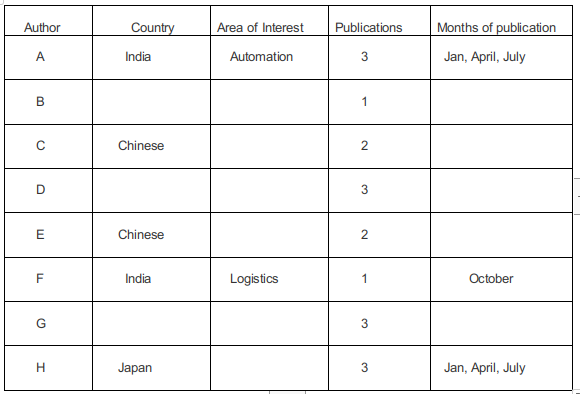
In statement 6, B, from the Logistics area, had a paper scheduled in the April issue of the journal.
In statement 7, B and G belonged to the same country. None of their papers were scheduled in the same issue of the journal. Since B and G belonged to the same country the only possibility is that both of them belonged to the same country and since they published Journals in different months. G must have published in January, July, and October.
In statement 8, D, a Japanese author from the Manufacturing area, did not have a paper scheduled in the July issue. Hence he must have had the three issues in Jan, April, Oct. The other Japanese author H must have written in logistics.
The fourth Indian author G must have written a paper in Automation.
In January, one more paper needs to be publicized, one in April, 1 in July, and one in October.
In statement 5, E had papers scheduled in consecutive issues of the journal but C did not.
Hence C must have written in Jan and October, and E in April and July.
In statement 9, C and H belonged to different areas. Hence C must be from Manufacturing and E must be from Logistics.
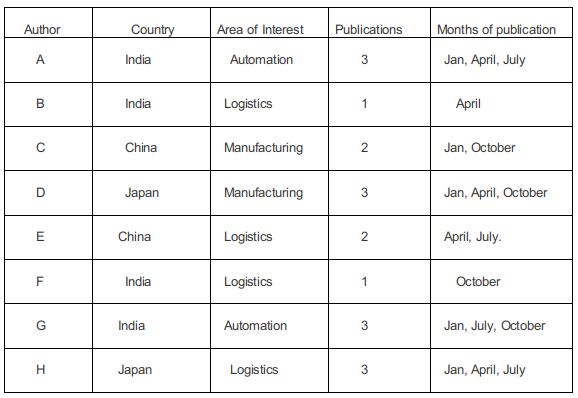
.Number of papers written by B, C, E, and G are: 1, 2, 2, 3
How many papers were written by Indian authors?
In the information, it is provided that there are four authors in the logistics department, 2 authors in automation, and 2 authors in manufacturing. There are 4 Indian authors, 2 Chinese authors, and 2 Japanese authors.
The total issues publicized were 18 of which the publications done by A, D, G, H are twice the papers written by the other four authors. Hence A+D+G+H has written 12 papers in total and B+C+E+F has written 6 in total. Since an author can write a minimum of 4 papers and a maximum of 3 papers. Each of A, D, G, H must have written 3 papers each.
In statement 3 it was provided that none of the Indian authors were from the Manufacturing area and none of the Japanese or Chinese authors were from the Automation area.
Since none of the Japanese and Chinese authors belonged to automation. Hence the two automation authors must be from India. In statement 1 it was given that F an Indian author is from logistics.
Of the remaining 5 authors 3 from logistics and 2 from manufacturing, in statement 5 it is given that the two Chinese authors are from different areas and hence they must be from manufacturing and logistics.
Of the remaining 3 authors 2 in logistics and 1 in manufacturing, in statement 8 is given that a Japanese author belonged to manufacturing, and hence of the remaining 2 in logistics one of them was from India and the other from Japan.
Of the four Indian authors, 2 belonged to logistics and 2 automation. Of the two authors from Japan, one belonged to manufacturing and one logistics. Of the two Chinese authors, one of them belonged to logistics and the other manufacturing.
Five papers were scheduled in each of the January and April issues, while four were scheduled in each of July and October issues.
Using statement 1, F an Indian author wrote a single paper in logistics published in October.
Using statement 2, A was from Automation and did not have a paper scheduled in October. Since A wrote 3 papers in total he must have written in the other three months and since only Indian authors worked in Automation he must have been from India.
Using statement 5, C, E are Chinese and wrote an equal number of papers. Since B+C+E+F have written a total of 6 papers. The two possibilities are 2+2+1+1 or 3+1+1+1.. Since it was given that E had papers scheduled in consecutive issues and C did not. So the only possible case is C = 2, E =2, F = 1, B = 1.
Using statement 4, A and H were from different countries and wrote papers in the same months. Hence H must be Japanese and must have written in Jan, April, July.
In statement 6, B, from the Logistics area, had a paper scheduled in the April issue of the journal.
In statement 7, B and G belonged to the same country. None of their papers were scheduled in the same issue of the journal. Since B and G belonged to the same country the only possibility is that both of them belonged to the same country and since they published Journals in different months. G must have published in January, July, and October.
In statement 8, D, a Japanese author from the Manufacturing area, did not have a paper scheduled in the July issue. Hence he must have had the three issues in Jan, April, Oct. The other Japanese author H must have written in logistics.
The fourth Indian author G must have written a paper in Automation.
In January, one more paper needs to be publicized, one in April, 1 in July, and one in October.
In statement 5, E had papers scheduled in consecutive issues of the journal but C did not.
Hence C must have written in Jan and October, and E in April and July.
In statement 9, C and H belonged to different areas. Hence C must be from Manufacturing and E must be from Logistics.
Indian authors wrote a total of 3+1+1+3 = 8 papers
Which of the following statement(s) MUST be true?
Statement A: Every issue had at least one paper by author(s) from each country.
Statement B: Every issue had at most two papers by author(s) from each area.
In the information, it is provided that there are four authors in the logistics department, 2 authors in automation, and 2 authors in manufacturing. There are 4 Indian authors, 2 Chinese authors, and 2 Japanese authors.
The total issues publicized were 18 of which the publications done by A, D, G, H are twice the papers written by the other four authors. Hence A+D+G+H has written 12 papers in total and B+C+E+F has written 6 in total. Since an author can write a minimum of 4 papers and a maximum of 3 papers. Each of A, D, G, H must have written 3 papers each.
In statement 3 it was provided that none of the Indian authors were from the Manufacturing area and none of the Japanese or Chinese authors were from the Automation area.
Since none of the Japanese and Chinese authors belonged to automation. Hence the two automation authors must be from India. In statement 1 it was given that F an Indian author is from logistics.
Of the remaining 5 authors 3 from logistics and 2 from manufacturing, in statement 5 it is given that the two Chinese authors are from different areas and hence they must be from manufacturing and logistics.
Of the remaining 3 authors 2 in logistics and 1 in manufacturing, in statement 8 is given that a Japanese author belonged to manufacturing, and hence of the remaining 2 in logistics one of them was from India and the other from Japan.
Of the four Indian authors, 2 belonged to logistics and 2 automation. Of the two authors from Japan, one belonged to manufacturing and one logistics. Of the two Chinese authors, one of them belonged to logistics and the other manufacturing.
Five papers were scheduled in each of the January and April issues, while four were scheduled in each of July and October issues.
Using statement 1, F an Indian author wrote a single paper in logistics published in October.
Using statement 2, A was from Automation and did not have a paper scheduled in October. Since A wrote 3 papers in total he must have written in the other three months and since only Indian authors worked in Automation he must have been from India.
Using statement 5, C, E are Chinese and wrote an equal number of papers. Since B+C+E+F have written a total of 6 papers. The two possibilities are 2+2+1+1 or 3+1+1+1.. Since it was given that E had papers scheduled in consecutive issues and C did not. So the only possible case is C = 2, E =2, F = 1, B = 1.
Using statement 4, A and H were from different countries and wrote papers in the same months. Hence H must be Japanese and must have written in Jan, April, July.
In statement 6, B, from the Logistics area, had a paper scheduled in the April issue of the journal.
In statement 7, B and G belonged to the same country. None of their papers were scheduled in the same issue of the journal. Since B and G belonged to the same country the only possibility is that both of them belonged to the same country and since they published Journals in different months. G must have published in January, July, and October.
In statement 8, D, a Japanese author from the Manufacturing area, did not have a paper scheduled in the July issue. Hence he must have had the three issues in Jan, April, Oct. The other Japanese author H must have written in logistics.
The fourth Indian author G must have written a paper in Automation.
In January, one more paper needs to be publicized, one in April, 1 in July, and one in October.
In statement 5, E had papers scheduled in consecutive issues of the journal but C did not.
Hence C must have written in Jan and October, and E in April and July.
In statement 9, C and H belonged to different areas. Hence C must be from Manufacturing and E must be from Logistics.
The publication of April has three authors from logistics. Hence false

Which of the following statements is FALSE?
In the information, it is provided that there are four authors in the logistics department, 2 authors in automation, and 2 authors in manufacturing. There are 4 Indian authors, 2 Chinese authors, and 2 Japanese authors.
The total issues publicized were 18 of which the publications done by A, D, G, H are twice the papers written by the other four authors. Hence A+D+G+H has written 12 papers in total and B+C+E+F has written 6 in total. Since an author can write a minimum of 4 papers and a maximum of 3 papers. Each of A, D, G, H must have written 3 papers each.
In statement 3 it was provided that none of the Indian authors were from the Manufacturing area and none of the Japanese or Chinese authors were from the Automation area.
Since none of the Japanese and Chinese authors belonged to automation. Hence the two automation authors must be from India. In statement 1 it was given that F an Indian author is from logistics.
Of the remaining 5 authors 3 from logistics and 2 from manufacturing, in statement 5 it is given that the two Chinese authors are from different areas and hence they must be from manufacturing and logistics.
Of the remaining 3 authors 2 in logistics and 1 in manufacturing, in statement 8 is given that a Japanese author belonged to manufacturing, and hence of the remaining 2 in logistics one of them was from India and the other from Japan.
Of the four Indian authors, 2 belonged to logistics and 2 automation. Of the two authors from Japan, one belonged to manufacturing and one logistics. Of the two Chinese authors, one of them belonged to logistics and the other manufacturing.
Five papers were scheduled in each of the January and April issues, while four were scheduled in each of July and October issues.
Using statement 1, F an Indian author wrote a single paper in logistics published in October.
Using statement 2, A was from Automation and did not have a paper scheduled in October. Since A wrote 3 papers in total he must have written in the other three months and since only Indian authors worked in Automation he must have been from India.
Using statement 5, C, E are Chinese and wrote an equal number of papers. Since B+C+E+F have written a total of 6 papers. The two possibilities are 2+2+1+1 or 3+1+1+1.. Since it was given that E had papers scheduled in consecutive issues and C did not. So the only possible case is C = 2, E =2, F = 1, B = 1.
Using statement 4, A and H were from different countries and wrote papers in the same months. Hence H must be Japanese and must have written in Jan, April, July.
In statement 6, B, from the Logistics area, had a paper scheduled in the April issue of the journal.
In statement 7, B and G belonged to the same country. None of their papers were scheduled in the same issue of the journal. Since B and G belonged to the same country the only possibility is that both of them belonged to the same country and since they published Journals in different months. G must have published in January, July, and October.
In statement 8, D, a Japanese author from the Manufacturing area, did not have a paper scheduled in the July issue. Hence he must have had the three issues in Jan, April, Oct. The other Japanese author H must have written in logistics.
The fourth Indian author G must have written a paper in Automation.
In January, one more paper needs to be publicized, one in April, 1 in July, and one in October.
In statement 5, E had papers scheduled in consecutive issues of the journal but C did not.
Hence C must have written in Jan and October, and E in April and July.
In statement 9, C and H belonged to different areas. Hence C must be from Manufacturing and E must be from Logistics.
.Option C is false in the issue of April there were three authors from logistics department.
Which of the following statements is FALSE?
In the information, it is provided that there are four authors in the logistics department, 2 authors in automation, and 2 authors in manufacturing. There are 4 Indian authors, 2 Chinese authors, and 2 Japanese authors.
The total issues publicized were 18 of which the publications done by A, D, G, H are twice the papers written by the other four authors. Hence A+D+G+H has written 12 papers in total and B+C+E+F has written 6 in total. Since an author can write a minimum of 4 papers and a maximum of 3 papers. Each of A, D, G, H must have written 3 papers each.
In statement 3 it was provided that none of the Indian authors were from the Manufacturing area and none of the Japanese or Chinese authors were from the Automation area.
Since none of the Japanese and Chinese authors belonged to automation. Hence the two automation authors must be from India. In statement 1 it was given that F an Indian author is from logistics.
Of the remaining 5 authors 3 from logistics and 2 from manufacturing, in statement 5 it is given that the two Chinese authors are from different areas and hence they must be from manufacturing and logistics.
Of the remaining 3 authors 2 in logistics and 1 in manufacturing, in statement 8 is given that a Japanese author belonged to manufacturing, and hence of the remaining 2 in logistics one of them was from India and the other from Japan.
Of the four Indian authors, 2 belonged to logistics and 2 automation. Of the two authors from Japan, one belonged to manufacturing and one logistics. Of the two Chinese authors, one of them belonged to logistics and the other manufacturing.
Five papers were scheduled in each of the January and April issues, while four were scheduled in each of July and October issues.
Using statement 1, F an Indian author wrote a single paper in logistics published in October.
Using statement 2, A was from Automation and did not have a paper scheduled in October. Since A wrote 3 papers in total he must have written in the other three months and since only Indian authors worked in Automation he must have been from India.
Using statement 5, C, E are Chinese and wrote an equal number of papers. Since B+C+E+F have written a total of 6 papers. The two possibilities are 2+2+1+1 or 3+1+1+1.. Since it was given that E had papers scheduled in consecutive issues and C did not. So the only possible case is C = 2, E =2, F = 1, B = 1.
Using statement 4, A and H were from different countries and wrote papers in the same months. Hence H must be Japanese and must have written in Jan, April, July.
In statement 6, B, from the Logistics area, had a paper scheduled in the April issue of the journal.
In statement 7, B and G belonged to the same country. None of their papers were scheduled in the same issue of the journal. Since B and G belonged to the same country the only possibility is that both of them belonged to the same country and since they published Journals in different months. G must have published in January, July, and October.
In statement 8, D, a Japanese author from the Manufacturing area, did not have a paper scheduled in the July issue. Hence he must have had the three issues in Jan, April, Oct. The other Japanese author H must have written in logistics.
The fourth Indian author G must have written a paper in Automation.
In January, one more paper needs to be publicized, one in April, 1 in July, and one in October.
In statement 5, E had papers scheduled in consecutive issues of the journal but C did not.
Hence C must have written in Jan and October, and E in April and July.
In statement 9, C and H belonged to different areas. Hence C must be from Manufacturing and E must be from Logistics.
There are no authors from Manufacturing in the July issue and hence option D is false.
Which of the following is the correct sequence of number of papers by authors from Automation, Manufacturing and Logistics areas, respectively?
In the information, it is provided that there are four authors in the logistics department, 2 authors in automation, and 2 authors in manufacturing. There are 4 Indian authors, 2 Chinese authors, and 2 Japanese authors.
The total issues publicized were 18 of which the publications done by A, D, G, H are twice the papers written by the other four authors. Hence A+D+G+H has written 12 papers in total and B+C+E+F has written 6 in total. Since an author can write a minimum of 4 papers and a maximum of 3 papers. Each of A, D, G, H must have written 3 papers each.
In statement 3 it was provided that none of the Indian authors were from the Manufacturing area and none of the Japanese or Chinese authors were from the Automation area.
Since none of the Japanese and Chinese authors belonged to automation. Hence the two automation authors must be from India. In statement 1 it was given that F an Indian author is from logistics.
Of the remaining 5 authors 3 from logistics and 2 from manufacturing, in statement 5 it is given that the two Chinese authors are from different areas and hence they must be from manufacturing and logistics.
Of the remaining 3 authors 2 in logistics and 1 in manufacturing, in statement 8 is given that a Japanese author belonged to manufacturing, and hence of the remaining 2 in logistics one of them was from India and the other from Japan.
Of the four Indian authors, 2 belonged to logistics and 2 automation. Of the two authors from Japan, one belonged to manufacturing and one logistics. Of the two Chinese authors, one of them belonged to logistics and the other manufacturing.
Five papers were scheduled in each of the January and April issues, while four were scheduled in each of July and October issues.
Using statement 1, F an Indian author wrote a single paper in logistics published in October.
Using statement 2, A was from Automation and did not have a paper scheduled in October. Since A wrote 3 papers in total he must have written in the other three months and since only Indian authors worked in Automation he must have been from India.
Using statement 5, C, E are Chinese and wrote an equal number of papers. Since B+C+E+F have written a total of 6 papers. The two possibilities are 2+2+1+1 or 3+1+1+1.. Since it was given that E had papers scheduled in consecutive issues and C did not. So the only possible case is C = 2, E =2, F = 1, B = 1.
Using statement 4, A and H were from different countries and wrote papers in the same months. Hence H must be Japanese and must have written in Jan, April, July.
In statement 6, B, from the Logistics area, had a paper scheduled in the April issue of the journal.
In statement 7, B and G belonged to the same country. None of their papers were scheduled in the same issue of the journal. Since B and G belonged to the same country the only possibility is that both of them belonged to the same country and since they published Journals in different months. G must have published in January, July, and October.
In statement 8, D, a Japanese author from the Manufacturing area, did not have a paper scheduled in the July issue. Hence he must have had the three issues in Jan, April, Oct. The other Japanese author H must have written in logistics.
The fourth Indian author G must have written a paper in Automation.
In January, one more paper needs to be publicized, one in April, 1 in July, and one in October.
In statement 5, E had papers scheduled in consecutive issues of the journal but C did not.
Hence C must have written in Jan and October, and E in April and July.
In statement 9, C and H belonged to different areas. Hence C must be from Manufacturing and E must be from Logistics.
In Automation, there are a total of 6 papers, Logistics 7 papers, and Manufacturing a total of 5 papers.

Ganga, Kaveri, and Narmada are three women who buy four raw materials (Mango, Apple, Banana and Milk) and sell five finished products (Mango smoothie, Apple smoothie, Banana smoothie, Mixed fruit smoothie and Fruit salad). Table-1 gives information about the raw materials required to produce the five finished products. One unit of a finished product requires one unit of each of the raw materials mentioned in the second column of the table.
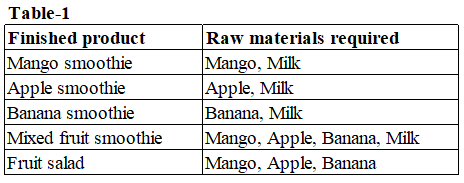
One unit of milk, mango, apple, and banana cost ₹5, ₹3, ₹2, and ₹1 respectively. Each unit of a finished product is sold for a profit equal to two times the number of raw materials used to make that product. For example, apple smoothie is made with two raw materials (apple and milk) and will be sold for a profit of ₹4 per unit. Leftover raw materials are sold during the last business hour of the day for a loss of ₹1 per unit.
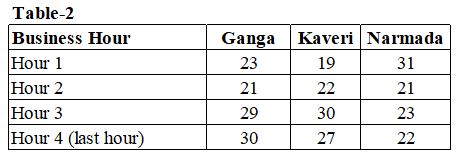
The amount, in rupees, received from sales (revenue) for each woman in each of the four business hours of the day is given in Table-2.
The following additional facts are known.
1. No one except possibly Ganga sold any Mango smoothie.
2. Each woman sold either zero or one unit of any single finished product in any hour.
3. Each woman had exactly one unit each of two different raw materials as leftovers.
4. No one had any banana leftover.
What BEST can be concluded about the number of units of fruit salad sold in the first hour?
Given that each item is sold for a profit of 2 times the number of materials required for the dish.
Hence for different finished products: The cost price and selling price are :
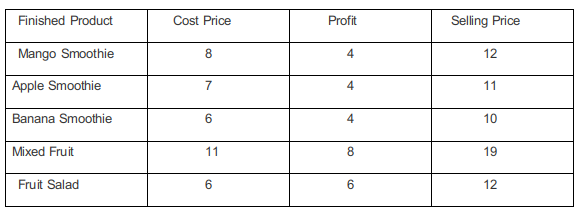
Given that in any hour only either zero or one unit of a single finished product is sold. Hence the price distribution for the first three hours sales distribution is given by :
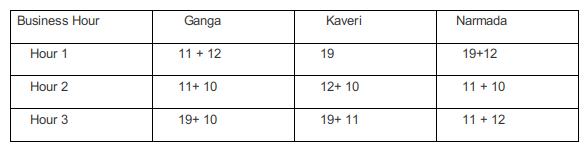
Additionally, it has been mentioned that no one except Ganga possibly sold Mango smoothies.
Considering Apple Smoothie : (AS), Mango Smoothie : ( M.S), Banana Smoothie : (B. S), Mixed Fruit : (M.F), Fruit Salad : (F.S)
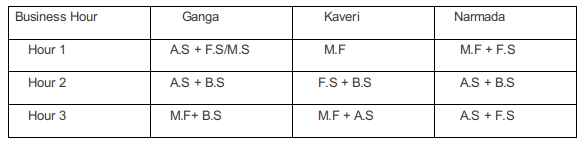
In the last one hour everyone had one unit each of two different materials as leftovers:
Each leftover item is sold at Re1 less than their cost price. Hence
One unit of milk, mango, and apple will cost ₹4, ₹2, ₹1,
The three possible combinations for the last hour in which raw materials can be sold is :
One unit of milk+ One unit of mango = Rs 4+2 = Rs 6.
One unit of milk+ One unit of apple = Rs 4+1 = Rs 5.
One unit of mango+ One unit of apple = Rs 2+1 = Rs 3.
In the last one hour :
Total sale of Ganga is Rs 30. This is the total cost earned by considering selling the finished items and raw materials :
Hence the possible cases are :
(24 + 6) or (25 + 5) or ( 27 + 3). It is not possible to earn 25 and 27 by selling finished products.
Hence she earns Rs 24 which is possible by selling one ( M.S + F.S) and one raw unit of milk and mango each.
Total sale of Kaveri is Rs 27. This is the total cost earned by considering selling the finished items and raw materials :
Hence the possible cases are :
(21 + 6) or (22+5) or (24+3).
Since Kaveri cannot sell mango smoothies the possible cases are :
(21+6) Selling one apple smoothie and one banana smoothie and one raw unit of Milk and Mango.
(22+5) Selling one Banana smoothie and Fruit Salad, one unit of raw milk, and one unit of Raw Apple.
Total sale for Narmada is Rs 22. The possible cases are :
(16+6), (17+5), (19+3).
Among these, the only possible case is 19 + 3. Selling one unit Mixed Fruit, and one raw unit of Mango and Apple.
Case 1 :
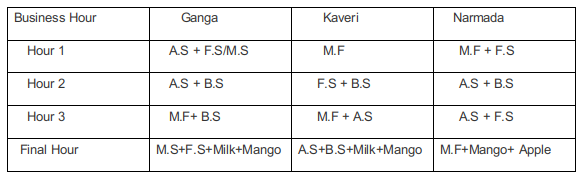
case 2 :
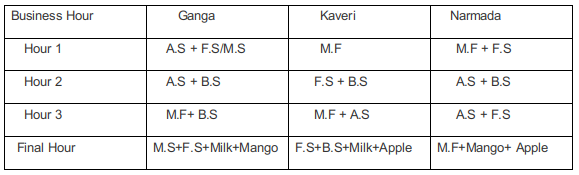
In the first one hour, either one or two fruit salads are sold.
Which of the following is NECESSARILY true?
Given that each item is sold for a profit of 2 times the number of materials required for the dish.
Hence for different finished products: The cost price and selling price are :
Given that in any hour only either zero or one unit of a single finished product is sold. Hence the price distribution for the first three hours sales distribution is given by :
Additionally, it has been mentioned that no one except Ganga possibly sold Mango smoothies.
Considering Apple Smoothie : (AS), Mango Smoothie : ( M.S), Banana Smoothie : (B. S), Mixed Fruit : (M.F), Fruit Salad : (F.S)
In the last one hour everyone had one unit each of two different materials as leftovers:
Each leftover item is sold at Re1 less than their cost price. Hence
One unit of milk, mango, and apple will cost ₹4, ₹2, ₹1,
The three possible combinations for the last hour in which raw materials can be sold is :
One unit of milk+ One unit of mango = Rs 4+2 = Rs 6.
One unit of milk+ One unit of apple = Rs 4+1 = Rs 5.
One unit of mango+ One unit of apple = Rs 2+1 = Rs 3.
In the last one hour :
Total sale of Ganga is Rs 30. This is the total cost earned by considering selling the finished items and raw materials :
Hence the possible cases are :
(24 + 6) or (25 + 5) or ( 27 + 3). It is not possible to earn 25 and 27 by selling finished products.
Hence she earns Rs 24 which is possible by selling one ( M.S + F.S) and one raw unit of milk and mango each.
Total sale of Kaveri is Rs 27. This is the total cost earned by considering selling the finished items and raw materials :
Hence the possible cases are :
(21 + 6) or (22+5) or (24+3).
Since Kaveri cannot sell mango smoothies the possible cases are :
(21+6) Selling one apple smoothie and one banana smoothie and one raw unit of Milk and Mango.
(22+5) Selling one Banana smoothie and Fruit Salad, one unit of raw milk, and one unit of Raw Apple.
Total sale for Narmada is Rs 22. The possible cases are :
(16+6), (17+5), (19+3).
Among these, the only possible case is 19 + 3. Selling one unit Mixed Fruit, and one raw unit of Mango and Apple.
Case 1 :
case 2 :
In both, cases Ganga did not sell any leftover apples. The other options are not necessarily true.
What BEST can be concluded about the total number of units of milk the three women had in the beginning?
Given that each item is sold for a profit of 2 times the number of materials required for the dish.
Hence for different finished products: The cost price and selling price are :
Given that in any hour only either zero or one unit of a single finished product is sold. Hence the price distribution for the first three hours sales distribution is given by :
Additionally, it has been mentioned that no one except Ganga possibly sold Mango smoothies.
Considering Apple Smoothie : (AS), Mango Smoothie : ( M.S), Banana Smoothie : (B. S), Mixed Fruit : (M.F), Fruit Salad : (F.S)
In the last one hour everyone had one unit each of two different materials as leftovers:
Each leftover item is sold at Re1 less than their cost price. Hence
One unit of milk, mango, and apple will cost ₹4, ₹2, ₹1,
The three possible combinations for the last hour in which raw materials can be sold is :
One unit of milk+ One unit of mango = Rs 4+2 = Rs 6.
One unit of milk+ One unit of apple = Rs 4+1 = Rs 5.
One unit of mango+ One unit of apple = Rs 2+1 = Rs 3.
In the last one hour :
Total sale of Ganga is Rs 30. This is the total cost earned by considering selling the finished items and raw materials :
Hence the possible cases are :
(24 + 6) or (25 + 5) or ( 27 + 3). It is not possible to earn 25 and 27 by selling finished products.
Hence she earns Rs 24 which is possible by selling one ( M.S + F.S) and one raw unit of milk and mango each.
Total sale of Kaveri is Rs 27. This is the total cost earned by considering selling the finished items and raw materials :
Hence the possible cases are :
(21 + 6) or (22+5) or (24+3).
Since Kaveri cannot sell mango smoothies the possible cases are :
(21+6) Selling one apple smoothie and one banana smoothie and one raw unit of Milk and Mango.
(22+5) Selling one Banana smoothie and Fruit Salad, one unit of raw milk, and one unit of Raw Apple.
Total sale for Narmada is Rs 22. The possible cases are :
(16+6), (17+5), (19+3).
Among these, the only possible case is 19 + 3. Selling one unit Mixed Fruit, and one raw unit of Mango and Apple.
Case 1 :
case 2 :
In except fruit salad, all the other finished products require one unit of milk :
For case 1: a minimum of 19 units of milk and a maximum of 20 units of milk can be used.
For case 2: a minimum of 18 units of milk and a maximum of 19 units of milk is used

If it is known that three leftover units of mangoes were sold during the last business hour of the day, how many apple smoothies were sold during the day?
Given that each item is sold for a profit of 2 times the number of materials required for the dish.
Hence for different finished products: The cost price and selling price are :
Given that in any hour only either zero or one unit of a single finished product is sold. Hence the price distribution for the first three hours sales distribution is given by :
Additionally, it has been mentioned that no one except Ganga possibly sold Mango smoothies.
Considering Apple Smoothie : (AS), Mango Smoothie : ( M.S), Banana Smoothie : (B. S), Mixed Fruit : (M.F), Fruit Salad : (F.S)
In the last one hour everyone had one unit each of two different materials as leftovers:
Each leftover item is sold at Re1 less than their cost price. Hence
One unit of milk, mango, and apple will cost ₹4, ₹2, ₹1,
The three possible combinations for the last hour in which raw materials can be sold is :
One unit of milk+ One unit of mango = Rs 4+2 = Rs 6.
One unit of milk+ One unit of apple = Rs 4+1 = Rs 5.
One unit of mango+ One unit of apple = Rs 2+1 = Rs 3.
In the last one hour :
Total sale of Ganga is Rs 30. This is the total cost earned by considering selling the finished items and raw materials :
Hence the possible cases are :
(24 + 6) or (25 + 5) or ( 27 + 3). It is not possible to earn 25 and 27 by selling finished products.
Hence she earns Rs 24 which is possible by selling one ( M.S + F.S) and one raw unit of milk and mango each.
Total sale of Kaveri is Rs 27. This is the total cost earned by considering selling the finished items and raw materials :
Hence the possible cases are :
(21 + 6) or (22+5) or (24+3).
Since Kaveri cannot sell mango smoothies the possible cases are :
(21+6) Selling one apple smoothie and one banana smoothie and one raw unit of Milk and Mango.
(22+5) Selling one Banana smoothie and Fruit Salad, one unit of raw milk, and one unit of Raw Apple.
Total sale for Narmada is Rs 22. The possible cases are :
(16+6), (17+5), (19+3).
Among these, the only possible case is 19 + 3. Selling one unit Mixed Fruit, and one raw unit of Mango and Apple.
Case 1 :
case 2 :
3 units of leftover mangoes were available in case 1 and in here a total of 6 apple shakes were sold.
Amudha, Bharatan, Chandran, Dhinesh, Ezhil, Fani and Gowtham are seven people in a town. Any pair of them could either be strangers, acquaintances, or friends. All relationships are mutual. For example, if Amudha is a friend of Bharatan, then Bharatan is also a friend of Amudha. Similarly, if Amudha is a stranger to Bharatan, then Bharatan is also a stranger to Amudha.
Partial information about the number of friends, acquaintances, and strangers of each of these people among them is given in the table below.
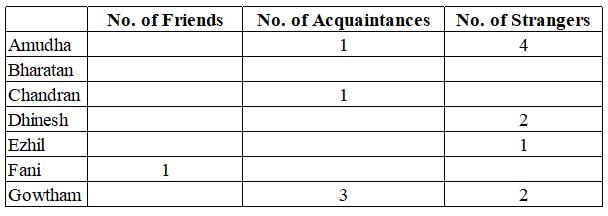
The following additional facts are also known.
1. Amudha, Bharatan, and Chandran are mutual strangers.
2. Amudha, Dhinesh, and Fani are Ezil's friends.
3. Chandran and Gowtham are friends.
4. Every friend of Amudha is an acquaintance of Bharatan, and every acquaintance of Bharatan is a friend of Amudha.
5. Every friend of Bharatan is an acquaintance of Amudha, and every acquaintance of Amudha is a friend of Bharatan.
Who are Gowtham’s acquaintances?
Since A, B, C are mutual strangers,( B, C )are strangers for A, (A, C) are strangers for B, (A, B) are strangers for C.
Since the total number of strangers+ acquaintances+ friends for any among the 7 is 6.
The number of friends for Amudha is 1, the number of friends for Gowtham is 1.
Using statement 3 Chandran and Gowtham are friends.
Using statement 2: Amudha, Dinesh, and Fani are Ezil’s friends. Similarly, Ezil is a friend of Amudha, Dhinesh, and Fani.
Using statement 4 Every friend of Bharatan is an acquaintance of Amudha, and every acquaintance of Amudha is a friend of Bharatan, Hence the number of acquaintances of Bharatan is equal to the number of friends of Amudha.
Using statement 5 Every friend of Amudha is an acquaintance of Bharatan, and every acquaintance Bharatan is a friend of Amudha, Hence the number of acquaintances of Amudha is equal to the number of friends of Bharatan.
Hence Bharatan has one friend, 1 Acquaintance, 4 strangers.
For Amudha we are yet to find a relationship with Dhinesh, Fani, and Gowtham. Any among the three can be the stranger for Amudha, considering the three different cases.
Case 1 :
Considering Fani as an acquaintance of Amudha, then Dhinesh and Gowtham are strangers to Amudha.
Every acquaintance of Amudha is a friend of Bharathan and since the friend and acquaintance of Bharatan are known the strangers are found for Bharatan.
Fani is an acquaintance of Amudha, hence Amudha is an Acquaintance of Fani, Fani is a friend of Bharathan and hence Bharathan is a friend of Fani. But Fani has only one friend and Ezhil is already a friend of Fani.
Hence this case fails.
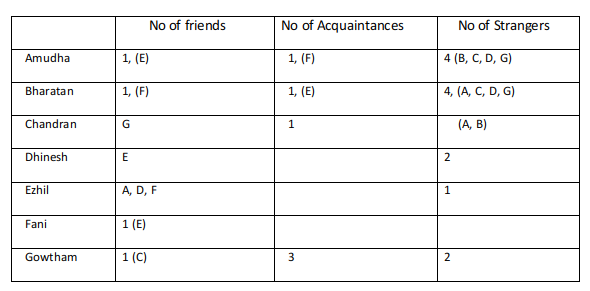
Case 2 :
Considering Gowtham as an acquaintance of Amudha, then Dhinesh and Fani are strangers to Amudha.
Every acquaintance of Amudha is a friend of Bharathan and since the friend and acquaintance of Bharatan are known the strangers are found for Bharatan.Since Gowtham is a friend of Bharatan, Bharatan must be a friend of Gowtham. But Gowtham can only have one friend and it already mentioned that Chandran is a friend of Gowtham and hence this case fails.
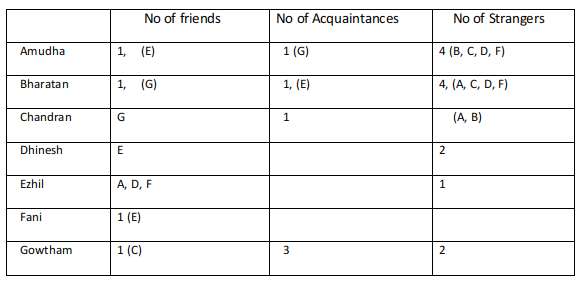
Case 3 :
Considering Dhinesh as an acquaintance of Amudha, then Fani and Gowtham are strangers to Amudha.
Every acquaintance of Amudha is a friend of Bharathan and since the friend and acquaintance of Bharatan are known the strangers are found for Bharatan.
Since Fani, Gowtham are strangers to Amudha, Bharatan. Amudha, Bharatan are strangers to Fani, Gowtham.
The 2 strangers to Gowtham and his only friend are known. Hence his three acquaintances are (Dhinesh, Ezhil, Fani).
Hence Gowtham is an acquaintance of Dhinesh, Ezhil, and Fani.
Dhinesh is an acquaintance of Amudha and hence Amudha must be an acquaintance of Dhinesh.
Dhinesh is a friend of Bharatan and hence Bharatan is a friend of Dhinesh.
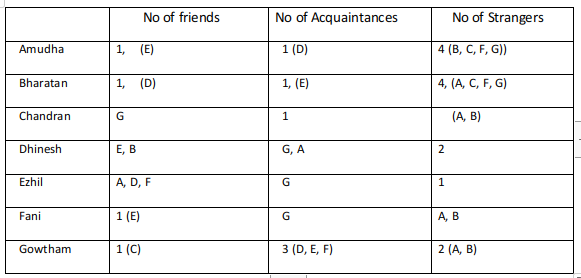
Ezhil is an acquaintance of Bharatan and hence Bharatan is an acquaintance of Ezhil. The only stranger to Ezhil who is left is Chandran. Hence Ezhil is a stranger to Chandran.
The two strangers to Dhinesh who are left are Chandran and Fani. Chandran is a stranger to Dhinesh and hence Dhinesh is a stranger to Chandran.
The only acquaintance of Chandran who is left is Fani.
The remaining relationships with Fani are Dhinesh and Chandran. Dhinesh is a stranger to Fani and Chandran is an acquaintance of Fani.
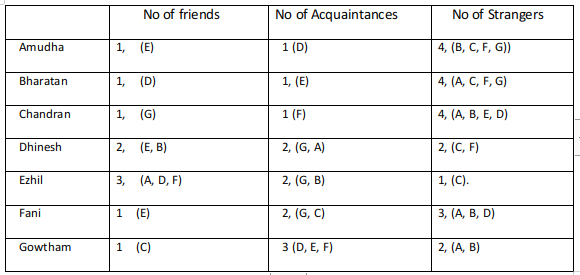
Gowtham's Acquaintances are Ghinesh, Ezhil, Fani.
Which of these pairs share the same type of relationship?
Since A, B, C are mutual strangers,( B, C )are strangers for A, (A, C) are strangers for B, (A, B) are strangers for C.
Since the total number of strangers+ acquaintances+ friends for any among the 7 is 6.
The number of friends for Amudha is 1, the number of friends for Gowtham is 1.
Using statement 3 Chandran and Gowtham are friends.
Using statement 2: Amudha, Dinesh, and Fani are Ezil’s friends. Similarly, Ezil is a friend of Amudha, Dhinesh, and Fani.
Using statement 4 Every friend of Bharatan is an acquaintance of Amudha, and every acquaintance of Amudha is a friend of Bharatan, Hence the number of acquaintances of Bharatan is equal to the number of friends of Amudha.
Using statement 5 Every friend of Amudha is an acquaintance of Bharatan, and every acquaintance Bharatan is a friend of Amudha, Hence the number of acquaintances of Amudha is equal to the number of friends of Bharatan.
Hence Bharatan has one friend, 1 Acquaintance, 4 strangers.
For Amudha we are yet to find a relationship with Dhinesh, Fani, and Gowtham. Any among the three can be the stranger for Amudha, considering the three different cases.
Case 1 :
Considering Fani as an acquaintance of Amudha, then Dhinesh and Gowtham are strangers to Amudha.
Every acquaintance of Amudha is a friend of Bharathan and since the friend and acquaintance of Bharatan are known the strangers are found for Bharatan.
Fani is an acquaintance of Amudha, hence Amudha is an Acquaintance of Fani, Fani is a friend of Bharathan and hence Bharathan is a friend of Fani. But Fani has only one friend and Ezhil is already a friend of Fani.
Hence this case fails.
Case 2 :
Considering Gowtham as an acquaintance of Amudha, then Dhinesh and Fani are strangers to Amudha.
Every acquaintance of Amudha is a friend of Bharathan and since the friend and acquaintance of Bharatan are known the strangers are found for Bharatan.Since Gowtham is a friend of Bharatan, Bharatan must be a friend of Gowtham. But Gowtham can only have one friend and it already mentioned that Chandran is a friend of Gowtham and hence this case fails.
Case 3 :
Considering Dhinesh as an acquaintance of Amudha, then Fani and Gowtham are strangers to Amudha.
Every acquaintance of Amudha is a friend of Bharathan and since the friend and acquaintance of Bharatan are known the strangers are found for Bharatan.
Since Fani, Gowtham are strangers to Amudha, Bharatan. Amudha, Bharatan are strangers to Fani, Gowtham.
The 2 strangers to Gowtham and his only friend are known. Hence his three acquaintances are (Dhinesh, Ezhil, Fani).
Hence Gowtham is an acquaintance of Dhinesh, Ezhil, and Fani.
Dhinesh is an acquaintance of Amudha and hence Amudha must be an acquaintance of Dhinesh.
Dhinesh is a friend of Bharatan and hence Bharatan is a friend of Dhinesh.
Ezhil is an acquaintance of Bharatan and hence Bharatan is an acquaintance of Ezhil. The only stranger to Ezhil who is left is Chandran. Hence Ezhil is a stranger to Chandran.
The two strangers to Dhinesh who are left are Chandran and Fani. Chandran is a stranger to Dhinesh and hence Dhinesh is a stranger to Chandran.
The only acquaintance of Chandran who is left is Fani.
The remaining relationships with Fani are Dhinesh and Chandran. Dhinesh is a stranger to Fani and Chandran is an acquaintance of Fani.
In the given options Bharatan and Ezhil are Acauaintances, Fani and Gowtham are acquaintances.

Who is an acquaintance of Amudha?
Since A, B, C are mutual strangers,( B, C )are strangers for A, (A, C) are strangers for B, (A, B) are strangers for C.
Since the total number of strangers+ acquaintances+ friends for any among the 7 is 6.
The number of friends for Amudha is 1, the number of friends for Gowtham is 1.
Using statement 3 Chandran and Gowtham are friends.
Using statement 2: Amudha, Dinesh, and Fani are Ezil’s friends. Similarly, Ezil is a friend of Amudha, Dhinesh, and Fani.
Using statement 4 Every friend of Bharatan is an acquaintance of Amudha, and every acquaintance of Amudha is a friend of Bharatan, Hence the number of acquaintances of Bharatan is equal to the number of friends of Amudha.
Using statement 5 Every friend of Amudha is an acquaintance of Bharatan, and every acquaintance Bharatan is a friend of Amudha, Hence the number of acquaintances of Amudha is equal to the number of friends of Bharatan.
Hence Bharatan has one friend, 1 Acquaintance, 4 strangers.
For Amudha we are yet to find a relationship with Dhinesh, Fani, and Gowtham. Any among the three can be the stranger for Amudha, considering the three different cases.
Case 1 :
Considering Fani as an acquaintance of Amudha, then Dhinesh and Gowtham are strangers to Amudha.
Every acquaintance of Amudha is a friend of Bharathan and since the friend and acquaintance of Bharatan are known the strangers are found for Bharatan.
Fani is an acquaintance of Amudha, hence Amudha is an Acquaintance of Fani, Fani is a friend of Bharathan and hence Bharathan is a friend of Fani. But Fani has only one friend and Ezhil is already a friend of Fani.
Hence this case fails.
Case 2 :
Considering Gowtham as an acquaintance of Amudha, then Dhinesh and Fani are strangers to Amudha.
Every acquaintance of Amudha is a friend of Bharathan and since the friend and acquaintance of Bharatan are known the strangers are found for Bharatan.Since Gowtham is a friend of Bharatan, Bharatan must be a friend of Gowtham. But Gowtham can only have one friend and it already mentioned that Chandran is a friend of Gowtham and hence this case fails.
Case 3 :
Considering Dhinesh as an acquaintance of Amudha, then Fani and Gowtham are strangers to Amudha.
Every acquaintance of Amudha is a friend of Bharathan and since the friend and acquaintance of Bharatan are known the strangers are found for Bharatan.
Since Fani, Gowtham are strangers to Amudha, Bharatan. Amudha, Bharatan are strangers to Fani, Gowtham.
The 2 strangers to Gowtham and his only friend are known. Hence his three acquaintances are (Dhinesh, Ezhil, Fani).
Hence Gowtham is an acquaintance of Dhinesh, Ezhil, and Fani.
Dhinesh is an acquaintance of Amudha and hence Amudha must be an acquaintance of Dhinesh.
Dhinesh is a friend of Bharatan and hence Bharatan is a friend of Dhinesh.
Ezhil is an acquaintance of Bharatan and hence Bharatan is an acquaintance of Ezhil. The only stranger to Ezhil who is left is Chandran. Hence Ezhil is a stranger to Chandran.
The two strangers to Dhinesh who are left are Chandran and Fani. Chandran is a stranger to Dhinesh and hence Dhinesh is a stranger to Chandran.
The only acquaintance of Chandran who is left is Fani.
The remaining relationships with Fani are Dhinesh and Chandran. Dhinesh is a stranger to Fani and Chandran is an acquaintance of Fani.
Dhinesh is an acquaintance of Amudha
Who is an acquaintance of Chandran?
Since A, B, C are mutual strangers,( B, C )are strangers for A, (A, C) are strangers for B, (A, B) are strangers for C.
Since the total number of strangers+ acquaintances+ friends for any among the 7 is 6.
The number of friends for Amudha is 1, the number of friends for Gowtham is 1.
Using statement 3 Chandran and Gowtham are friends.
Using statement 2: Amudha, Dinesh, and Fani are Ezil’s friends. Similarly, Ezil is a friend of Amudha, Dhinesh, and Fani.
Using statement 4 Every friend of Bharatan is an acquaintance of Amudha, and every acquaintance of Amudha is a friend of Bharatan, Hence the number of acquaintances of Bharatan is equal to the number of friends of Amudha.
Using statement 5 Every friend of Amudha is an acquaintance of Bharatan, and every acquaintance Bharatan is a friend of Amudha, Hence the number of acquaintances of Amudha is equal to the number of friends of Bharatan.
Hence Bharatan has one friend, 1 Acquaintance, 4 strangers.
For Amudha we are yet to find a relationship with Dhinesh, Fani, and Gowtham. Any among the three can be the stranger for Amudha, considering the three different cases.
Case 1 :
Considering Fani as an acquaintance of Amudha, then Dhinesh and Gowtham are strangers to Amudha.
Every acquaintance of Amudha is a friend of Bharathan and since the friend and acquaintance of Bharatan are known the strangers are found for Bharatan.
Fani is an acquaintance of Amudha, hence Amudha is an Acquaintance of Fani, Fani is a friend of Bharathan and hence Bharathan is a friend of Fani. But Fani has only one friend and Ezhil is already a friend of Fani.
Hence this case fails.
Case 2 :
Considering Gowtham as an acquaintance of Amudha, then Dhinesh and Fani are strangers to Amudha.
Every acquaintance of Amudha is a friend of Bharathan and since the friend and acquaintance of Bharatan are known the strangers are found for Bharatan.Since Gowtham is a friend of Bharatan, Bharatan must be a friend of Gowtham. But Gowtham can only have one friend and it already mentioned that Chandran is a friend of Gowtham and hence this case fails.
Case 3 :
Considering Dhinesh as an acquaintance of Amudha, then Fani and Gowtham are strangers to Amudha.
Every acquaintance of Amudha is a friend of Bharathan and since the friend and acquaintance of Bharatan are known the strangers are found for Bharatan.
Since Fani, Gowtham are strangers to Amudha, Bharatan. Amudha, Bharatan are strangers to Fani, Gowtham.
The 2 strangers to Gowtham and his only friend are known. Hence his three acquaintances are (Dhinesh, Ezhil, Fani).
Hence Gowtham is an acquaintance of Dhinesh, Ezhil, and Fani.
Dhinesh is an acquaintance of Amudha and hence Amudha must be an acquaintance of Dhinesh.
Dhinesh is a friend of Bharatan and hence Bharatan is a friend of Dhinesh.
Ezhil is an acquaintance of Bharatan and hence Bharatan is an acquaintance of Ezhil. The only stranger to Ezhil who is left is Chandran. Hence Ezhil is a stranger to Chandran.
The two strangers to Dhinesh who are left are Chandran and Fani. Chandran is a stranger to Dhinesh and hence Dhinesh is a stranger to Chandran.
The only acquaintance of Chandran who is left is Fani.
The remaining relationships with Fani are Dhinesh and Chandran. Dhinesh is a stranger to Fani and Chandran is an acquaintance of Fani.
Fani is an acquaintance of Chandran
How many friends does Ezhil have?
Since A, B, C are mutual strangers,( B, C )are strangers for A, (A, C) are strangers for B, (A, B) are strangers for C.
Since the total number of strangers+ acquaintances+ friends for any among the 7 is 6.
The number of friends for Amudha is 1, the number of friends for Gowtham is 1.
Using statement 3 Chandran and Gowtham are friends.
Using statement 2: Amudha, Dinesh, and Fani are Ezil’s friends. Similarly, Ezil is a friend of Amudha, Dhinesh, and Fani.
Using statement 4 Every friend of Bharatan is an acquaintance of Amudha, and every acquaintance of Amudha is a friend of Bharatan, Hence the number of acquaintances of Bharatan is equal to the number of friends of Amudha.
Using statement 5 Every friend of Amudha is an acquaintance of Bharatan, and every acquaintance Bharatan is a friend of Amudha, Hence the number of acquaintances of Amudha is equal to the number of friends of Bharatan.
Hence Bharatan has one friend, 1 Acquaintance, 4 strangers.
For Amudha we are yet to find a relationship with Dhinesh, Fani, and Gowtham. Any among the three can be the stranger for Amudha, considering the three different cases.
Case 1 :
Considering Fani as an acquaintance of Amudha, then Dhinesh and Gowtham are strangers to Amudha.
Every acquaintance of Amudha is a friend of Bharathan and since the friend and acquaintance of Bharatan are known the strangers are found for Bharatan.
Fani is an acquaintance of Amudha, hence Amudha is an Acquaintance of Fani, Fani is a friend of Bharathan and hence Bharathan is a friend of Fani. But Fani has only one friend and Ezhil is already a friend of Fani.
Hence this case fails.
Case 2 :
Considering Gowtham as an acquaintance of Amudha, then Dhinesh and Fani are strangers to Amudha.
Every acquaintance of Amudha is a friend of Bharathan and since the friend and acquaintance of Bharatan are known the strangers are found for Bharatan.Since Gowtham is a friend of Bharatan, Bharatan must be a friend of Gowtham. But Gowtham can only have one friend and it already mentioned that Chandran is a friend of Gowtham and hence this case fails.
Case 3 :
Considering Dhinesh as an acquaintance of Amudha, then Fani and Gowtham are strangers to Amudha.
Every acquaintance of Amudha is a friend of Bharathan and since the friend and acquaintance of Bharatan are known the strangers are found for Bharatan.
Since Fani, Gowtham are strangers to Amudha, Bharatan. Amudha, Bharatan are strangers to Fani, Gowtham.
The 2 strangers to Gowtham and his only friend are known. Hence his three acquaintances are (Dhinesh, Ezhil, Fani).
Hence Gowtham is an acquaintance of Dhinesh, Ezhil, and Fani.
Dhinesh is an acquaintance of Amudha and hence Amudha must be an acquaintance of Dhinesh.
Dhinesh is a friend of Bharatan and hence Bharatan is a friend of Dhinesh.
Ezhil is an acquaintance of Bharatan and hence Bharatan is an acquaintance of Ezhil. The only stranger to Ezhil who is left is Chandran. Hence Ezhil is a stranger to Chandran.
The two strangers to Dhinesh who are left are Chandran and Fani. Chandran is a stranger to Dhinesh and hence Dhinesh is a stranger to Chandran.
The only acquaintance of Chandran who is left is Fani.
The remaining relationships with Fani are Dhinesh and Chandran. Dhinesh is a stranger to Fani and Chandran is an acquaintance of Fani.
Ezhil has a total of 3 friends.

How many people are either a friend or a friend-of-a-friend of Ezhil?
Since A, B, C are mutual strangers,( B, C )are strangers for A, (A, C) are strangers for B, (A, B) are strangers for C.
Since the total number of strangers+ acquaintances+ friends for any among the 7 is 6.
The number of friends for Amudha is 1, the number of friends for Gowtham is 1.
Using statement 3 Chandran and Gowtham are friends.
Using statement 2: Amudha, Dinesh, and Fani are Ezil’s friends. Similarly, Ezil is a friend of Amudha, Dhinesh, and Fani.
Using statement 4 Every friend of Bharatan is an acquaintance of Amudha, and every acquaintance of Amudha is a friend of Bharatan, Hence the number of acquaintances of Bharatan is equal to the number of friends of Amudha.
Using statement 5 Every friend of Amudha is an acquaintance of Bharatan, and every acquaintance Bharatan is a friend of Amudha, Hence the number of acquaintances of Amudha is equal to the number of friends of Bharatan.
Hence Bharatan has one friend, 1 Acquaintance, 4 strangers.
For Amudha we are yet to find a relationship with Dhinesh, Fani, and Gowtham. Any among the three can be the stranger for Amudha, considering the three different cases.
Case 1 :
Considering Fani as an acquaintance of Amudha, then Dhinesh and Gowtham are strangers to Amudha.
Every acquaintance of Amudha is a friend of Bharathan and since the friend and acquaintance of Bharatan are known the strangers are found for Bharatan.
Fani is an acquaintance of Amudha, hence Amudha is an Acquaintance of Fani, Fani is a friend of Bharathan and hence Bharathan is a friend of Fani. But Fani has only one friend and Ezhil is already a friend of Fani.
Hence this case fails.
Case 2 :
Considering Gowtham as an acquaintance of Amudha, then Dhinesh and Fani are strangers to Amudha.
Every acquaintance of Amudha is a friend of Bharathan and since the friend and acquaintance of Bharatan are known the strangers are found for Bharatan. Since Gowtham is a friend of Bharatan, Bharatan must be a friend of Gowtham. But Gowtham can only have one friend and it already mentioned that Chandran is a friend of Gowtham and hence this case fails.
Case 3 :
Considering Dhinesh as an acquaintance of Amudha, then Fani and Gowtham are strangers to Amudha.
Every acquaintance of Amudha is a friend of Bharathan and since the friend and acquaintance of Bharatan are known the strangers are found for Bharatan.
Since Fani, Gowtham are strangers to Amudha, Bharatan. Amudha, Bharatan are strangers to Fani, Gowtham.
The 2 strangers to Gowtham and his only friend are known. Hence his three acquaintances are (Dhinesh, Ezhil, Fani).
Hence Gowtham is an acquaintance of Dhinesh, Ezhil, and Fani.
Dhinesh is an acquaintance of Amudha and hence Amudha must be an acquaintance of Dhinesh.
Dhinesh is a friend of Bharatan and hence Bharatan is a friend of Dhinesh.
Ezhil is an acquaintance of Bharatan and hence Bharatan is an acquaintance of Ezhil. The only stranger to Ezhil who is left is Chandran. Hence Ezhil is a stranger to Chandran.
The two strangers to Dhinesh who are left are Chandran and Fani. Chandran is a stranger to Dhinesh and hence Dhinesh is a stranger to Chandran.
The only acquaintance of Chandran who is left is Fani.
The remaining relationships with Fani are Dhinesh and Chandran. Dhinesh is a stranger to Fani and Chandran is an acquaintance of Fani.
Ezhil has Amudha, Dhinesh, Fani as his friends. Dinesh has Bharatan as his friend. Hence a total of 4 (Amudha, Bharatan, Dhinesh, and Fani) are his friends or friend of a friend
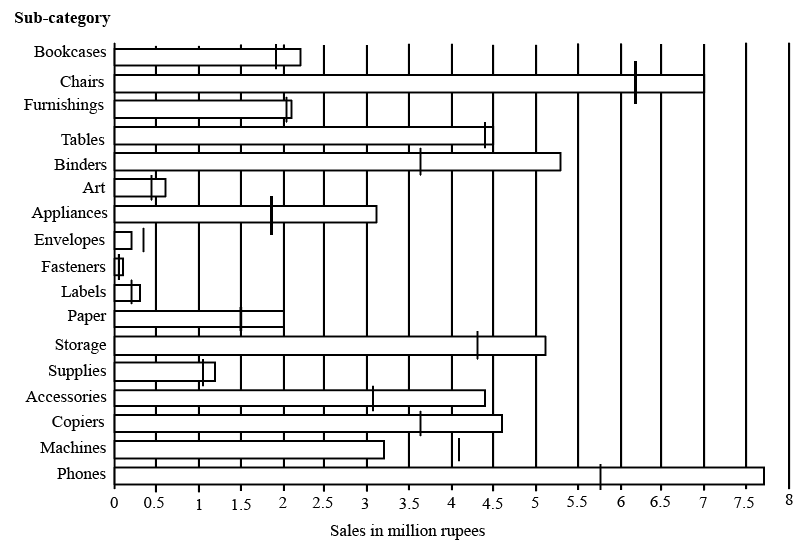
The horizontal bars in the above diagram represent 2020 aggregate sales (in ₹ million) of a company for the different subcategories of its products. The top four product subcategories (Bookcases, Chairs, Furnishings, Tables) belong to furniture product category; the bottom four product subcategories (Accessories, Copiers, Machines, Phones) belong to the technology product category while all other product subcategories belong to the office supply product category. For each of the product subcategories, there is a vertical line indicating the sales of the corresponding subcategory in 2019.
The total sales (in ₹ million) in 2019 from products in office supplies category is closest to
The total sales from products in the office supply category in 2019 is :
Sum of sales of :
Binders: 3.6 million
Art : 0.4 million.
Appliances: 1.9 million
Envelops: 0.3 million
Fasteners: 0.1 million
Labels: 0.2 million
Paper = 1.5 million.
Storage: 4.3 million.
Supplies: 1.1 million.
The sum of sales of these products = 3.6+0.4+1.9+0.3+0.1+0.2+1.5+4.3+1.1 = 13.4 million.
The closest among the option is 13.5 million.
The percentage increase in sales in Furniture category from 2019 to 2020 is closest to
The percentage increase in sales in the furniture category from 2019 to 2020 are :
Bookcases: 1.9 million in 2019 and 2.2 million in 2020.
Chairs: 6.2 million in 2019 and 7 million in 2020.
Furnishings: 2.05 million in 2019 and 2.1 million in 2020.
Tables: 4.4 million in 2019 and 4.5 million in 2020.
Hence the percentage increase is given by :
$$\frac{\left(\left(2.2+7+2.1+4.5\right)-\left(1.9+6.2+2.05+4.4\right)\right)}{1.9+6.2+2.05+4.4}$$
$$\frac{\left(15.8-14.55\right)}{14.55}\cdot100\ =\ \frac{125}{14.55}=\ 8.53\%$$

How many subcategories had sales of ₹ 4 million or more in 2019 and registered an increase in sales in excess of 25% in 2020?
The number of subcategories had sales of ₹ 4 million or more in 2019 and registered an increase in sales in excess of 25% in 2020 :
The subcategories with more than 4 million in sales in 2019 are :
Chairs: 6.2 million in 2019 and 7 million in 2020. ( For a 25 percent increase the sales must be at least 7.8 million and hence fails)
Tables: 4.4 million in 2019 and 4.5 million in 2020. ( For a 25 percent increase the sales must be at least 5.5 million and hence fails)
Storage: 4.3 million sales in 2019 and 5.1 million in 2020. ( For a 25 percent increase the sales must be at least 5.4 and hence fails)
Phones: 5.75 million in 2019 and 7.5 million in 2020. ( An increase of 30.5 percent)
Hence only one subcategory satisfies the condition.
The improvement index for a category is the maximum percentage increase in sales from 2019 to 2020 among any of its subcategories. The correct order of categories in increasing order of this improvement index is
The improvement index for a category is the maximum percentage increase in sales from 2019 to 2020 among any of its subcategories.
Hence based on the information provided in the tabular data we need to look for the different subcategories where the rise in sales from 2019 to 2020 is higher.
Based on the visual data :
In the furniture category :
Bookcases and Chairs have a relatively high percentage increase :
Books cases: 1.9 million to 2.2 million ( 15.7 percent increase )
Chairs: 6.2 million to 7 million ( 12.9 percent increase)
In the office supply category :
Binders and Appliances have a relatively high percentage increase :
Binders: 3.6 million to 5.3 million (47 percent increase )
Appliances: 1.9 million to 3.15 million ( 65.7 percent increase)
In technology product category :
Accessories: 3.1 to 4.4 million. (41.9 percent increase)
Phones: 5.8 million to 7.7 million ( 32.7 percent increase)
Hence among the categories :
The highest increase among them is in the order :
Furniture < Technology product < office supply.
Two trains cross each other in 14 seconds when running in opposite directions along parallel tracks. The faster train is 160 m long and crosses a lamp post in 12 seconds. If the speed of the other train is 6 km/hr less than the faster one, its length, in m, is
Speed of the faster train = $$\frac{160}{12}=\frac{40}{3}\ $$ m/s
Speed of the slower train = $$\frac{40}{3}-\left(6\times\ \frac{5}{18}\right)=\frac{35}{3}$$ m/s
Sum of speeds (when the trains travel towards each other) = $$\frac{40}{3}+\frac{35}{3}=25$$ m/s
Let the slower train be $$x$$ metres long; then: $$\frac{160+x}{25}=14$$
On solving, $$x=190\ m$$

If the area of a regular hexagon is equal to the area of an equilateral triangle of side 12 cm, then the length, in cm, of each side of the hexagon is
Area of a regular hexagon = $$\frac{3\sqrt{3}}{2}x^2$$
Area of an equilateral triangle = $$\frac{\sqrt{3}}{4}\left(a\right)^2$$ ; where a = side of the triangle
Since the area of the two figures are equal, we can equate them as folllows: $$\frac{3\sqrt{3}}{2}x^2=\frac{\sqrt{3}}{4}\left(12\right)^2$$
On simplifying: $$x^2=24\ $$
$$\therefore\ x=2\sqrt{6}$$
Suppose the length of each side of a regular hexagon ABCDEF is 2 cm.It T is the mid point of CD,then the length of AT, in cm, is
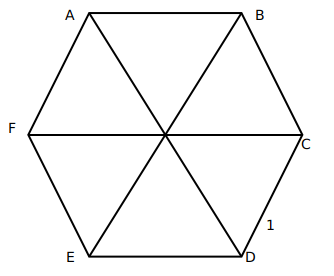
Since a regular hexagon can be considered to be made up of 6 equilateral triangles, a line joining the farthest vertices of a hexagon can be considered to be made up using the sides of two opposite equilateral triangle forming the hexagon. Hence, its length should be twice the side of the hexagon, in this case, 4 cm.
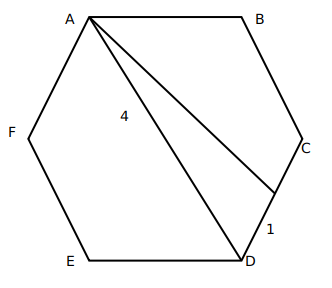
Now, AD divided the hexagon into two symmetrical halves. Hence, AD bisects angle D, and hence, angle ADC is $$60^{\circ\ }$$.
We can find out the value of AT using cosine formula:
$$AT^2=\ 4^2+1^2-2\times\ 1\times\ 4\cos60$$
$$AT^2=\ 17-4=13$$
$$AT=\sqrt{\ 13}$$
Anu, Vinu and Manu can complete a work alone in 15 days, 12 days and 20 days, respectively. Vinu works everyday. Anu works only on alternate days starting from the first day while Manu works only on alternate days starting from the second day. Then, the number of days needed to complete the work is
Let the total amount of work be 60 units.
Then Anu, Vinu, and Manu do 4, 5, and 3 units of work per day respectively.
On the 1st day, Anu and Vinu work. Work done on the 1st day = 9 units
On the 2nd day, Manu and Vinu work. Work done on the 2nd day = 8 units
This cycle goes on. And in 6 days, the work completed is 9+8+9+8+9+8 = 51 units.
On the 7th day, again Anu and Vinu work and complete the remaining 9 units of work. Thus, the number of days taken is 7 days.

The amount Neeta and Geeta together earn in a day equals what Sita alone earns in 6 days. The amount Sita and Neeta together earn in a day equals what Geeta alone earns in 2 days. The ratio of the daily earnings of the one who earns the most to that of the one who earns the least is
Let the amounts Neeta, Geeta, and Sita earn in a day be n, g, and s respectively.
Then, it has been given that:
n+g=6s -i
s+n=2g -ii
ii-i, we get: s-g = 2g-6s
7s = 3g.
Let g be 7a. Then s earns 3a.
Then n earns 6s-g = 18a-7a = 11a.
Thus, the ratio is 11a:3a = 11:3
Onion is sold for 5 consecutive months at the rate of Rs 10, 20, 25, 25, and 50 per kg, respectively. A family spends a fixed amount of money on onion for each of the first three months, and then spends half that amount on onion for each of the next two months. The average expense for onion, in rupees per kg, for the family over these 5 months is closest to
Let us assume the family spends Rs. 100 each month for the first 3 months and then spends Rs. 50 in each of the next two months.
Then amount of onions bought = 10, 5, 4, 2, 1, for months 1-5 respectively.
Total amount bought = 22kg.
Total amount spent = 100+100+100+50+50 = 400.
Average expense = $$\frac{400}{22}=Rs.18.18\approx\ 18$$
The number of groups of three or more distinct numbers that can be chosen from 1, 2, 3, 4, 5, 6, 7 and 8 so that the groups always include 3 and 5, while 7 and 8 are never included together is
The possible arrangements are of the form
35 _ Can be chosen in 6 ways.
35 _ _ We can choose 2 out of the remaining 6 in $$^6C_2=15$$ways. We remove 1 case where 7 and 8 are together to get 14 ways.
35 _ _ _We can choose 3 out of the remaining 6 in $$^6C_3=20$$ways. We remove 4 cases where 7 and 8 are together to get 16 ways.
35 _ _ _ _We can choose 4 out of the remaining 6 in $$^6C_4=15$$ways. We remove 6 case where 7 and 8 are together to get 9 ways.
35 _ _ _ _ _ We choose 1 out of 7 and 8 and all the remaining others in 2 ways.
Thus, total number of cases = 6+14+16+9+2 = 47.
Alternatively,
The arrangement requires a selection of 3 or more numbers while including 3 and 5 and 7, 8 are never included together. We have cases including a selection of only 7, only 8 and neither 7 nor 8.
Considering the cases, only 7 is selected.
We can select a maximum of 7 digit numbers. We must select 3, 5, and 7.
Hence we must have ( 3, 5, 7) for the remaining 4 numbers we have
Each of the numbers can either be selected or not selected and we have 4 numbers :
Hence we have _ _ _ _ and 2 possibilities for each and hence a total of 2*2*2*2 = 16 possibilities.
SImilarly, including only 8, we have 16 more possibilities.
Cases including neither 7 nor 8.
We must have 3 and 5 in the group but there must be no 7 and 8 in the group.
Hence we have 3 5 _ _ _ _.
For the 4 blanks, we can have 2 possibilities for either placing a number or not among 1, 2, 4, 6.
= 16 possibilities
But we must remove the case where neither of the 4 numbers are placed because the number becomes a two-digit number.
Hence 16 - 1 = 15 cases.
Total = 16+15+16 = 47 possibilities

Amal purchases some pens at ₹ 8 each. To sell these, he hires an employee at a fixed wage. He sells 100 of these pens at ₹ 12 each. If the remaining pens are sold at ₹ 11 each, then he makes a net profit of ₹ 300, while he makes a net loss of ₹ 300 if the remaining pens are sold at ₹ 9 each. The wage of the employee, in INR, is
Let the number of pens purchased be n. Then the cost price is 8n. The total expenses incurred would be 8n+W, where W refers to the wage.
Then SP in the first case = $$12\times\ 100+11\times\ \left(n-100\right)$$
Given profit is 300 in this case: 1200+11n-1100-8n-W=300 =>3n-W = 200
In second case: 1200+9n-900-8n-W=-300 (Loss). => W-n = 600.
Adding the two equations: 2n = 800
n = 400.
Thus W = 600 + 400 = 1000
A basket of 2 apples, 4 oranges and 6 mangoes costs the same as a basket of 1 apple, 4 oranges and 8 mangoes, or a basket of 8 oranges and 7 mangoes. Then the number of mangoes in a basket of mangoes that has the same cost as the other baskets is
Let the cost of an apple, an orange and a mango be a, o, and m respectively.
Then it is given that:
2a+4o+6m = a+4o+8m
or a = 2m.
Also, a+4o+8m = 8o + 7m
10m-7m = 4o
3m = 4o.
We can now express the cost of a basket in terms of mangoes only:
2a+4o+6m = 4m+3m+6m = 13m.
The number of integers n that satisfy the inequalities $$\mid n - 60 \mid < \mid n - 100 \mid < \mid n - 20 \mid$$ is
We have $$\mid n - 60 \mid < \mid n - 100 \mid < \mid n - 20 \mid$$.
Now, the difference inside the modulus signified the distance of n from 60, 100, and 20 on the number line. This means that when the absolute difference from a number is larger, n would be further away from that number.
Example: The absolute difference of n and 60 is less than that of the absolute difference between n and 20. Hence, n cannot be $$\le\ 40$$, as then it would be closer to 20 than 60, and closer on the number line would indicate lesser value of absolute difference. Thus we have the condition that n>40.
The absolute difference of n and 100 is less than that of the absolute difference between n and 20. Hence, n cannot be $$\le\ 60$$, as then it would be closer to 20 than 100. Thus we have the condition that n>60.
The absolute difference of n and 60 is less than that of the absolute difference between n and 100. Hence, n cannot be $$\ge80$$, as then it would be closer to 100 than 60. Thus we have the condition that n<80.
The number which satisfies the conditions are 61, 62, 63, 64......79. Thus, a total of 19 numbers.
Alternatively
as per the given condition : $$\mid n - 60 \mid < \mid n - 100 \mid < \mid n - 20 \mid$$.
Dividing the range of n into 4 segments. (n < 20, 20<n<60, 60<n<100, n > 100 )
1) For n < 20.
|n-20| = 20-n, |n-60| = 60- n, |n-100| = 100-n
considering the inequality part :$$\left|n-100\right|<\ \left|n\ -20\right|$$
100 -n < 20 -n,
No value of n satisfies this condition.
2) For 20 < n < 60.
|n-20| = n-20, |n-60| = 60- n, |n-100| = 100-n.
60- n < 100 - n and 100 - n < n - 20
For 100 -n < n - 20.
120 < 2n and n > 60. But for the considered range n is less than 60.
3) For 60 < n < 100
|n-20| = n-20, |n-60| = n-60, |n-100| = 100-n
n-60 < 100-n and 100-n < n-20.
For the first part 2n < 160 and for the second part 120 < 2n.
n takes values from 61 ................79.
A total of 19 values
4) For n > 100
|n-20| = n-20, |n-60| = n-60, |n-100| = n-100
n-60 < n - 100.
No value of n in the given range satisfies the given inequality.
Hence a total of 19 values satisfy the inequality.

How many three-digit numbers are greater than 100 and increase by 198 when the three digits are arranged in the reverse order?
Let the numbers be of the form 100a+10b+c, where a, b, and c represent single digits.
Then (100c+10b+a)-(100a+10b+c)=198
99c-99a=198
c-a = 2.
Now, a can take the values 1-7. a cannot be zero as the initial number has 3 digits and cannot be 8 or 9 as then c would not be a single-digit number.
Thus, there can be 7 cases.
B can take the value of any digit from 0-9, as it does not affect the answer. Hence, the total cases will be $$7\times\ 10=70$$.
Anil invests some money at a fixed rate of interest, compounded annually. If the interests accrued during the second and third year are ₹ 806.25 and ₹ 866.72, respectively, the interest accrued, in INR, during the fourth year is nearest to
Let the principal amount be P and the interest rate be r.
Then $$P\left(1+r\right)^2-P\left(1+r\right)=806.25$$ -(1)
$$P\left(1+r\right)^3-P\left(1+r\right)^2=866.72$$ -(2)
Dividing (2) by (1), we get:
$$\frac{\left(P\left(1+r\right)^3-P\left(1+r\right)^2\right)}{P\left(1+r\right)^2-P\left(1+r\right)}=\frac{866.72}{806.25}$$
$$\frac{\left(\left(1+r\right)^2-1-r\right)}{1+r-1}=1.075$$
$$\frac{r^2+r}{r}=1.075$$
r=0.075 or 7.5%
$$\frac{\left(Interest\ accrued\ in\ 4th\ yr\right)}{Interest\ accrued\ in\ 3rd\ yr}=\frac{X}{866.72}$$
$$\frac{\left(P\left(1+r\right)^4-P\left(1+r\right)^3\right)}{P\left(1+r\right)^3-P\left(1+r\right)^2}=\frac{X}{866.72}$$
Dividing numerator and denominator by $$P\left(1+r\right)^2$$
$$\frac{r^2+2r+1-1-r}{1+r-1}=\frac{X}{866.72}$$
$$r+1=\frac{X}{866.72}$$
$$X=1.075\times\ 866.72=931.72$$
Suppose hospital A admitted 21 less Covid infected patients than hospital B, and all eventually recovered. The sum of recovery days for patients in hospitals A and B were 200 and 152, respectively. If the average recovery days for patients admitted in hospital A was 3 more than the average in hospital B then the number admitted in hospital A was
Let the number of Covid patients in Hospitals A and B be x and x+21, respectively. Then, it has been given that:
$$\dfrac{200}{x}-\dfrac{152}{x+21}=3$$
$$\dfrac{\left(200x+4200-152x\right)}{x\left(x+21\right)}=3$$
$$\dfrac{\left(48x+4200\right)}{x\left(x+21\right)}=3$$
$$16x+1400=x\left(x+21\right)$$
$$x^2+5x-1400=0$$
(x+40)(x-35)=0
Hence, x=35.

A circle of diameter 8 inches is inscribed in a triangle ABC where $$\angle ABC = 90^\circ$$. If BC = 10 inches then the area of the triangle in square inches is
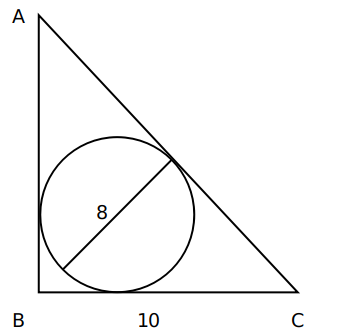
We know that Inradius=$$\frac{\left(Perpendicular+Base-Hypotenuse\right)}{2}$$
$$4=\frac{\left(p+10-h\right)}{2}$$
h-p = 2 or h= p+2.
Now, $$p^2+100\ =\ h^2$$
$$p^2+100\ =\ \left(p+2\right)^2$$
$$p^2+100\ =\ p^2+4p+4$$
4p = 96
p=24.
Hence, Area = $$\frac{1}{2}\times\ 10\times\ 24\ =\ 120$$.
$$f(x) = \frac{x^2 + 2x - 15}{x^2 - 7x - 18}$$ is negative if and only if
$$f(x) = \frac{x^2 + 2x - 15}{x^2 - 7x - 18}$$<0
$$\frac{\left(x+5\right)\left(x-3\right)}{\left(x-9\right)\left(x+2\right)}<0$$
We have four inflection points -5, -2, 3, and 9.
For x<-5, all four terms (x+5), (x-3), (x-9), (x+2) will be negative. Hence, the overall expression will be positive. Similarly, when x>9, all four terms will be positive.
When x belongs to (-2,3), two terms are negative and two are positive. Hence, the overall expression is positive again.
We are left with the range (-5,-2) and (3,9) where the expression will be negative.
If $$5 - \log_{10}\sqrt{1 + x} + 4 \log_{10} \sqrt{1 - x} = \log_{10} \frac{1}{\sqrt{1 - x^2}}$$, then 100x equals
$$5 - \log_{10}\sqrt{1 + x} + 4 \log_{10} \sqrt{1 - x} = \log_{10} \frac{1}{\sqrt{1 - x^2}}$$
We can re-write the equation as: $$5-\log_{10}\sqrt{1+x}+4\log_{10}\sqrt{1-x}=\log_{10}\left(\sqrt{1+x}\times\ \sqrt{1-x}\right)^{-1}$$
$$5-\log_{10}\sqrt{1+x}+4\log_{10}\sqrt{1-x}=\left(-1\right)\log_{10}\left(\sqrt{1+x}\right)+\left(-1\right)\log_{10}\left(\sqrt{1-x}\right)$$
$$5=-\log_{10}\sqrt{1+x}+\log_{10}\sqrt{1+x}-\log_{10}\sqrt{1-x}-4\log_{10}\sqrt{1-x}$$
$$5=-5\log_{10}\sqrt{1-x}$$
$$\sqrt{1-x}=\frac{1}{10}$$
Squaring both sides: $$\left(\sqrt{1-x}\right)^2=\frac{1}{100}$$
$$\therefore\ $$ $$x=1-\frac{1}{100}=\frac{99}{100}$$
Hence, $$100\ x\ =100\times\ \frac{99}{100}=99$$

Amar, Akbar and Anthony are working on a project. Working together Amar and Akbar can complete the project in 1 year, Akbar and Anthony can complete in 16 months, Anthony and Amar can complete in 2 years. If the person who is neither the fastest nor the slowest works alone, the time in months he will take to complete the project is
Let the total work be 48 units. Let Amar do 'm' work, Akbar do 'k' work, and Anthony do 'n' units of work in a month.
Amar and Akbar complete the project in 12 months. Hence, in a month they do $$\frac{48}{12}$$=4 units of work.
m+k = 4.
Similarly, k+n = 3, and m+n = 2.
Solving the three equations, we get $$m=\frac{3}{2},\ k=\frac{5}{2},\ n=\frac{1}{2}$$.
Here, Amar works neither the fastest not the slowest, and he does 1.5 units of work in a month. Hence, to complete the work, he would take $$\frac{48}{1.5}=32$$months.
If $$x_0 = 1, x_1 = 2$$, and $$x_{n + 2} = \frac{1 + x_{n + 1}}{x_n}, n = 0, 1, 2, 3, ......,$$ then $$x_{2021}$$ is equal to
$$x_0=1$$
$$x_1=2$$
$$x_2=\frac{\left(1+x_1\right)}{x_0}=\frac{\left(1+2\right)}{1}=3$$
$$x_3=\frac{\left(1+x_2\right)}{x_1}=\frac{\left(1+3\right)}{2}=2$$
$$x_4=\frac{\left(1+x_3\right)}{x_2}=\frac{\left(1+2\right)}{3}=1$$
$$x_5=\frac{\left(1+x_4\right)}{x_3}=\frac{\left(1+1\right)}{2}=1$$
$$x_6=\frac{\left(1+x_5\right)}{x_4}=\frac{\left(1+1\right)}{1}=2$$
Hence, the series begins to repeat itself after every 5 terms. Terms whose number is of the form 5n are 1, 5n+1 are 2... and so on, where n=0,1,2,3,....
2021 is of the form 5n+1. Hence, its value will be 2.
The strength of an indigo solution in percentage is equal to the amount of indigo in grams per 100 cc of water. Two 800 cc bottles are filled with indigo solutions of strengths 33% and 17%, respectively. A part of the solution from the first bottle is thrown away and replaced by an equal volume of the solution from the second bottle. If the strength of the indigo solution in the first bottle has now changed to 21% then the volume, in cc, of the solution left in the second bottle is
Let Bottle A have an indigo solution of strength 33% while Bottle B have an indigo solution of strength 17%.
The ratio in which we mix these two solutions to obtain a resultant solution of strength 21% : $$\frac{A}{B}=\frac{21-17}{33-21}=\frac{4}{12}or\ \frac{1}{3}$$
Hence, three parts of the solution from Bottle B is mixed with one part of the solution from Bottle A. For this process to happen, we need to displace 600 cc of solution from Bottle A and replace it with 600 cc of solution from Bottle B {since both bottles have 800 cc, three parts of this volume = 600cc}.As a result, 200 cc of the solution remains in Bottle B.
Hence, the correct answer is 200 cc.
Identical chocolate pieces are sold in boxes of two sizes, small and large. The large box is sold for twice the price of the small box. If the selling price per gram of chocolate in the large box is 12% less than that in the small box, then the percentage by which the weight of chocolate in the large box exceeds that in the small box is nearest to
Let the selling price of the Large and Small boxes of chocolates be Rs.200 and Rs.100 respectively. Let us consider that the Large box has $$L$$ grams of chocolate while the Small box has $$S$$ grams of chocolate.
The relation between the selling price per gram of chocolate can be represented as: $$\frac{200}{L}=0.88\times\ \frac{100}{S}$$
On solving we obtain the ratio of the amount of chocolate in each box as: $$\frac{L}{S}=\frac{25}{11}$$
The percentage by which the weight of chocolate in the large box exceeds that in the small box = $$\left(\frac{25}{11}-1\right)\times\ 100\approx\ 127\%$$
The natural numbers are divided into groups as (1), (2, 3, 4), (5, 6, 7, 8, 9), ….. and so on. Then, the sum of the numbers in the 15th group is equal to
The first number in each group: 1, 2, 5, 10, 17.....
Their common difference is in Arithmetic Progression. Hence, the general term of the series can be expressed as a quadratic equation.
Let the quadratic equation of the general term be $$ax^2+bx+c$$
1st term = a+b+c=1
2nd term = 4a+2b+c=2
3rd term = 9a+3b+c=5
Solving the equations, we get a=1, b=-2, c=2.
Hence, the first term in the 15th group will be $$\left(15\right)^2-2\left(15\right)+2=197$$
We can see that the number of terms in each group is 1, 3, 5, 7.... and so on. These are of the form 2n-1. Hence, the number of terms in 15th group will be 29. Hence, the last term in the 15th group will be 197+29-1 = 225.
Sum of terms in group 15= $$\frac{29}{2}\left(197+225\right)\ =\ 6119$$
Alternatively,
The final term in each group is the square of the group number.
In the first group 1, second group 4, ............
The final element of the 14th group is $$\left(14\right)^2=\ 196$$, similarly for the 15th group this is : $$\left(15\right)^2=\ 225$$
Each group contains all the consecutive elements in this range.
Hence the 15th group the elements are:
(197, 198, ................................225).
This is an Arithmetic Progression with a common difference of 1 and the number of element 29.
Hence the sum is given by : $$\frac{n}{2}\cdot\left(first\ term\ +last\ term\right)$$
$$\frac{29}{2}\cdot\left(197+225\right)$$
6119.
If r is a constant such that $$\mid x^2 - 4x - 13 \mid = r$$ has exactly three distinct real roots, then the value of r is
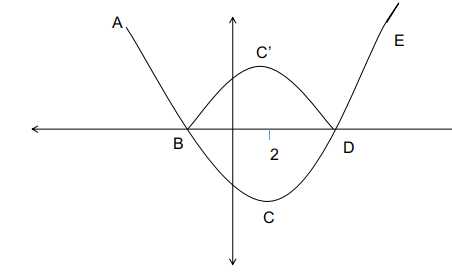
The quadratic equation of the form $$\mid x^2 - 4x - 13 \mid = r$$ has its minimum value at x = -b/2a, and hence does not vary irrespective of the value of x.
Hence at x = 2 the quadratic equation has its minimum.
Considering the quadratic part : $$\left|x^2-4\cdot x-13\right|$$. as per the given condition, this must-have 3 real roots.
The curve ABCDE represents the function $$\left|x^2-4\cdot x-13\right|$$. Because of the modulus function, the representation of the quadratic equation becomes :
ABC'DE.
There must exist a value, r such that there must exactly be 3 roots for the function. If r = 0 there will only be 2 roots, similarly for other values there will either be 2 or 4 roots unless at the point C'.
The point C' is a reflection of C about the x-axis. r is the y coordinate of the point C' :
The point C which is the value of the function at x = 2, = $$2^2-8-13$$
= -17, the reflection about the x-axis is 17.
Alternatively,
$$\mid x^2 - 4x - 13 \mid = r$$ .
This can represented in two parts :
$$x^2-4x-13\ =\ r\ if\ r\ is\ positive.$$
$$x^2-4x-13\ =\ -r\ if\ r\ is\ negative.$$
Considering the first case : $$x^2-4x-13\ =r$$
The quadraticequation becomes : $$x^2-4x-13-r\ =\ 0$$
The discriminant for this function is : $$b^2-4ac\ =\ 16-\ \left(4\cdot\left(-13-r\right)\right)=68+4r$$
SInce r is positive the discriminant is always greater than 0 this must have two distinct roots.
For the second case :
$$x^2-4x-13+r\ =\ 0$$ the function inside the modulus is negaitve
The discriminant is $$16\ -\ \left(4\cdot\left(r-13\right)\right)\ =\ 68-4r$$
In order to have a total of 3 roots, the discriminant must be equal to zero for this quadratic equation to have a total of 3 roots.
Hence $$\ 68-4r\ =\ 0$$
r = 17, for r = 17 we can have exactly 3 roots.

Educational materials for CAT preparation
 Share
Share