91- 6303239042
In which year was the increase in spending on CSR, vis - à - vis the previous year, the maximum?
Sign in
Please select an account to continue using cracku.in
↓ →
Based on the following information.
The following graphs give annual data of Assets, Sales (as percentage of Assets) and Spending on Corporate Social Responsibility (CSR) (as percentage of Sales), of a company for the period 2004 - 2009.

In which year was the increase in spending on CSR, vis - à - vis the previous year, the maximum?
Total value of assets in the year 2004 = 100 crore
Total value of sales in the year 2004 = 0.60*100 = 60 crore
CSR spending in the year 2004 = $$\dfrac{5/3}{100}\times 100$$ = 1 crore.
Similarly, we can calculate for the remaining years. Tabulating the same data, (All the values are in crores)
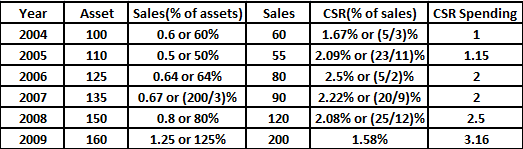
From the table, we can see that the increase in CSR spending 2006 is more than 1.5 times as compared to previous year whereas for none of the other values this is true. Hence, option B is the correct answer.
Of the years indicated below, in which year was the ratio of CSR/ Assets the maximum?
Total value of assets in the year 2004 = 100 crore
Total value of sales in the year 2004 = 0.60*100 = 60 crore
CSR spending in the year 2004 = $${5/3}{100}\times 100$$ = 1 crore.
Similarly, we can calculate for the remaining years. Tabulating the same data, (All the values are in crores)
CSR/ Assets ratio for the year 2004 = $$\dfrac{1}{100}$$ = 0.01
CSR/ Assets ratio for the year 2005 = $$\dfrac{1.15}{110}$$ = 0.01045
CSR/ Assets ratio for the year 2006 = $$\dfrac{2}{125}$$ = 0.016
CSR/ Assets ratio for the year 2007 = $$\dfrac{2}{135}$$ = 0.0148
CSR/ Assets ratio for the year 2008 = $$\dfrac{2.5}{150}$$ = 0.0166
We can see that CSR/Asset ratio is maximum for the year 2008. Hence, option E is the correct answer.
The maximum value of spending on CSR activities in the period 2004-2009 is closest to which of the following options?
Total value of assets in the year 2004 = 100 crore
Total value of sales in the year 2004 = 0.60*100 = 60 crore
CSR spending in the year 2004 = $$\dfrac{5/3}{100}\times 100$$ = 1 crore.
Similarly, we can calculate for the remaining years. Tabulating the same data, (All the values are in crores)
From the table we can see that maximum spending on CSR activities in the period 2004 - 2009 = 3.16 crore $$\approx$$ 3 crore. Hence, option D is the correct answer.
In which year, did the spending on CSR (measured in Rs) decline, as compared to previous year?
Total value of assets in the year 2004 = 100 crore
Total value of sales in the year 2004 = 0.60*100 = 60 crore
CSR spending in the year 2004 = $$\dfrac{5/3}{100}\times 100$$ = 1 crore.
Similarly, we can calculate for the remaining years. Tabulating the same data, (All the values are in crores)
From the table, we can see that the CSR spending never decreased as compared to previous year. Hence, option E is the correct answer.
Based on the following information.
Five years ago Maxam Glass Co. had estimated its staff requirements in the five levels in their organization as: Level - 1: 55; Level - 2: 65; Level - 3: 225 ; Level - 4: 255 & Level - 5: 300. Over the years the company had recruited people based on ad-hoc requirements, in the process also selecting ex-defence service men and ex -policemen. The following graph shows actual staff strength at various levels as on date.

The level in which the Ex-Defence Servicemen are highest in percentage terms is:
Percentage of Ex-defense serviceman in level 1 = $$\dfrac{6}{52}\times 100$$ = 11.54 percent
Percentage of Ex-defense serviceman in level 2 = $$\dfrac{8}{65}\times 100$$ = 12.31 percent
Percentage of Ex-defense serviceman in level 3 = $$\dfrac{30}{210}\times 100$$ = 14.28 percent
Percentage of Ex-defense serviceman in level 4 = $$\dfrac{25}{130}\times 100$$ = 19.23 percent
Percentage of Ex-defense serviceman in level 5 = $$\dfrac{60}{330}\times 100$$ = 18.18 percent
We can see that in level 4 the Ex-Defence Servicemen are the highest in percentage terms. Hence, option D is the correct answer.
If the company decides to abolish all vacant posts at all levels, which level would incur the highest reduction in percentage terms ?
From the bar graph we can see that actual staff strength is 130 whereas the staff requirements is 255. So, the company has to abolish 125 vacant seats. we can see that the company has to abolish nearly 50 percent of the total strength which is greater than any other remaining levels. Hence, option D is the correct answer.
Among all levels, which level has the lowest representation of Ex- policemen?
Percentage representation of Ex- policemen in level 1 = $$\dfrac{4}{52}\times 100$$ = 7.69 percent
Percentage representation of Ex- policemen in level 2 = $$\dfrac{4}{65}\times 100$$ = 6.15 percent
Percentage representation of Ex- policemen in level 3 = $$\dfrac{9}{210}\times 100$$ = 4.29 percent
Percentage representation of Ex- policemen in level 4 = $$\dfrac{7}{130}\times 100$$ = 5.38 percent
Percentage representation of Ex- policemen in level 5 = $$\dfrac{15}{330}\times 100$$ = 4.54 percent
We can see that in level 3 the Ex- policemen are the lowest in percentage terms. Hence, option C is the correct answer.
In a locality, there are ten houses in a row. On a particular night a thief planned to steal from three houses of the locality. In how many ways can he plan such that no two of them are next to each other?
Total number of houses = 10
If first house is robbed, then II is not and if II house is robbed, then III is not and so on.
Thus 2 adjacent houses can never be chosen
So, number of ways in which three houses can be robbed such that no two of them are next to each other.
= $$C^{10 - 2}_3 = C^8_3$$
= $$\frac{8 \times 7 \times 6}{1 \times 2 \times 3}$$
= $$56$$
If $$x=(9+4\sqrt{5})^{48} = [x] +f$$, where [x] is defined as integral part of x and f is a fraction, then x (1 - f) equals
It is given that $$x=(9+4\sqrt{5})^{48}$$ ... (1)
Let us assume that $$y=(9-4\sqrt{5})^{48}$$ ... (2)
We can see that 0 < y < 1.
Also, x + y = 2($$48C0*(9)^{48}$$+$$48C2*(9)^{46}*(4\sqrt{5})^2$$+$$48C4(9)^{44}*(4\sqrt{5})^4$$+...+$$48C48*(4\sqrt{5})^{48}$$)
We can see that x + y is an integer therefore we can say that y + f = 1. Hence, y = (1 - f)
We can see that = x(1 - f) = x*y
$$\Rightarrow$$ $$(9+4\sqrt{5})^{48}(9-4\sqrt{5})^{48}$$
$$\Rightarrow$$ $$(9^2-(4\sqrt{5})^2)^{48}$$
$$\Rightarrow$$ $$(81-80)^{48}$$ = 1
Hence, option A is the correct answer.
Let $$a_{n} = 1 1 1 1 1 1 1..... 1$$, where 1 occurs n number of times. Then,
i. $$a_{741}$$ is not a prime.
ii. $$a_{534}$$ is not a prime.
iii. $$a_{123}$$ is not a prime.
iv. $$a_{77}$$ is not a prime.
i. $$a_{741}$$ has 741 ones, it will be divisible by 3
ii. $$a_{534}$$ has 534 ones, it will be divisible by 3
iii. $$a_{123}$$ has 123 ones, it will be divisible by 3
iv. $$a_{77}$$ has 77 ones and each pair of 11 ones is divisible by 13.
Therefore, i,ii,iii and iv are not prime.
Ans -(D) All are correct.
Based on the following information

Total income tax payable is obtained by adding two additional surcharges on calculated income tax.
Education Cess : An additional surcharge called ‘Education Cess’ is levied at the rate of 2% on the amount of income tax.
Secondary and Higher Education Cess : An additional surcharge called ‘Secondary and Higher Education Cess` is levied at the rate of 1% on the amount of income tax.
Sangeeta is a young working lady. Towards the end of the financial year 2009 - 10, she found her total annual income to be Rs. 3, 37, 425/ -. What % of her income is payable as income tax?
Income tax payable by Sangeeta according to her salary band = 0.2*(337425-300000) + 0.1(300000-190000) = Rs. 18485
Total education cess levied on income tax = 2 + 1 = 3% of income tax
Therefore, the total income tax payable by Sangeeta = 1.03*18485 = 19039.55.
Hence, the required percentage = $$\dfrac{19039.55}{337425}\times 100$$ = 5.64 percent
Therefore, we can say that option A is the correct answer.
Mr. Madan observed his tax deduction at source, done by his employer, as Rs. 3,17,910/-. What was his total income (in Rs.) if he neither has to pay any additional tax nor is eligible for any refund?
Madan's tax deduction at source = Rs. 3,17,910
From the table we can see that one can pay this much amount of tax if he earns more than 5 lakh.
Let say Madan's is Rs. x more than 5 lakhs. Therefore, Madan's total income = Rs. 500000+x.
Total income tax paid by Madan = 1.03{0.3*(x) + 0.2*(200000) + 0.1(140000)}
$$\Rightarrow$$ $$\dfrac{317910}{1.03} = 0.3x + 54000$$
$$\Rightarrow$$ x = 848835.
Therefore, Madan's total income = 500000+848835 = Rs. 1348835. Hence, option A is the correct answer.
A straight line through point P of a triangle PQR intersects the side QR at the point S and the circumcircle of the triangle PQR at the point T. lf S is not the centre of the circumcircle, then which of the following is true?

Using properties of secant, $$PS \times ST = QS \times SR$$ -------------Eqn(I)
Also, for two numbers, $$PS$$ and $$ST$$, we know that harmonic mean is less than geometric mean.
=> $$\frac{2}{\frac{1}{PS} + \frac{1}{ST}} < \sqrt{PS \times ST}$$
=> $$\frac{1}{PS} + \frac{1}{ST} > \frac{2}{\sqrt{PS \times ST}}$$
Using Eqn(I)
=> $$\frac{1}{PS} + \frac{1}{ST} > \frac{2}{\sqrt{QS \times SR}}$$ ------Eqn(II)
Also, for two numbers, $$QS$$ and $$SR$$, geometric mean is less than arithmetic mean.
=> $$\sqrt{QS \times SR} < \frac{QS + SR}{2}$$
=> $$\frac{1}{\sqrt{QS \times SR}} > \frac{2}{QR}$$ $$(\because QS + SR = QR)$$
Multiplying both sides by $$2$$
=> $$\frac{2}{\sqrt{QS \times SR}} > \frac{4}{QR}$$ ----------Eqn(III)
From eqn(II) and (III)
$$\therefore \frac{1}{PS} + \frac{1}{ST} > \frac{4}{QR}$$
What is the maximum possible value of (21 Sin X + 72 Cos X)?
To find the minimum or maximum value, we need to find first derivative and put it equal to zero
Expression : $$f(x) = 21 sin x + 72 cos x$$
=> $$f'(x) = 21 cos x - 72 sin x = 0$$
=> $$21 cos x = 72 sin x$$
=> $$\frac{sin x}{cos x} = tan x = \frac{21}{72} = \frac{7}{24}$$
=> $$sin x = \frac{7}{\sqrt{7^2 + 24^2}} = \frac{7}{\sqrt{49 + 576}}$$
=> $$sin x = \frac{7}{\sqrt{625}} = \frac{7}{25}$$
Similarly, $$ cos x = \frac{24}{25}$$
Putting it in the original expression, we get :
=> $$f(x) = (21 \times \frac{7}{25}) + (72 \times \frac{24}{25})$$
= $$\frac{147}{25} + \frac{1728}{25} = \frac{1728 + 147}{25}$$
= $$\frac{1875}{25} = 75$$
Shortcut Method : Maximum value of $$a sin x + b cos x = \sqrt{a^2 + b^2}$$
and minimum value = $$- \sqrt{a^2 + b^2}$$
=> Max value of $$21 sin x + 72 cos x = \sqrt{(21)^2 + (72)^2}$$
= $$\sqrt{441 + 5184} = \sqrt{5625}$$
= $$75$$
The scheduling officer for a local police department is trying to schedule additional patrol units in each of two neighbourhoods - southern and northern. She knows that on any given day, the probabilities of major crimes and minor crimes being committed in the northern neighbourhood were 0.418 and 0.612, respectively, and that the corresponding probabilities in the southern neighbourhood were 0.355 and 0.520. Assuming that all crime occur independent of each other and likewise that crime in the two neighbourhoods are independent of each other, what is the probability that no crime of either type is committed in either neighbourhood on any given day?
For northern neighbourhood,
Probability that there is no major crime = $$(1 - 0.418) = 0.582$$
Probability that there is no minor crime = $$(1 - 0.612) = 0.388$$
For southern neighbourhood,
Probability that there is no major crime = $$(1 - 0.355) = 0.645$$
Probability that there is no minor crime = $$(1 - 0.520) = 0.480$$
$$\therefore$$ Probability that no crime of either type is committed in either neighbourhood on any given day
= $$0.582 \times 0.388 \times 0.645 \times 0.480$$
= $$0.069$$
Based on the following information
A man standing on a boat south of a light house observes his shadow to be 24 meters long, as measured at the sea level. On sailing 300 meters eastwards, he finds his shadow as 30 meters long, measured in a similar manner. The height of the man is 6 meters above sea level.
The height of the light house above the sea level is:

KL = lighthouse
BA = initial position man of man and BC = shadow
After moving 300 m east, DE = new position of man and EF = shadow
Given : AB = DE = 6 m
BC = 24 m and EF = 30 m and BE = 300 m
$$\triangle$$ LBE is right angled triangle (sea level).
To find : KL = ?
Solution : In $$\triangle$$ KLF and $$\triangle$$ DEF
=> $$\angle KLF = \angle DEF = 90$$
$$\angle KFL = \angle DFE$$ (common angle)
=> $$\triangle KLF \sim \triangle DEF$$
=> $$\frac{KL}{DE} = \frac{LF}{EF}$$ -----------Eqn(I)
Similarly, $$\triangle KLC \sim \triangle ABC$$
=> $$\frac{KL}{AB} = \frac{LC}{BC}$$ ----------Eqn(II)
From eqn (I) and (II), and using AB = DE
=> $$\frac{LC}{BC} = \frac{LF}{EF}$$
=> $$\frac{LC}{24} = \frac{LF}{30}$$
=> $$\frac{LC}{LF} = \frac{24}{30} = \frac{4}{5}$$
If, LC is 4 part $$\equiv$$ LF is 5 part
=> $$LB = 4x$$ and $$LE = 5x$$
$$\because$$ $$\triangle$$ LBE is right angled triangle
=> $$(LE)^2 - (LB)^2 = (BE)^2$$
=> $$25X^2 - 16X^2 = 90000$$
=> $$x^2 = \frac{90000}{9} = 10000$$
=> $$x = \sqrt{10000} = 100$$
=> $$LB = 400$$ and $$LE = 500$$
=> $$LC = LB + BC = 400 + 24 = 424$$
Now, using Eqn (II), we get :
=> $$KL = \frac{LC}{BC} \times AB$$
= $$\frac{424}{24} \times 6 = \frac{424}{4}$$
= $$106 m$$
What is the horizontal distance of the man from the lighthouse in the second position?
KL = lighthouse
BA = initial position man of man and BC = shadow
After moving 300 m east, DE = new position of man and EF = shadow
Given : AB = DE = 6 m
BC = 24 m and EF = 30 m and BE = 300 m
$$\triangle$$ LBE is right angled triangle (sea level).
To find : LE = ?
Solution : In $$\triangle$$ KLF and $$\triangle$$ DEF
=> $$\angle KLF = \angle DEF = 90$$
$$\angle KFL = \angle DFE$$ (common angle)
=> $$\triangle KLF \sim \triangle DEF$$
=> $$\frac{KL}{DE} = \frac{LF}{EF}$$ -----------Eqn(I)
Similarly, $$\triangle KLC \sim \triangle ABC$$
=> $$\frac{KL}{AB} = \frac{LC}{BC}$$ ----------Eqn(II)
From eqn (I) and (II), and using AB = DE
=> $$\frac{LC}{BC} = \frac{LF}{EF}$$
=> $$\frac{LC}{24} = \frac{LF}{30}$$
=> $$\frac{LC}{LF} = \frac{24}{30} = \frac{4}{5}$$
If, LC is 4 part $$\equiv$$ LF is 5 part
=> $$LB = 4x$$ and $$LE = 5x$$
$$\because$$ $$\triangle$$ LBE is right angled triangle
=> $$(LE)^2 - (LB)^2 = (BE)^2$$
=> $$25^2 - 16X^2 = 90000$$
=> $$x^2 = \frac{90000}{9} = 10000$$
=> $$x = \sqrt{10000} = 100$$
$$\therefore LE = 5 \times 100 = 500 m$$
A 25 ft long ladder is placed against the wall with its base 7 ft from the wall. The base of the ladder is drawn out so that the top comes down by half the distance that the base is drawn out. This distance is in the range:
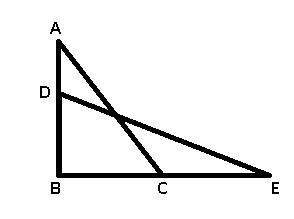
Original position of the ladder = AC = $$25$$ ft
Base = BC = $$7$$ ft
=> In $$\triangle$$ ABC, using Pythagoras theorem
=> $$(AB)^2 = (AC)^2 - (BC)^2$$
=> $$(AB)^2 = (25)^2 - (7)^2$$
=> $$AB = \sqrt{625 - 49} = \sqrt{576}$$
=> $$AB = 24$$ ft
After drawing out the base, the new position of ladder = ED = $$25$$ ft
and $$AD = x$$ and $$CE = 2x$$
To find : CE = ?
Solution : In $$\triangle$$ DBE
$$DB = (24 - x)$$ and $$BE = (7 + 2x)$$
=> $$(DB)^2 + (BE)^2 = (ED)^2$$
=> $$(24 - x)^2 + (7 + 2x)^2 = (25)^2$$
=> $$(576 - 48x + x^2) + (49 + 28x + 4x^2) = 625$$
=> $$625 - 20x + 5x^2 = 625$$
=> $$5x^2 = 20x$$
=> $$x = \frac{20}{5} = 4$$
$$\therefore$$ $$CE = 2 \times 4 = 8$$ ft
None of the options include 8 in the interval.
The domain of the function $$f(x) =log_{7}({ log_{3}(log_{5}(20x-x^{2}-91 )))}$$ is:
A logarithm function of the form $$log_a b$$ is true, iff $$b > 0$$
and $$c = a^b$$ can be written as = $$log_a c = b$$
We have, $$f(x) =log_{7}({ log_{3}(log_{5}(20x-x^{2}-91 )))}$$
=> $$log_{3}(log_{5}(20x - x^{2} - 91 )) > 0$$
=> $$log_{5}(20x - x^{2} - 91 ) > (3)^0$$
=> $$log_{5}(20x - x^{2} - 91 ) > 1$$
=> $$20x - x^{2} - 91 > (5)^1$$
=> $$x^2 - 20x + 96 < 0$$
=> $$(x - 8) (x - 12) < 0$$
=> $$8 < x < 12$$
$$\therefore$$ Domain of $$f(x)$$ = $$(8,12)$$
There are four machines in a factory. At exactly 8 pm, when the mechanic is about to leave the factory, he is informed that two of the four machines are not working properly. The mechanic is in a hurry, and decides that he will identify the two faulty machines before going home, and repair them next morning. It takes him twenty minutes to walk to the bus stop. The last bus leaves at 8:32 pm. If it takes six minutes to identify whether a machine is defective or not, and if he decides to check the machines at random, what is the probability that the mechanic will be able to catch the last bus?
As the mechanic has decided to check two machines, thus if he identifies either both defective machines or both non defective, then the probability that he is able to catch the last bus is sum of the two. Thus, the possible outcomes are :
(i) : Both are defective machines, probability = $$(\frac{1}{2})(\frac{1}{3}) = \frac{1}{6}$$
(ii) : First is defective and second is non defective, probability = $$(\frac{1}{2})(\frac{2}{3}) = \frac{1}{3}$$
(iii) : First is non defective and second is defective, probability = $$(\frac{1}{2})(\frac{2}{3}) = \frac{1}{3}$$
(iv) : Both are non defective machines, probability = $$(\frac{1}{2})(\frac{1}{3}) = \frac{1}{6}$$
In the first and last cases, the mechanic would have identified the defective machines in time to catch the bus.
$$\therefore$$ Probability that he is able to catch the last bus = $$\frac{1}{6} + \frac{1}{6} = \frac{1}{3}$$
=> Ans - (D)
The football league of a certain country is played according to the following rules:
Each team plays exactly one game against each of the other teams.
The winning team of each game is awarded 1 point, and the losing team gets 0 points.
If a match ends in a draw, both teams get $$\frac{1}{2}$$ point.
After the league was over, the teams were ranked according to the points that they earned at the end of the tournament. Analysis of the points table revealed the following:
Exactly half of the points earned by each team were earned in games against the ten teams which finished at the bottom of the table.
Each of the bottom ten teams earned half of their total points against the other nine teams in the bottom ten. How many teams participated in the league?
Number of teams in the bottom group $$= 10$$
Let the total number of teams in top group = $$n$$
Total number of teams $$ = 10 + n$$
=> Number of matches played amongst the bottom group teams = $$^{10}C_2$$
= $$\frac{10 \times 9}{1 \times 2} = 45$$
Number of points bottom group teams get playing amongst themselves $$= 45\cdot1=45$$
Let the total number of teams in top group = $$n$$
wkt, "Each of the bottom ten teams earned half of their total points against the other nine teams in the bottom ten"
i.e. they get half the total points by playing amongst themselves and the other half of total points by playing with the top group teams.
Since they got 45 points playing amongst themselves, the bottom teams get 45 points from their matches against top group teams, => 45 out of $$10 n$$ points
Total points by matches between top teams and bottom teams $$= 10\cdot{n}\cdot1 =10n$$ points
Number of points that top group teams get from matches playing amongst themselves = $$^nC_2$$
Number of points that top group gets against the bottom group = $$10n - 45$$
wkt, "Exactly half of the points earned by each team were earned in games against the ten teams which finished at the bottom of the table.". Therefore the top n teams obtained half points by playing amongst themselves and half the points by playing against bottom 10 teams.
=> $$^nC_2 = 10n - 45$$
=> $$n (n - 1) = 20n - 90$$
=> $$n^2 - 21n + 90 = 0$$
=> $$(n - 6) (n - 15) = 0$$
If, $$n = 6$$, top group would get = $$C^n_2 + 10n - 45$$
= $$C^6_2 + 60 - 45 = 30$$
Average points per game = $$\frac{30}{6} = 5$$
Bottom teams will get on an average = $$\frac{45 + 45}{10} = 9$$
This is not possible.
=> $$n = 15$$
$$\therefore$$ Total number of teams = $$15 + 10 = 25$$
In a city, there is a circular park. There are four points of entry into the park, namely - P, Q, R and S. Three paths were constructed which connected the points PQ, RS, and PS. The length of the path PQ is 10 units, and the length of the path RS is 7 units. Later, the municipal corporation extended the paths PQ and RS past Q and R respectively, and they meet at a point T on the main road outside the park. The path from Q to T measures 8 units, and it was found that the angle PTS is 60.
Find the area (in square units) enclosed by the paths PT, TS, and PS.
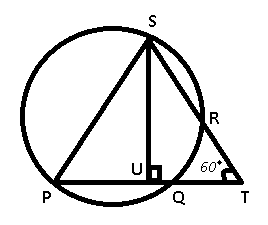
Given : PQ = 10 , QT = 8 , RS = 7
Now, TQ*TP=TR*TS (Secant from same external point)
8(PQ+QT)=TR(TR+RS)
8*18=TR(TR+7)
TR=9
TS=9+7=16
$$\therefore ar (\triangle PTS) = \frac{1}{2} \times PT \times TS \times sin60 $$
= $$\frac{1}{4} \times (16 \sqrt{3}) \times 18$$
= $$72 \sqrt{3}$$
based on the following information.
From a group of 545 contenders, a party has to select a leader. Even after holding a series of meetings, the politicians and the general body failed to reach a consensus. It was then proposed that all 545 contenders be given a number from 1 to 545. Then they will be asked to stand on a podium in a circular arrangement, and counting would start from the contender numbered 1. The counting would be done in a clockwise fashion. The rule is that every alternate contender would be asked to step down as the counting continued, with the circle getting smaller and smaller, till only one person remains standing. Therefore the first person to be eliminated would be the contender numbered 2.
Which position should a contender choose if he has to be the leader?
If the group had two members, the one in the first position would win.
If the group had three members, the one in the third position would win.
If the group had four members, the one in the first position would again win.
Similarly, for five members, the one in the third position will win
Similarly, for six members, the one in the fifth position will win.
So, for f(2n), the one at 2f(n)-1 will win
And for f(2n+1) members, the one at 2f(n)+1 will win.
When 2n = 2, the winner will be 1.
For 2n = 4, winner will be 2f(2) - 1. And since f(2)=1, for f(4), the winner will be 1.
Now, f(545) = 2f(242) + 1
f(272) = 2f(136) - 1
f(136) = 2f(68) - 1
f(68) = 2f(34) - 1
f(34) = 2f(17) - 1
f(17) = 2f(8) + 1
f(8) = 2f(4) - 1
f(4) = 2f(2) - 1
Since f(2) = 1, f(4) = 1,f(8) = 1,.......f(545) = 67
Thus, the correct option is B.
One of the contending politicians, Mr. Chanaya, was quite proficient in calculations and could correctly figure out the exact position. He was the last person remaining in the circle. Sensing foul play the politicians decided to repeat the game. However, this time, instead of removing every alternate person, they agreed on removing every 300th person from the circle. All other rules were kept intact. Mr. Chanaya did some quick calculations and found that for a group of 542 people the right position to become a leader would be 437. What is the right position for the
whole group of 545 as per the modified rule?
For f(2n), the one at 2f(n)-1 will win.
And for f(2n+1) members, the one at 2f(n)+1 will win.
When 2n = 2, the winner will be 1.
For 2n = 4, winner will be 2f(2) - 1. And since f(2)=1, for f(4), the winner will be 1.
Now, f(545) = 2f(242) + 1
f(272) = 2f(136) - 1
f(136) = 2f(68) - 1
f(68) = 2f(34) - 1
f(34) = 2f(17) - 1
f(17) = 2f(8) + 1
f(8) = 2f(4) - 1
f(4) = 2f(2) - 1
Since f(2) = 1, f(4) = 1,f(8) = 1, f(17)= 3,f(34)= 5, f(68) = 9, f(136) = 17, f(272) = 33, f(545) = 67
Now, f(544) = 65, f(543) = 63....
So when every second member is removed, for f(n) = A, f(n - m) = A - 2m.
When every x member is removed and f(n) = A, f(n - m) = A - x*m.
If A > f(n), then f(n) = A % f(n)...(i)
Now, f(542) = 437, and x = 300
f(543) = 437 + 300 = 637 % 543 = 194
f(544) = 196 + 300 = 494
f(545) = 496 + 300 = 794 % 545 = 249
Thus, the correct option is C.
Little Pika who is five and half years old has just learnt addition. However, he does not know how to carry. For example, he can add 14 and 5, but he does not know how to add 14 and 7. How many pairs of consecutive integers between 1000 and 2000 (both 1000 and 2000 included) can Little Pika add?
Little Pika can add (1000, 1001), (1001, 1002), (1002, 1003), (1003, 1004), (1004, 1005) and (1009, 1010).
Similarly, he can add (1010, 1011), (1011, 1012), (1012, 1013), (1013, 1014), (1014, 1015) and (1019, 1020).
Similarly, he can add (1020, 1021), (1021, 1022), (1022, 1023), (1023, 1024), (1024, 1025) and (1029, 1030).
Similarly, he can add (1030, 1031), (1031, 1032), (1032, 1033), (1033, 1034), (1034, 1035) and (1039, 1040).
Similarly, he can add (1040, 1041), (1041, 1042), (1042, 1043), (1043, 1044) , (1044, 1045) and (1049, 1050).
We can see that there are 30 cases when we have changed unit and tens digit. Now the hundreds digit can be anything from {0, 1, 2, 3, 4}.
Hence, total number of such pairs which Pika can add = 5*30 = 150.
He can also number of form, (1099, 1100), (1199, 1200), (1299, 1300), (1399, 1400) (1499, 1500) and (1999, 2000)
Therefore, we can say that Pika can add 150+6 = 156 numbers. Hence, option C is the correct answer.
In the country of Twenty, there are exactly twenty cities, and there is exactly one direct road between any two cities. No two direct roads have an overlapping road segment. After the election dates are announced, candidates from their respective cities start visiting the other cities. Following are the rules that the election commission has laid down for the candidates:
Each candidate must visit each of the other cities exactly once.
Each candidate must use only the direct roads between two cities for going from one city to another.
The candidate must return to his own city at the end of the campaign.
No direct road between two cities would be used by more than one candidate.
The maximum possible number of candidates is
There are 20 cities and one direct road between any 2 cities.
=> Total number of paths = $${}^{20}C_2$$
= $$\frac{20 \times 19}{1 \times 2} = 190$$
Now, each candidate needed to visit all the cities and then come back to the city he started from
=> Paths taken by each candidate = $$20$$
Let maximum number of candidates = $$n$$
=> $$20 n < 190$$
=> $$n < \frac{190}{20}$$
=> $$n < 9.5$$
$$\therefore$$ Maximum possible number of candidates = $$9$$
The micromanometer in a certain factory can measure the pressure inside the gas chamber from 1 unit to 999999 units. Lately this instrument has not been working properly. The problem with the instrument is that it always skips the digit 5 and moves directly from 4 to 6. What is the actual pressure inside the gas chamber if the micromanometer displays 003016?
The meter skips all the numbers in which there is a 5
From, (1 to 99) -> 5 occurs 10 times in tens place and 10 times in units place (which also includes 55)
=> Total occurrence = $$10 + 10 - 1 = 19$$
Similarly from (100 to 199), from (200 to 299)..., from (400 to 499) , from (600 to 699),...from (900 to 999)
It occurs = $$8 \times 19 = 152$$
Now, from (500 to 599), there are 100 numbers, => micromanometer reading can change from 499 to 600.
Thus, total numbers skipped from (1 to 999) = $$19 + 152 + 100 = 271$$
Similarly, from (1000 to 1999) = 271
and from (2000 to 2999) = 271
Also, 3005 and 3015 are also skipped
=> Total number of skips = $$271 + 271 + 271 + 2 = 815$$
$$\therefore$$ Actual pressure = $$3016 - 815 = 2201$$
Consider a square ABCD of side 60 cm. lt contains arcs BD and AC drawn with centres at A and D respectively. A circle is drawn such that it is tangent to side AB, and the arcs BD and AC. What is the radius of the circle?

Given : Side of square = CD = 60 cm
=> AB = CD = 60 cm , => Radius of circles centered at A and D have equal radius of 60 cm
To find : OP = $$r = ?$$
Solution : $$AO = 60 - r$$ and $$AQ = OP = r$$
In $$\triangle$$ AOQ
=> $$(OQ)^2 = (AO)^2 - (AQ)^2$$
=> $$(OQ)^2 = (60 - r)^2 - (r)^2$$
=> $$(OQ)^2 = 3600 - 120r + r^2 - r^2$$
=> $$(OQ)^2 = 3600 - 120r$$
Now, $$OD = 60 + r$$ and $$QD = 60 - r$$
In $$\triangle$$ DOQ
=> $$(OD)^2 = (QD)^2 + (OQ)^2$$
=> $$(60 + r)^2 = (60 - r)^2 + (3600 - 120r)$$
=> $$(3600 + 120r + r^2)$$ = $$(3600 - 120r + r^2) + (3600 - 120r)$$
=> $$120r + 120r + 120r = 3600$$
=> $$r = \frac{3600}{360} = 10 cm$$
There are 240 second year students in a B - School. The Finance area offers 3 electives in the second year. These are Financial Derivatives, Behavioural Finance, and Security Analysis. Four students have taken all the three electives, and 48 students have taken Financial Derivatives. There are twice as many students who study Financial Derivatives and Security Analysis but not Behavioural Finance, as those who study both Financial Derivatives and Behavioural Finance but not Security Analysis, and 4 times as many who study all the three. 124 students study Security Analysis. There are 59 students who could not muster courage to take up any of these subjects. The group of students who study both Financial Derivatives and Security Analysis but not Behavioural Finance, is exactly the same as the group made up of students who study both Behavioural Finance and Security Analysis. How many students study Behavioural Finance only?

Given : $$e = 4$$
$$FD = 48$$, => $$a + b + d + e = 48$$
$$d = 2b$$ and $$d = 4e$$
$$SA = 124$$, => $$d + e + f + g = 124$$
$$d = e + f$$ and $$h = 59$$
To find : $$c = ?$$
Solution : $$d = 4e = 4 \times 4 = 16$$
=> $$b = \frac{d}{2} = \frac{16}{2} = 8$$
=> $$f = d - e = 16 - 4 = 12$$
=> $$a = 48 - b - d - e = 48 - 8 - 16 - 4 = 20$$
=> $$g = 124 - d - e - f = 124 - 16 - 4 - 12 = 92$$
Now, we know that, $$a + b + c + d + e + f + g + h = 240$$
=> $$20 + 8 + c + 16 + 4 + 12 + 92 + 59 = 240$$
=> $$c + 211 = 240$$
=> $$c = 240 - 211 = 29$$
ln a plane rectangular coordinate system, points L, M, N and O are represented by the coordinates (-5, 0), (1,-1), (0, 5), and (-1, 5) respectively. Consider a variable point P in the same plane. The minimum value of PL + PM + PN + PO is
$$(PL + PN)$$ will be minimum if P lies on LN, and $$(PM + PO)$$ will be minimum if P lies on OM.
=> P must be the intersection point of the diagonals of the quadrilateral.
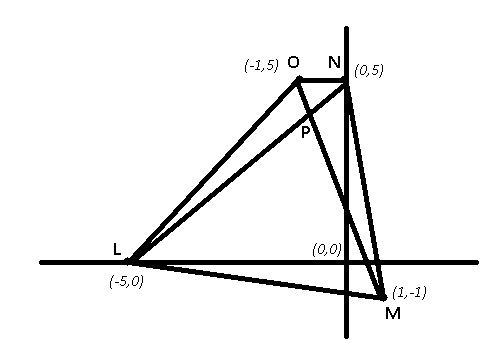
$$\therefore$$ Min (PL + PM + PN + PO)
= $$LN + OM$$
= $$(\sqrt{(0 + 5)^2 + (5 - 0)^2}) + (\sqrt{(1 + 1)^2 + (-1 - 5)^2})$$
= $$(\sqrt{25 + 25}) + (\sqrt{4 + 36})$$
= $$\sqrt{50} + \sqrt{40} = 5 \sqrt{2} + 2 \sqrt{10}$$
Ln a bank the account numbers are all 8 digit numbers, and they all start with the digit 2. So, an account number can be represented as $$2x_1x_2x_3x_4x_5x_6x_7$$. An account number is considered to be a ‘magic’ number if $$x_{1}x_{2}x_{3}$$ is exactly the same as $$x_{4}x_{5}x_{6}$$ or $$x_{5}x_{6}x_{7}$$ or both. $$X_{i}$$ can take values from 0 to 9, but 2 followed by seven $$0_{s}$$ is not a valid account number. What is the maximum possible number of customers having a ‘magic’ account number?
Account number = $$2 x_1x_2x_3x_4x_5x_6x_7$$
Case 1 : $$x_1x_2x_3$$ is exactly same as $$x_4x_5x_6$$
=> $$x_1x_2x_3 = x_4x_5x_6 = 000$$ and $$x_7$$ = 1 to 9 (as '20000000' is not valid)
=> 9 possibilities
Now, $$x_1x_2x_3 = x_4x_5x_6$$ = 001 to 999 and $$x_7$$ = 0 to 9
=> $$999 \times 10 = 9990$$ possibilities.
Case 2 : $$x_1x_2x_3$$ is exactly same as $$x_5x_6x_7$$
=> $$x_1x_2x_3 = x_5x_6x_7 = 000$$ and $$x_4$$ = 1 to 9 (as '20000000' is not valid)
=> 9 possibilities
Now, $$x_1x_2x_3 = x_5x_6x_7$$ = 001 to 999 and $$x_4$$ = 0 to 9
=> $$999 \times 10 = 9990$$ possibilities.
Subtracting common possibilities in above cases.
=> $$x_4x_5x_6 = x_5x_6x_7$$
=> $$x_4 = x_5 = x_6 = x_7$$
Except '0', the possibilities are 1111,2222,....,9999 => 9 possibilities.
$$\therefore$$ Maximum possible number of customers having a ‘magic’ account number
= $$(9 + 9990) + (9 + 9990) - (9)$$
= $$19989$$
In a list of 7 integers, one integer, denoted as x is unknown. The other six integers are 20, 4, 10, 4,8, and 4. If the mean, median, and mode of these seven integers are arranged in increasing order, they form an arithmetic progression. The sum of all possible values of x is
Integers = $$4,4,4,8,10,20,x$$
Clearly, irrespective of the value of $$x$$, Mode = $$4$$
Sum of above integers = $$4 + 4 + 4 + 8 + 10 + 20 + x$$
= $$50 + x$$
Mean = $$\frac{50 + x}{7}$$
Case 1 : If $$x < 4$$
Median of $$x,4,4,4,8,10,20$$ = 4
Mode = 4
Since the median and mode of the dataset are equal, they cannot be arranged in increasing order.
So this case is rejected.
Case 2 : If $$4 < x < 8$$
Median of $$4,4,4,x,8,10,20$$ = $$x$$
Mode = 4
Mean = $$\frac{50 + x}{7}$$
=> $$\frac{54}{7} < Mean < \frac{58}{7}$$
As these are in AP => $$x = 6$$ and Mean = $$8$$
Case 3 : If $$x > 8$$
Mean = $$\frac{50 + x}{7} > \frac{58}{7}$$
Median of $$4,4,4,8,x,10,20$$ = $$8$$
Mode = $$4$$
As these are in AP, => Mean = $$12$$
=> $$\frac{50 + x}{7} = 12$$
=> $$50 + x = 84$$
=> $$x = 84 - 50 = 34$$
$$\therefore$$ Sum of all possible values of x is = $$6 + 34 = 40$$
Prof. Bee noticed something peculiar while entering the quiz marks of his five students into a spreadsheet. The spreadsheet was programmed to calculate the average after each score was entered. Prof. Bee entered the marks in a random order and noticed that after each mark was entered, the average was always an integer. In ascending order, the marks of the students were 71, 76, 80, 82 and 91. What were the fourth and fifth marks that Prof. Bee entered?
Marks = 71, 76, 80, 82 and 91
For average to be an integer each time, the sum of numbers entered after 2nd entry should be divisible by 2, after third entry should be divisible by 3 and so on.
The first two numbers have to be both odd or both even, so that their sum is even and can be divisible by 2.
Also, the sum of first four numbers should also be even.
=> Numbers entered are either $$OOEEE$$ or $$EEOOE$$ (where O -> odd and E -> even)
Case 1 : First two numbers are 71 and 91 in any order.
Average = $$\frac{71 + 91}{2} = 81$$
Now, sum of 71 and 91 is multiple of 3, so the third number has to be a multiple of 3, which is not possible.
Case 2 : First two numbers can be = $$(76,80) , (76,82) , (80,82)$$
Now, following above criteria, only 2nd option is possible
So, third number has to be 91, average = $$\frac{76 + 82 + 91}{3} = 83$$
$$\therefore$$ The fourth and fifth marks that Prof. Bee entered = 71 and 80
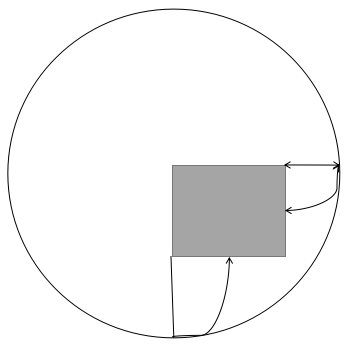
Rakhal is looking for a field where he can graze his cow. He finds a local farmer, Gopal, who agrees to rent his field to Rakhal for Rs. 1000 a year. Rakhal finds a post in the field and ties his cow to the post with a 25 feet rope. After some months, Gopal tells Rakhal that he will build a shed with four walls on the field with the post as one of the corner posts. The shed would be 15 feet by 10 feet. Rakhal agrees but he realizes that this arrangement would reduce the available area for grazing. What should be the modified rent to compensate for this loss of grazing area if Rakhal has to keep the cow tied to the same post with the same rope?
Original area for grazing = $$\pi \times (25)^2$$
= $$625 \pi$$ sq. feet
After the shed (15 $$\times$$ 10 feet) is built, quarter of the area will be reduced.
=> New area = $$\frac{3}{4} \pi \times (25)^2 + \frac{1}{4}[\pi (10)^2 + \pi (15)^2]$$
= $$\frac{1875 \pi}{4} + \frac{325 \pi}{4}$$
= $$\frac{2200 \pi}{4} = 550 \pi$$
Now, original area corresponds to Rs. 1,000
=> $$625 \pi \equiv 1000$$
$$\therefore 550 \pi \equiv 1000 \times \frac{550}{625}$$
= $$Rs. 880$$
are followed by two statements labelled as I and II. Decide if these statements are sufficient to conclusively answer the question. Choose the appropriate answer from the options given below:
A. Statement I alone is sufficient to answer the question.
B. Statement II alone is sufficient to answer the question.
C. Statement I and Statement II together are sufficient, but neither of the two alone is sufficient to answer the question.
D. Either Statement I or Statement II alone is sufficient to answer the question.
E. Neither Statement I nor Statement II is necessary to answer the question.
Let PQRS be a quadrilateral. Two circles O1 and O2 are inscribed in triangles PQR and PSR respectively. Circle O1 touches PR at M and circle O2 touches PR at N. Find the length of MN.
I. A circle is inscribed in the quadrilateral PQRS.
II. The radii of the circles O1 and O2 are 5 and 6 units respectively.
_tWXH1mA.PNG)
Using the property that, tangents from same point to a circle are equal in lengths.
In above quadrilateral, PA = PM + MN, => $$d = a + MN$$ ----------Eqn(I)
RC = RN + NM
=> $$PS = d + e$$
$$SR = e + c$$
$$QR = b + c + MN$$
$$PQ = a + b$$
From statement I :
.PNG)
We can conclude that, $$w + x + y + z = w + x + y + z$$
=> $$(w + z) + (x + y) = (w + x) + (y + z)$$
=> $$PQ + SR = PS + QR$$
Substituting values from above equation, we get :
$$\therefore a + b + e + c = d + e + b + c + MN$$
Using eqn(I),
=> $$a = a + MN + MN$$
=> $$MN = 0$$
Thus, statement I alone is sufficient.
Statement II alone is not sufficient, for we can have more than one value of MN possible.
Given below is an equation where the letters represent digits.
(PQ). (RQ) = XXX. Determine the sum of P + Q + R+ X.
I. X = 9.
II. The digits are unique.
Given relationship is $$(PQ)(RQ) = XXX$$
Since, X can take nine values from 1 to 9, thus we have 9 possibilities.
$$111 = 3 \times 37$$ $$666 = 18 \times 37$$
$$222 = 6 \times 37$$ $$777 = 21 \times 37$$
$$333 = 9 \times 37$$ $$888 = 24 \times 37$$
$$444 = 12 \times 37$$ $$999 = 27 \times 37$$
$$555 = 15 \times 37$$
But, out of these 9 cases, only in 999, we get the unit's digit of the two numbers same. Since it is a unique value,
Thus, we need neither statement I nor II to answer the question.
Answer questions based on the following information:
Mulchand Textiles produces a single product of only one quality – waterproof synthetic fabric. Mr.Sharma, the cost accountant of Mulchand Textiles, estimated the costs of Mulchand Textiles for different possible monthly output levels. Before he could tabulate his estimates his computer crashed, and Mr. Sharma lost all data. Fortunately he had some printouts of some incomplete tables, charts and diagrams. The table titled “Variable Cost Estimates of Mulchand Textiles” provided the estimates of labour and material costs.

Apart from labour and material costs Mulchand Textiles incurs administrative costs of Rs. 40,000 per month, and electricity costs. Mr. Sharma recalled that estimate data of variable electricity cost had certain peculiar characteristics. Values at every 25000 sq ft of output increased in geometric progression till 150000 sq ft of output, after which values increased in arithmetic progression for every 25000 sq ft of output. Mr. Sharma remembered that the electricity cost was estimated to be Rs. 3800 for 25000 sq.ft. of output, Rs. 5700 for 50000 square feet of output and Rs. 38856.50 for 175000 square feet of output.
The estimated cost per square feet of output is least for:
It is given that cost for electricity changed in geometric progression till 150000 sq ft.
Estimated electricity cost for 25000 sq. ft = Rs. 3800
Estimated electricity cost for 50000 sq. ft = Rs. 5700
Hence, we can say that common ratio of the GP that is formed by electricity cost = $$\dfrac{5700}{3800}$$ = 1.5
Therefore, estimated electricity cost for 75000 sq. ft = 5700*1.5 = Rs. 8550.
Similarly, we can calculate the electricity cost till 150000 sq. ft.
Estimated electricity cost for 200000 sq. ft = 2*Estimated electricity cost for 175000 sq. ft - Estimated electricity cost for 150000 sq. ft = 2*38856.5 - 28856.25 = Rs. 48856.75 {As these numbers are in an arithmetic sequence).
Tabulating the all data and calculating the cost per square feet.
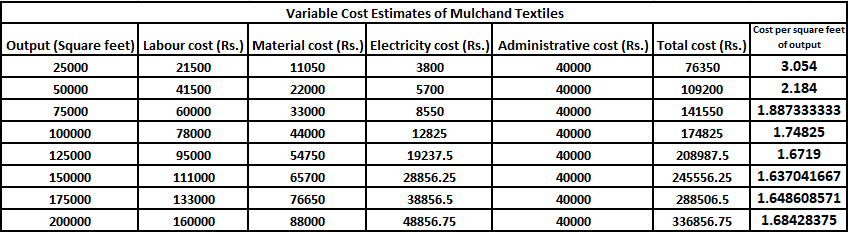
From the table, we can that cost per square feet of output is least for 150000 sq ft output. Hence, option D is the correct answer.
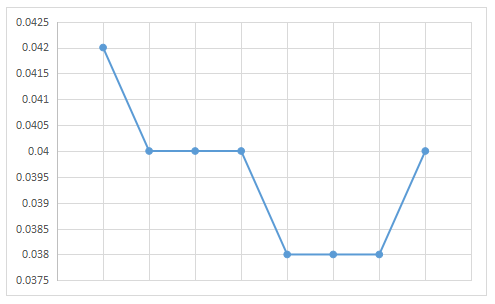
The estimated material cost given in the table titled “Variable Cost Estimates of Mulchand Textiles” included the cost of material that gets spoiled in the production process. Mr. Sharma decomposed the estimated material cost into material spoilage cost and material usage cost, but he lost the data when his computer crashed. When he saw the following line diagram, here called that he measured the estimate of material spoilage cost per square feet of output on the y - axis and monthly output on the x - axis.
Estimated material usage cost per square feet of output.
Material cost for 25000 sq. ft output = Rs. 11050
Spoilage cost per sq. ft = 0.042 {Form the graph}
Therefore the spoilage cost for 25000 sq. ft = 25000*0.042 = Rs. 1050. Hence, the usage cost = 11050 - 1050 = Rs. 10000.
Therefore, the usage cost per sq. ft. = $$\dfrac{10000}{25000}$$ = Rs. 0.40.
Similarly, we can calculate for the remaining output and tabulating the same.
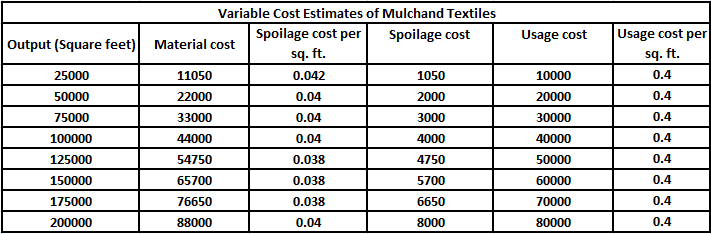
From the table we can see that that the usage cost per sq.ft is the same for all outputs. Hence, we can see that option C is the correct answer.
Mr. Sharma found some printouts of line diagrams. The axes of the graphs were not marked, but Mr. Sharma remembered that he measured monthly output on the x - axis. Which of the following diagrams would represent the estimates of electricity cost per square feet of output versus monthly output?
It is given that cost for electricity changed in geometric progression till 150000 sq ft.
Estimated electricity cost for 25000 sq. ft = Rs. 3800
Estimated electricity cost for 50000 sq. ft = Rs. 5700
Hence, we can say that common ratio of the GP that is formed by electricity cost = $$\dfrac{5700}{3800}$$ = 1.5
Therefore, estimated electricity cost for 75000 sq. ft = 5700*1.5 = Rs. 8550.
Similarly, we can calculate the electricity cost till 150000 sq. ft.
Estimated electricity cost for 200000 sq. ft = 2*Estimated electricity cost for 175000 sq. ft - Estimated electricity cost for 150000 sq. ft = 2*38856.5 - 28856.25 = Rs. 48856.75 {As these numbers are in an arithmetic sequence).
Electricity cost per sq. ft. for 25000 sq. ft = $$\dfrac{3800}{25000}$$ = Rs. 15
Similarly, we can calculate the remaining data.Tabulating the all data,
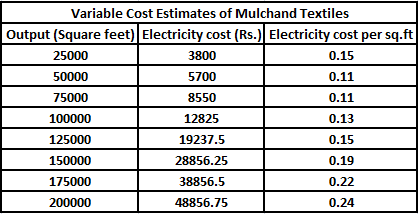
We can see from the table that the cost per sq. ft decreased first then increased to 0.24 which is present in option B. Hence, option B is the correct answer.
answer questions based on the following information:
In the beginning of the year 2010, Mr. Sanyal had the option to invest Rs. 800000 in one or more of the following assets – gold, silver, US bonds, EU bonds, UK bonds and Japanese bonds. In order to invest in US bonds, one must first convert his investible fund into US Dollars at the ongoing exchange rate. Similarly, if one wants to invest in EU bonds or UK bonds or Japanese bonds one must first convert his investible fund into Euro, British Pounds and Japanese Yen respectively at the ongoing exchange rates. Transactions were allowed only in the beginning of every month. Bullion prices and exchange rates were fixed at the beginning of every
month and remained unchanged throughout the month. Refer to the table titled “Bullion Prices and Exchange Rates in 2010" for the relevant data.
Bullion Prices and Exchange Rates in 2010
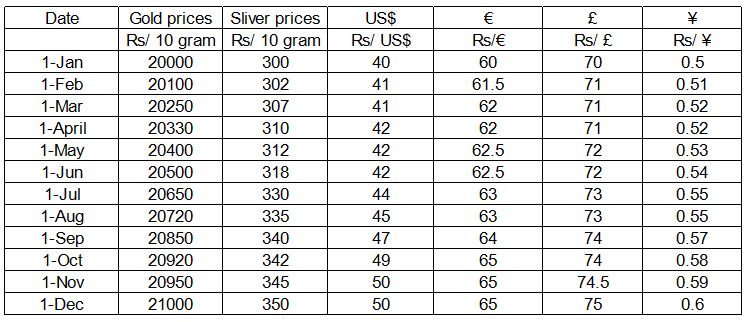
Interest rates on US, EU, UK and Japanese bonds are 10%, 20%, 15% and 5% respectively.
Mr. Sanyal invested his entire fund in gold, US bonds and EU bonds in January 2010. He liquefied his assets on 31st August 2010 and gained 13% on his investments. If instead he had held his assets for an additional month he would have gained 16.25%. Which of the following options is correct?
If you go through the options, you will find that only option B supports the given conditions.
Let the ratio of investments in gold, US and EU bonds be 40%, 40% and 20%, respectively.
Thus, the investment amounts are 320000, 320000 and 160000, respectively.
For returns in August 2010:
Gold: (20720/20000) *320000 = 331520
US bonds: (45/40)*320000 + (320000 * 8 * 10)/(12 * 100) = 381333
EU bonds: (63/60)*160000 + (160000 * 8 * 20)/(12 * 100) = 189333
Thus, total returns in August = 902186
Thus, percentage return = 90218600/800000 = 13 ( approx.)
Hence, it satisfies the condition for August.
For returns in September 2010:
Gold: (20850/20000) *320000 = 333600
US bonds: (47/40)*320000 + (320000 * 9 * 10)/(12 * 100) = 400000
EU bonds: (64/60)*160000 + (160000 * 9 * 20)/(12 * 100) = 194666
Thus, total returns in August = 928266
Thus, percentage return = 92826600/800000 = 16.25 ( approx.)
Hence, it satisfies the condition for September, too.
Hence, option B is the answer.
At the beginning of every month, by sheer luck, Mr. Sanyal managed to correctly guess the asset that gave maximum return during that month and invested accordingly. If he liquefied his assets on 31st December 2010, how much was the percentage gain from his investments?
To solve this problem, we need to find the maximum possible return Mr. Sanyal could achieve by shifting his entire capital (Rs. 800,000) into the single best-performing asset at the beginning of every month. Each month, the "return" is a combination of that month's accrued interest and the percentage change in the asset's price (bullion) or exchange rate (bonds).
Each monthly multiplier is calculated as the maximum of:
Bullion Yield: $$\frac{\Pr ice\ at\ the\ end\ of\ month}{\Pr ice\ at\ the\ start\ of\ month}$$
Bond Yield:$$\frac{Exchange\ rate\ at\ the\ end\ of\ month}{Exchange\ rate\ at\ the\ start\ of\ month}\times\ \left(1+\frac{Annual\ interest\ rate\ }{12}\right)$$.
Jan: EU Bond -> 1 + (61.5/60 - 1) + 0.20/12 = 1.04167
Feb: EU Bond -> 1 + (62/61.5 - 1) + 0.20/12 = 1.02480
Mar: US Bond -> 1 + (41/41 - 1) + 0.10/12 = 1.00833 (Gold/Silver actually lower)
Apr: UK Bond -> 1 + (72/71 - 1) + 0.15/12 = 1.02658
May: JP Bond -> 1 + (0.54/0.53 - 1) + 0.05/12 = 1.02302
Jun: US Bond -> 1 + (44/42 - 1) + 0.10/12 = 1.05595
Jul: US Bond -> 1 + (45/44 - 1) + 0.10/12 = 1.03106
Aug: US Bond -> 1 + (47/45 - 1) + 0.10/12 = 1.05278
Sep: US Bond -> 1 + (49/47 - 1) + 0.10/12 = 1.05089
Oct: US Bond -> 1 + (50/49 - 1) + 0.10/12 = 1.02874
Nov: JP Bond -> 1 + (0.60/0.59 - 1) + 0.05/12 = 1.02112
Dec: EU Bond (Interest only) -> 1 + 0 + 0.20/12 = 1.01667
1.04167×1.02480×1.00833×1.02658×1.02302×1.05595×1.03106×1.05278×1.05089×1.02874×1.02112×1.01667 $$\approx\ $$ 1.4671.
This amounts to an overall gain of 46.71%
Mr. Sanyal adopted the following investment strategy. On lst January 2010 he invested half of his investible fund in gold and the other half he kept in fixed deposit of an Indian bank that offered 25% interest per annum. At the beginning of every quarter he liquefied his assets to create his investible fund for that quarter. Every quarter he invested half of his fund in the bullion that gave maximum return in the previous quarter and the other half in the foreign bond that gave maximum return in the previous quarter. However, if in any quarter none of the foreign bonds gave a better return than the fixed deposit of his Indian bank, he invested half of his investible fund in the fixed deposit for the next quarter. On 31st December 2010 Mr. Sanyal liquefied his assets and realized that all of the following options are true except:
Advisors were asked to prepare an investment strategy that involved US Bonds, EU Bonds and Japanese Bonds, keeping at least 20% of the initial fund in each of these assets for the entire year, and allowing exactly four additional transactions in the course of the year. On 2nd January 2011, while comparing five different recommendations that he had received from his financial advisors in the beginning of 2010, Mr. Sanyal referred to the table “Bullion Prices and Exchange Rates in 20
10”. One transaction is defined as the buying or selling of an asset. Which of the recommendation out of the following was the best one?
To determine the best investment strategy for Mr. Sanyal, we must identify the timing that maximizes returns from two sources: the annual interest rates of the bonds (EU at 20%, US at 10%, and Japan at 5%) and the exchange rate appreciation of the respective currencies against the Rupee (Rs.). Since the rules require at least 20% of the initial Rs. 800,000 to remain in each asset for the entire year, the goal is to move the "flexible" remainder of the funds into the asset that is about to experience the steepest growth in value.
The most significant variable in this scenario is the US Dollar (US$), which starts the year at Rs. 40 and ends at Rs. 50, representing a 25% appreciation. However, this growth is not linear. Between April and June, the exchange rate is completely stagnant at Rs. 42. It then begins a sharp climb starting in July, hitting Rs. 44, and continues rising until it peaks and stabilizes at Rs. 50 in November and December.
By choosing Option A (June and November), the investor perfectly brackets this growth period. Shifting the flexible capital in June allows the investor to buy into US bonds just before the currency begins its rapid ascent from 42 to 50. Conversely, performing transactions in March or May would be premature, as the capital would sit in a stagnant currency while missing out on the superior 20% interest rate offered by the EU bonds during those months.
Finally, the November transaction allows the investor to "lock in" the gains from the US Dollar's peak. Since the exchange rate remains at 50 through December, there is no further currency gain to be had in the final month. By moving funds in November, the investor can shift back into the higher-interest EU bonds for the final month of the year, ensuring the highest possible closing balance for the portfolio.
Thus, the correct answer is Option A.
Start your IIM journey with the right preparation and crack CAT 2026.

Educational materials for CAT preparation
 Share
Share