For the following questions answer them individually
Match List I with List II
     List I                   List II
A. Young's Modulus (Y)Â Â Â Â Â Â Â Â Â Â Â I. [ML$$^{-1}$$T$$^{-1}$$]
B. Co-efficient of Viscosity ($$\eta$$)Â Â Â Â II. [ML$$^2$$T$$^{-1}$$]
C. Planck's Constant (h)Â Â Â Â Â Â Â Â III. [ML$$^{-1}$$T$$^{-2}$$]
D. Work Function ($$\phi$$)Â Â Â Â Â Â Â Â Â Â Â Â IV. [ML$$^2$$T$$^{-2}$$]
The distance travelled by a particle is related to time $$t$$ as $$x = 4t^2$$. The velocity of the particle at $$t = 5$$ s is
Two objects are projected with same velocity $$u$$ however at different angles $$\alpha$$ and $$\beta$$ with the horizontal. If $$\alpha + \beta = 90°$$, the ratio of horizontal range of the first object to the 2$$^{nd}$$ object will be:
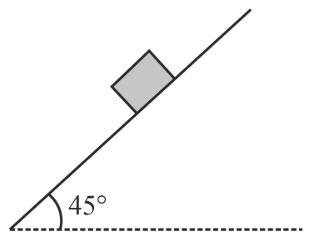
Consider a block kept on an inclined plane (inclined at 45°) as shown in the figure. If the force required to just push it up the incline is 2 times the force required to just prevent it from sliding down, the coefficient of friction between the block and inclined plane ($$\mu$$) is equal to:Â
A body of mass is taken from earth surface to the height $$h$$ equal to twice the radius of earth ($$R_e$$), the increase in potential energy will be: ($$g$$ = acceleration due to gravity on the surface of earth)
Every planet revolves around the sun in an elliptical orbit:
A. The force acting on a planet is inversely proportional to square of distance from sun.
B. Force acting on planet is inversely proportional to product of the masses of the planet and the sun.
C. The centripetal force acting on the planet is directed away from the sun.
D. The square of time period of revolution of planet around sun is directly proportional to cube of semi-major axis of elliptical orbit.
Choose the correct answer from the options below:
According to law of equipartition of energy the molar specific heat of a diatomic gas at constant volume where the molecule has one additional vibrational mode is:-
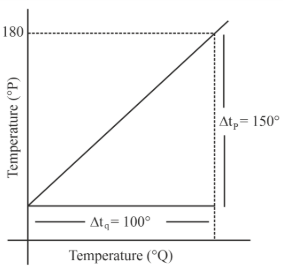
The graph between two temperature scales P and Q is shown in the figure. Between upper fixed point and lower fixed point there are 150 equal divisions of scale P and 100 divisions on scale Q. The relationship for conversion between the two scales is given by:Â
Match List I with List II:
A. Isothermal Process  I. Work done by the gas decreases internal energy
B. Adiabatic Process  II. No change in internal energy
C. Isochoric Process  III. The heat absorbed goes partly to increase internal energy and partly to do work
D. Isobaric Process  IV. No work is done on or by the gas
Choose the correct answer from the options below:
A particle executes simple harmonic motion between $$x = -A$$ and $$x = +A$$. If time taken by particle to go from $$x = 0$$ to $$\frac{A}{2}$$ is 2 s; then time taken by particle in going from $$x = \frac{A}{2}$$ to $$A$$ is:
Match List I with List II
A. Troposphere    I. Approximate 65-75 km over Earth's surface
B. E-Part of Stratosphere   II. Approximate 300 km over Earth's surface
C. F$$_2$$-Part of Thermosphere  III. Approximate 10 km over Earth's surface
D. D-Part of Stratosphere   IV. Approximate 100 km over Earth's surface
Choose the correct answer from the options given below :
A point charge of 10 $$\mu$$C is placed at the origin. At what location on the X-axis should a point charge of 40 $$\mu$$C be placed so that the net electric field is zero at $$x = 2$$ cm on the X-axis?
The resistance of a wire is 5 $$\Omega$$. Its new resistance in ohm, if stretched to 5 times of its original length will be:
For a moving coil galvanometer, the deflection in the coil is 0.05 rad when a current of 10 mA is passed through it. If the torsional constant of suspension wire is $$4.0 \times 10^{-5}$$ N m rad$$^{-1}$$, the magnetic field is 0.01 T and the number of turns in the coil is 200, the area of each turn (in cm$$^2$$) is:
A wire of length 1 m moving with velocity 8 m s$$^{-1}$$ at right angles to a magnetic field of 2 T. The magnitude of induced emf, between the ends of wire will be _____.
Match List I and List II
A. Gauss's Law in Electrostatics    I. $$\oint \vec{E} \cdot d\vec{l} = -\frac{d\phi_B}{dt}$$
B. Faraday's Law               II. $$\oint \vec{B} \cdot d\vec{A} = 0$$
C. Gauss's Law in Magnetism    III. $$\oint \vec{B} \cdot d\vec{l} = \mu_0 i_c + \mu_0 \epsilon_0 \frac{d\phi_E}{dt}$$
D. Ampere-Maxwell Law     IV. $$\oint \vec{E} \cdot d\vec{s} = \frac{q}{\epsilon_0}$$
Choose the correct answer from the options given below :
The light rays from an object have been reflected towards an observer from a standard flat mirror, the image observed by the observer are:-
A. Real
B. Erect
C. Smaller in size than object
D. Laterally inverted
Choose the most appropriate answer from the options below:
Given below are two statements:
Statement I: Stopping potential in photoelectric effect does not depend on the power of the light source.
Statement II: For a given metal, the maximum kinetic energy of the photoelectron depends on the wavelength of the incident light.
In the light of above statements, choose the most appropriate answer from the options given below.
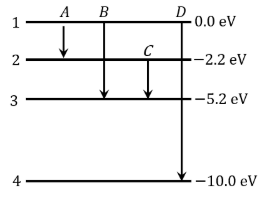
The energy levels of an atom is shown in figure.
Which one of these transitions will result in the emission of a photon of wavelength 124.1 nm?
Given ($$h = 6.62 \times 10^{-34}$$ J s)
Statement I: When a Si sample is doped with Boron, it becomes P type and when doped by Arsenic it becomes N-type semi conductor such that P-type has excess holes and N-type has excess electrons.
Statement II: When such P-type and N-type semi-conductors, are fused to make a junction, a current will automatically flow which can be detected with an externally connected ammeter.
In the light of above statements, choose the most appropriate answer from the options given below.
A nucleus disintegrates into two smaller parts, which have their velocities in the ratio 3 : 2. The ratio of their nuclear sizes will be $$(\frac{x}{3})^{\frac{1}{3}}$$. The value of '$$x$$' is:
A body of mass 1 kg collides head on elastically with a stationary body of mass 3 kg. After collision, the smaller body reverses its direction of motion and moves with a speed of 2 m s$$^{-1}$$. The initial speed of the smaller body before collision is _____ m s$$^{-1}$$.
If a solid sphere of mass 5 kg and a disc of mass 4 kg have the same radius, then the ratio of moment of inertia of the disc about a tangent in its plane to the moment of inertia of the sphere about its tangent will be $$\frac{x}{7}$$. The value of $$x$$ is _____.
A spherical drop of liquid splits into 1000 identical spherical drops. If $$u_i$$ is the surface energy of the original drop and $$u_f$$ is the total surface energy of the resulting drops, the (ignoring evaporation), $$\frac{u_f}{u_i} = (\frac{10}{x})$$. Then value of $$x$$ is _____:
A train blowing a whistle of frequency 320 Hz approaches an observer standing on the platform at a speed of 66 m s$$^{-1}$$. The frequency observed by the observer will be (given speed of sound = 330 m s$$^{-1}$$) _____ Hz.
A capacitor has capacitance 5 $$\mu$$F when its parallel plates are separated by air medium of thickness $$d$$. A slab of material of dielectric constant 1.5 having area equal to that of plates but thickness $$\frac{d}{2}$$ is inserted between the plates. Capacitance of the capacitor in the presence of slab will be _____ $$\mu$$F.
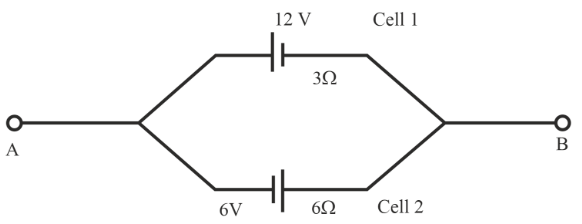
Two cells are connected between points A and B as shown. Cell 1 has emf of 12 V and internal resistance of 3 $$\Omega$$. Cell 2 has emf of 6 V and internal resistance of 6 $$\Omega$$. An external resistor R of 4 $$\Omega$$ is connected across A and B. The current flowing through R will be _____ A.
Two long parallel wires carrying currents 8 A and 15 A in opposite directions are placed at a distance of 7 cm from each other. A point P is at equidistant from both the wires such that the lines joining the point P to the wires are perpendicular to each other. The magnitude of magnetic field at P is _____ $$\times 10^{-6}$$ T. (Given: $$\sqrt{2}$$ = 1.4)
A series LCR circuit is connected to an AC source of 220 V, 50 Hz. The circuit contains a resistance $$R = 80$$ $$\Omega$$, an inductor of inductive reactance $$X_L = 70$$ $$\Omega$$, and a capacitor of capacitive reactance $$X_C = 130$$ $$\Omega$$. The power factor of circuit is $$\frac{x}{10}$$. The value of $$x$$ is:
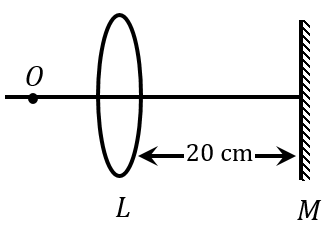
An object is placed on the principal axis of convex lens of focal length 10 cm as shown. A plane mirror is placed on the other side of lens at a distance of 20 cm. The image produced by the plane mirror is 5 cm inside the mirror. The distance of the object from the lens is _____ cm.