NTA JEE Main 10th April 2016 Online
For the following questions answer them individually
NTA JEE Main 10th April 2016 Online - Question 21
Consider an electromagnetic wave propagating in vacuum. Choose the correct statement:
NTA JEE Main 10th April 2016 Online - Question 22
To determine refractive index of glass slab using a travelling microscope, minimum number of readings required are:
NTA JEE Main 10th April 2016 Online - Question 23
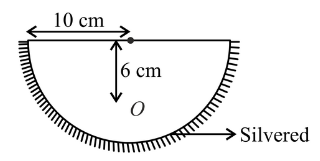
A hemispherical glass body of radius 10 cm and refractive index 1.5 is silvered on its curved surface. A small air bubble is 6 cm below the flat surface inside it along the axis. The position of the image of the air bubble made by the mirror is seen:

NTA JEE Main 10th April 2016 Online - Question 24
Two stars are 10 light years away from the earth. They are seen through a telescope of objective diameter 30 cm. The wavelength of light is 600 nm. To see the stars just resolved by the telescope, the minimum distance between them should be (1 light year = $$9.46 \times 10^{15}$$ m) of the order of:
NTA JEE Main 10th April 2016 Online - Question 25
A photoelectric surface is illuminated successively by monochromatic light of wavelengths $$\lambda$$ and $$\frac{\lambda}{2}$$. If the maximum kinetic energy of the emitted photoelectrons in the second case is 3 times that in the first case, the work function of the surface is:
NTA JEE Main 10th April 2016 Online - Question 26
A neutron moving with a speed 'v' makes a head on collision with a stationary hydrogen atom in ground state. The minimum kinetic energy of the neutron for which perfectly inelastic collision will take place is:
NTA JEE Main 10th April 2016 Online - Question 27
The ratio (R) of output resistance $$r_0$$, and the input resistance $$r_i$$ in measurements of input and output characteristics of a transistor is typically in the range:
NTA JEE Main 10th April 2016 Online - Question 28
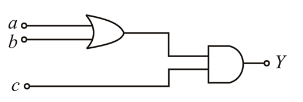
To get an output of 1 from the circuit shown in the figure the input must be:
NTA JEE Main 10th April 2016 Online - Question 29
A realistic graph depicting the variation of the reciprocal of input resistance in an input characteristics measurement in a common emitter transistor configuration is:
NTA JEE Main 10th April 2016 Online - Question 30
A modulated signal $$C_m(t)$$ has the form $$C_m(t) = 30\sin 300\pi t + 10(\cos 200\pi t - \cos 400\pi t)$$. The carrier frequency $$f'_c$$, the modulating frequency (message frequency) $$f_\omega$$ and the modulation index $$\mu$$ are respectively given by: