
Join Our JEE Preparation Group
Prep with like-minded aspirants; Get access to free daily tests and study material.
Sign in
Please select an account to continue using cracku.in
↓ →
Join Our JEE Preparation Group
Prep with like-minded aspirants; Get access to free daily tests and study material.
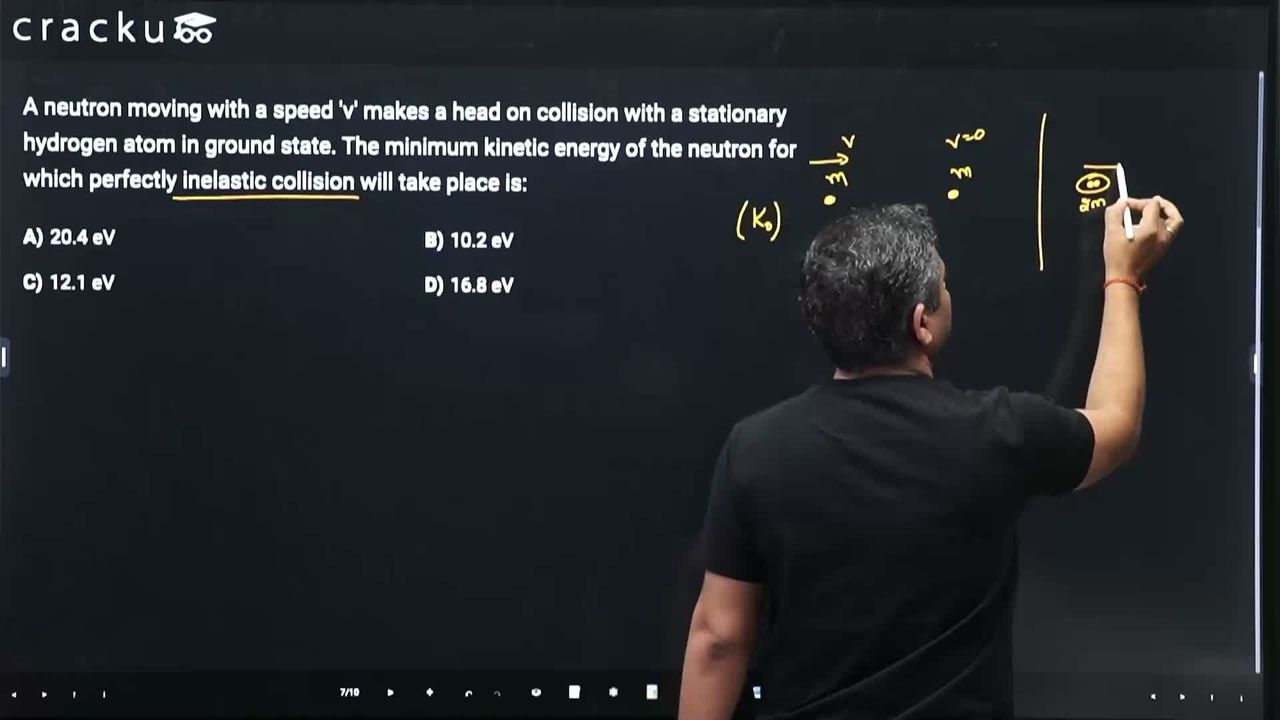
A neutron moving with a speed 'v' makes a head on collision with a stationary hydrogen atom in ground state. The minimum kinetic energy of the neutron for which perfectly inelastic collision will take place is:
Let the mass of the neutron be $$m_n$$ and the mass of the hydrogen atom be $$m_H$$. Since the mass of the electron is negligibly small in comparison with the proton and the neutron, we can safely take
$$m_H \simeq m_n=m$$
for all momentum and energy calculations. The neutron approaches with speed $$v$$ and the hydrogen atom is initially at rest. After a perfectly inelastic head-on collision the two bodies move together with a common speed, say $$u$$. As always, we begin with conservation of linear momentum.
$$\text{Initial momentum}=m v$$
$$\text{Final momentum}=(m+m)u=2m u$$
$$\Rightarrow m v = 2m u$$
$$\Rightarrow u = \frac{v}{2}$$
Now we calculate the kinetic energies. The initial kinetic energy of the neutron is
$$K_i = \frac12 m v^2.$$
The combined kinetic energy after collision is
$$K_f = \frac12 (2m)u^2 = m u^2.$$
Substituting $$u=\dfrac{v}{2}$$, we get
$$K_f = m\left(\frac{v}{2}\right)^2 = \frac{m v^2}{4}.$$
Hence the loss in kinetic energy during the collision is
$$\Delta K = K_i - K_f
= \frac12 m v^2 - \frac{m v^2}{4}
= \frac{m v^2}{4}.$$
For a perfectly inelastic collision to occur, this lost energy must be taken up as internal (excitation) energy of the hydrogen atom, because energy cannot simply disappear. The hydrogen atom in its ground state can absorb energy only in discrete amounts. The minimum such amount is the energy needed to raise the electron from the ground state $$n=1$$ to the first excited state $$n=2$$.
Using the Bohr energy‐level formula
$$E_n = -\frac{13.6\ \text{eV}}{n^2},$$
we have
$$E_1 = -13.6\ \text{eV}, \qquad
E_2 = -\frac{13.6}{4}\ \text{eV} = -3.4\ \text{eV}.$$
Therefore the excitation energy required is
$$\Delta E = E_2-E_1 = (-3.4)-(-13.6)=10.2\ \text{eV}.$$
This excitation energy must equal the lost kinetic energy:
$$\Delta K = 10.2\ \text{eV}.$$
But we already have $$\Delta K=\dfrac{m v^2}{4}$$. Expressing $$v^2$$ in terms of the initial kinetic energy $$K_i$$, we note that
$$K_i = \frac12 m v^2 \quad\Longrightarrow\quad v^2 = \frac{2 K_i}{m}.$$
Substituting this into the expression for $$\Delta K$$ gives
$$\Delta K = \frac{m}{4}\left(\frac{2 K_i}{m}\right) = \frac{2 K_i}{4} = \frac{K_i}{2}.$$
Setting this equal to the required 10.2 eV, we have
$$\frac{K_i}{2} = 10.2\ \text{eV} \quad\Longrightarrow\quad K_i = 20.4\ \text{eV}.$$
Thus the minimum kinetic energy of the incoming neutron for which a perfectly inelastic collision with a ground-state hydrogen atom can occur is
$$K_{\text{min}} = 20.4\ \text{eV}.$$
Hence, the correct answer is Option A.
Was this solution helpful?
Click on the Email ☝️ to Watch the Video Solution
Create a FREE account and get:
_1.webp)

Educational materials for JEE preparation

Ask our AI anything

AI can make mistakes. Please verify important information.
AI can make mistakes. Please verify important information.
